presents
Wheeless' Textbook of Orthopaedics
www.smith-nephew.com
Tracking Pixel
Search Site by Word
My Account

Arthroscopy of the Knee   


- See: Knee Joint Menu:

- Discussion:
    - arthroscopy of the arthritic knee:
    - Arthroscopy following TKR:
    - chondral and osteochondral injuries of the knee
    - meniscal tears:
         - prevalence of wrong pre-operative diagnosis or additional pathology:
               - always consider an alternative diagnosis especially in younger patients (in whom bone tumors should be considered);
               - " isolated medial meniscal tear"
                       - actually occurs only 21% of time;
                       - additional dx in 23%;
                       - lateral meniscal tear 5% of time (referred pain)
                       - in 70% of ACL tears, there will be a meniscus tear;


- Preparation and Anesthesia:


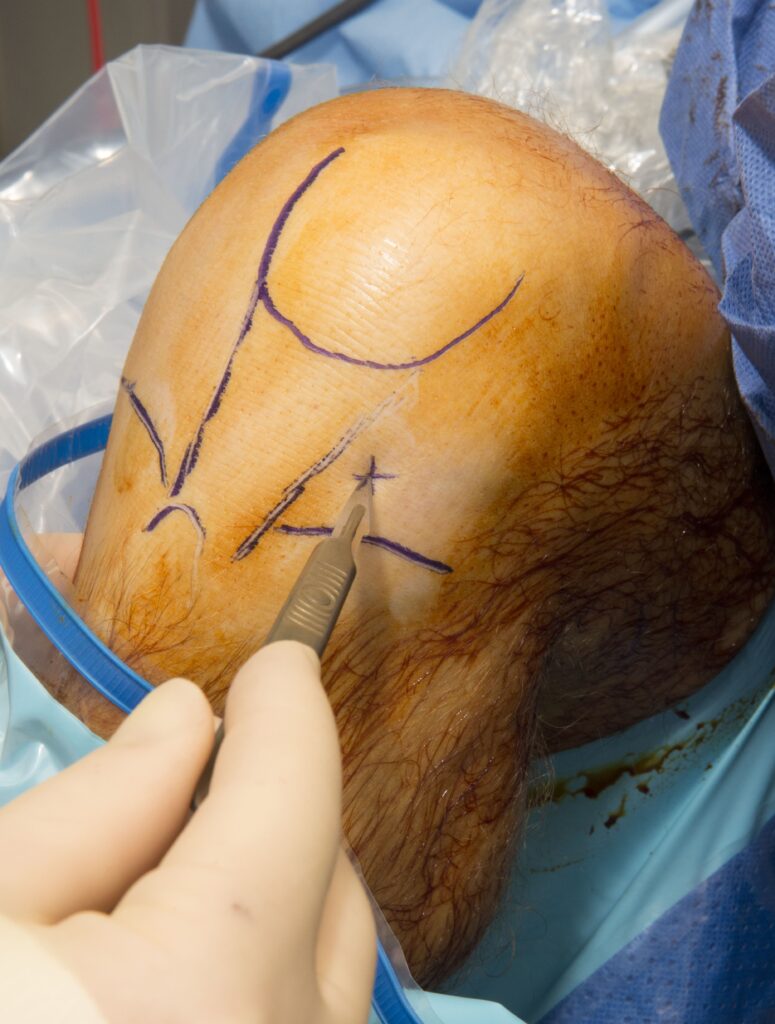
- Portals:
    - anteroloateral portal
    - superomedial portal:
    - medial portals:
    - superolateral portal:
            - useful viewing dynamics of patellofemoral articulation.
            - portal located just lateral to the quadriceps tendon about 2.5 cm superior to the superolateral corner of the patella;
            - in addition to the skin incision, the knife should nick the deep fascia to facilitate portal insertion;

    - references:
            - Posterior portals for arthroscopic surgery of the knee.  Ogilvie-Harris DJ. et al  Arthroscopy. 10(6):608-13, 1994 Dec.


- Supra-patellar Pouch:
    - most often affected by inflammatory arthritis (w/ hypertrophic synovium);
    - medial synovial plicae

- Patellofemoral Joint:
    - see: chondromalacia and osteochondral lesions);
    - it is important to visualize the entire lateral and medial patellar facets (including the odd facet at the medial aspect of the medial facet);
    - normal patellar position in the extended knee is slightly lateral to the lateral femoral condyle, patella moving medially and distally w/ increasing flexion;
           - increasing contact occurs between lateral patellar facet & lateral femoral condyle;
           - most often patella seats in the center of trochlea at about 45 deg of flexion (and w/ suspected patellar subluxation, it is important to document
                  the amount of knee flexion that elicits patellar contact and full patellar seating);
    - any plans for a lateral retinacular release should be delayed until the arthroscopy is completed, since bleeding from this procedure will interfere with visualization;
    - references:
           - Arthroscopic visualization of the patellofemoral joint.  U Lindberg et al.  Orthop. Clin. North Am. Vol 17. p 263-268. 1986.


- Medial Compartment:
    - chondral injuries of the knee
          - these lesions are identified by flexing the knee to 45 deg;
    - visualization of the medial meniscus
          - begin by flexing the knee and holding the tibia in external rotation;
          - while holding external rotation, apply valgus, and extend the leg to between 10-30 deg;
                - note that an ACL deficient will tend to pivot w/ valgus stress, which brings the tibia forward
                       thus imparing visualization of the posterior compartment;
                       - the solution is to firmly hold the tibia in external rotation, which prevents the tibia from
                               subluxing forward;
                - gently titrate flexion and extension to give the best visualization of the posterior meniscal horn;
          - in difficult cases, an assitant can ballott both the medial and lateral menisci which can facilitate visualization and menisectomy;
                - if an assistant is not available a spinal needle can be inserted into the posteror medial aspect of the joint to hold the meniscus in a anterior position;
    - references:
          - Arthoscopic visual field mapping at the periphery of the medial meniscus: A comparison of different portal approaches.
                BS Tolin, AA Sapega.   Arthrosocpy.  Vol 9. 1993. p 265-271.
          - Evaluation of arthrography and arthroscopy for lesions of the posteromedial corner of the knee.
                K Kimori et al.  Am J Sports Med. Vol 17. 1989. p 638-643.


- Intercondylar Notch:
    - ACL
    - PCL
    - for optimal assessment of the intercondylar notch, the surgeon should strive for the widest  panoramic view that is possible w/ the 30 deg scope directed laterally;
           - often the ligamentum mucosum will have to be taken down inorder to improve visualization;
           - if the fat pad appear to be in the way, then try a quick "push - pull" with the arthroscope inorder to pull the fat pad backwards;
           - if the fat pad continues to obstruct visualization of the notch, it will need to be partially shaved away;
                  - extend the knee and begin shaving above the intercondylar notch, and then work inferiorly;
                  - this method allows good visualization as the fat pad is being shaved;
           - fat pad syndrome or Hoffa's disease may be diagnosed arthroscopically when there is hypertrophic intercondylar /
                  or infrapatellar synovitis extending to central to the inner rim of the anterior horn of the meniscus;
           - references:
                  - Hoffa's disease: arthroscopic resection of the infrapatellar fat pad. DJ Ogilvie-Harris and J. Giddens.  Arthroscopy Vol 10. p 184-187. 1994. 
                  - Impingement of infrapatellar fat pad (Hoffa's disease): results of high-portal arthroscopic resection.

    - posteromedial drive thru:
           - a required part of any knee arthroscopy is the posteromedial drive thru;
           - the scope is slid along the lateral side of the medial femoral condyle (under the PCL) until it reaches the posterior compartment;
           - in cases of large posterior horn tears (or displaced bucket handle tears), the torn portion of the meniscus may flip up into the posterior compartment;
                  - this portion of the meniscus will not been seen from the medial compartment;
           - references:
                  - Arthroscopic examination of the posteromedial compartment of the knee joint.  J. Gillquist et al.  Int Orthop. Vol 3. p 13-18. 1979


- Lateral Compartment:
    - visualization of lateral compartment
    - lateral meniscus:
    - popliteus tendon:
         - this tendon, arises from distal part of lateral femoral condyle just anterior to origin of
                 the lateral collateral ligament;


- Complications of Arthroscopy:
    - infection:
         - note that there are several different methods of sterilizing arthroscopic instruments, and that some are better than others; 
         - ref: Septic arthritis following arthroscopic meniscus repair: a cluster of three cases.

    - vascular and nerve injury
         - neural disruption/neuropraxia - is usually secondary to prolonged tourniquet times;
    - neurologic complications
    - synovitis
    - persistent drainage
    - effusions are common;
    - hemarthrosis
    - deep venous thrombosis
           - in the report by Thomas Wirth et al. inorder to evaluate the risk of VTE in knee arthroscopy patients inorder to
                  determine efficacy and safety of a low-molecular weight heparin (LMWH) (reviparin sodium) in preventing VTE.
           - there were 262 patients undergoing elective knee arthroscopy prospectively randomized to receive either no treatment
                  or reviparin once daily subcutaneously for 7 to 10 days.
           - 239 patients were evaluable (122 no treatment, 117 receiving LMWH). 6 DVT were detected - 5 in
                  the control group (5/117 - 4.1%) and only one in the active treatment group (1/116 - 0.85%).
           - there was no major bleeding, four patients with minor bleedings.
           - 1 patient had a transitory fall in platelet count below 100 giga-particles/L without any clinical symptoms.
           - patients undergoing knee arthroscopy have a moderate risk of VTE and effective prophylaxis can be achieved with LMWH (reviparin).
           - ref: Prevention of venous thromboembolism after knee arthroscopy with low-molecular weight heparin (Reviparin).  Results of a randomized controlled trial
                      Thomas Wirth, M.D.   Arthroscopy April 2001 Volume 17 Number 4


- Arthroscopy following TKR
 - references:
      - Infection after arthroscopic treatment of symptomatic total knee arthroplasty.
      - Arthroscopy following total knee arthroplasty.
      - Arthroscopic release for knee joint stiffness after total knee arthroplasty
      - Technical aspects of arthroscopic arthrolysis after total knee replacement
      - The efficacy of arthroscopy following total knee replacement.


Current Concepts Review.  Neurological Complications Due to Arthroscopy.

Injury to infrapatellar branch of saphenous nerve in arthroscopic knee surgery.

Arthroscopic posteromedial visualization of the knee.

Posterior portals for arthroscopic surgery of the knee.

Arthroscopy of the acute traumatic knee in children. Prospective study of 138 cases.

Septic arthritis following arthroscopy: Clinical syndromes and analysis of risk factors.
       Armstrong RW, Bolding F, Joseph R: Arthroscopy 8:213-223, 1992


Original Text by Clifford R. Wheeless, III, MD.

Last updated by Clifford R. Wheeless, III, MD on Sunday, January 27, 2008 6:24 pm