

- See:
- Posterior Interosseous Nerve Syndrome :
- Radial Nerve Palsy Associated w/ Humeral Shaft Frx:
- Radial Nerve Block
- Tendon Transfers for Radial Nerve Palsy:
- Anatomy:
- three posterior divsions of brachial plexus form posterior cord: (C5 , C6 , C7, C8, T1)
- radial nerve (C5, C6, C7 , C8 , and T1 ) is largest of & most frequently injured branch of both the posterior cord (as
well as the brachial plexus);
- in axilla, it gives off:
- posterior cutaneous nerve of arm;
- branch to long & medial heads of triceps;
- between axilla & spiral groove of humerus:
- it distributes a branch to the lateral head of the triceps;
- nerve may or may not travel in spiral groove and is often separated by the humerus by
1 to 5 cm of muscle;
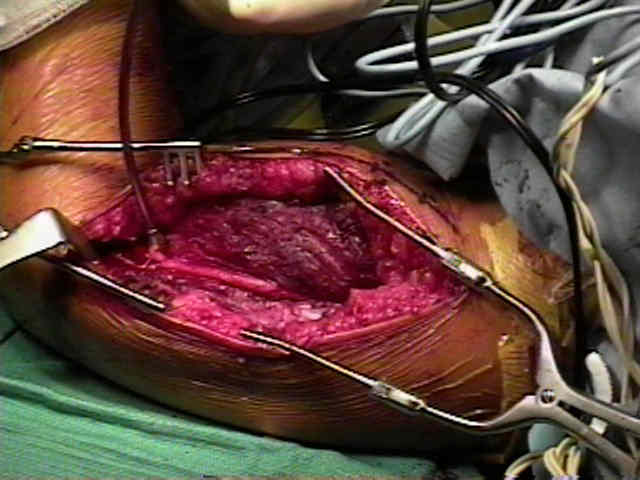
- course of nerve through the intermuscular septum;
- nerve travels from deep to the lateral head of the triceps, piercing the intermuscular septum;
- after piercing lateral intermuscular septum, the nerve comes to lie between the brachialis
and brachioradialis, and goes on to pass in front of elbow:
- radial nerve emanates from the spiral groove approximately 10 cm proximal to the
lateral epicondyle;
- branch to brachioradialis & ECRL ;
- nerve remains anterior relative to the humerus, and passes along the lateral column of the distal humerus;
- each of motor branches, arising from radial nerve & passing to lateral head of triceps, is accompanied closely by a branch of
profunda brachi artery and vein;
- as noted by Gerwin et al (1996), the nerve crosses the posterior aspect of the humerus at 20-21 cm proximal to the
medial epicondyle and 14-15 cm proximal to the lateral epicondyle;
- reference:
- Alternative operative exposures of the posterior aspect of the humeral diaphysis with reference to the radial nerve.
- One-third, two-thirds: relationship of the radial nerve to the lateral intermuscular septum in the arm.
- Radial nerve location at the posterior aspect of the humerus: an anatomic study of 100 specimens
- postion at the joint:
- radial nerve lies on the elbow capsule at the midportion of the capitellum
- arthroscopic capsular release can injure the nerve at this location;
- references:
- Anatomic Landmarks for the Radial Tunnel
- The course of the median and radial nerve across the elbow: an anatomic study
- posterior interosseous nerve :
- it divides in front of radial head, passes between superficial and deep heads of supinator, w/ deep branch (PIN)
passing backward thru supinator (arcade of Froshe) to supply 9 muscles on extensor aspect of forearm;
- because of the numerous branches into which the deep radial nerve breaks up at the lower border of the supinator, surgical
repair of the nerve here is difficult;
- remaining part PIN, runs downward parallel to posterior interosseous artery to supply all of deeper lying extensor muscles
& ends as a twig to wrist joint;
- superficial portion innervates ECU, EDC, and extensor digiti minimi;
- deep branch: innervates APL, EPB, EPL, and extensor indicis proprius;
- in this course, it passes superficial to long abductor & EPB of thumb, but its terminal branch to wrist joint passes
deep to EPL & EIP;
- sensory branch:
- superficial branch of radial nerve passes into forearm deep to brachioradialis muscle;
- approx 8 cm from tip of radial styloid, nerve emerges from under tendon of BR between tendon of BR & tendon of ECRL;
- sensory branch passes downward emerging dorsally from beneath BR tendon about 5 cm proximal to radial styloid;
- it lies just deep to the superficial veins;
- distally, it provides sensation to dorsum of thumb, excluding subungual region which is supplied by branches of median;
- superficial branch innervates dorsal aspect of first web space & hand as far ulnarward as middle of ring finger & as far distally
as proximal interphalangeal joint.
- references:
The radial sensory nerve. An anatomic study.
The superficial branch of the radial nerve: an anatomic study with surgical implications.
Transfer of sensory branches of radial nerve in hand surgery.
- Physcial Exam:
- signs of a radial nerve lesion include:
- inability to exten thumb, proximal phalanges, wrist or elbow;
- hand is pronated and the thumb adducted.
- termainal branches of superficial radial nerve are palpable in the anatomic snuff box where they cross EPL;
- paralysis of PIN will result in total loss of extension of fingers &, though rare occurrence, must be entertained in diff
dx of extensor tendon rupture (w/ the R.A. pt):
- exam for brachial plexus injury:
- brachioradialis (C5-6)
- supinator (C5-C6)
- ECRB (C6-C7)
- triceps (C6-8)
- Radial Tunnel Compression Syndrome:
- compression of the radial nerve at the elbow can involve the PIN or the superficial branch;
- radial tunnel syndrome refers to the syndrome of forearm pain without muscular weakness;
- it is often misdiagnosed as resistant tennis elbow or PIN syndrome;
- unlike tennis elbow, there is tenderness about 4 cm distal to the lateral humeral epicondyle;
- sites of compression:
- fibrous bands anterior to the radial head at the entrance of radial tunnel;
- radial recurrent vessels;
- tendinous origin of ECRB
- tendinous proximal border of supinator (arcade of Frohse)
- this is the most common location of nerve compression in radial tunnel syndrome;
- distal edge of the supinator at exit;
- exam:
- look for tenderness over the radial tunnel;
- pain may be experienced when the long finger is extended against resistance;
- active supination from a pronated position (tightening supinator) along w/ wrist flexion (which tighens the ECRB)
may reproduce the patient's symptoms;
- also consider differential injection of the deep radial nerve;
- treatment:
- as noted by Jebson and Engber (1997), about 2/3 patients with radial tunnel syndrome had good to excellent results,
however, complete pain relief and return to normal activities is not always predictable;
- treatment includes division of the fibrous edge of the supinator muscle (most common reason for impingement), and division
of the medial border of the ECRB;
- reference:
- Radial tunnel syndrome: long-term results of surgical decompression.
- Radial nerve entrapment at the elbow: surgical anatomy.
- Radial tunnel syndrome caused by ganglion cyst: Treatment by arthroscopic cyst decompression
High radial nerve palsy following strenuous muscular activity. A case report.
Radial nerve paralysis and tumor.
Treatment of radial neuropathy associated with fractures of the humerus.
The results of secondary microsurgical repair of radial nerve in 33 patients.
The surgical anatomy of the radial nerve around the humerus.
Radial nerve palsy caused by open humeral shaft fractures.
The Radial Nerve in the Brachium: An Anatomic Study in Human Cadavers