- child abuse: 30% of femoral frx in children < 4 yrs are 2nd to child abuse;
- Over-riding of Fracture Fragments:
- in children between the ages of 2-10 yrs, overgrowth averages 0.9 cm;
- in kids between 2 & 10 yrs, side to side apposition w/ 0.5 to 1 cm overriding is the ideal position;
- in children below ages of 8- 9 yrs, up to 2 cm of bayonet apposition can be accepted with no long-term adverse effects;
- overgrowth usually corrects most of the discrepancy;
- some workers still incorporate a femoral pin in the cast;
- references:
- Femoral shaft fractures in children: the effect of initial shortening on subsequent limb overgrowth.
- Fractures of the femoral shaft in children. The overgrowth phenomenon.
- Angulation at Frx Site:
- saggital plane tolerates 20-30 deg angulation (accept less in older child);
- frontal plane tolerates 10-15 deg angulation;
- late angulation is managed w/ wedging of the cast;
- Treatment:
- acceptable reduction:
- in this age group, can be treated w/ early spica cast unless the frx overrides > 2 cm;
- spica cast is left on for approximately 6-8 weeks;
- unacceptable reduction: (more than 2 cm overriding);
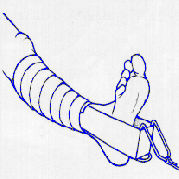
- w/ significant shortening of limb at frx site, consider 90-90 deg skin traction (in younger children) or distal femoral pin traction
(in older children) to maintain adequate limb length until early callus forms, then apply spica 1-2 weeks later;
- during the period of traction, the hip usually needs to be flexed upto 90 deg and knee flexed 90 deg in order to obtain reduction
during early phase of frx healing;
- after frx becomes sticky, less hip and knee flexion may be acceptable;
- need to obtain weekly radiographs to follow frx alignment and length;
- once frx site is less tender and once radiographs show early callus, traction may be discontinued;
- skin traction technique pearls:
- apply moleskin strips or Skin-Trac strips directly to skin;
- use no more than 7 lbs of traction force;
- in some cases, a distal femoral traction pin may be incorporated into the spica cast (and is left in place for 3 weeks);
- flexible IM nails:
- references:
- The operative stabilization of pediatric diaphyseal femur fractures with flexible IM nails: a prospective analysis.
- Titanium elastic nails for pediatric femur fractures: a multicenter study of early results with analysis of complications.
- Ender rod fixation of femoral shaft fractures in children.
- Elastic stable intramedullary nailing of femoral shaft fractures in children.
Intramedullary Nailing Compared with Spica Casts for Isolated Femoral Fractures in Four and Five-Year-Old Children.