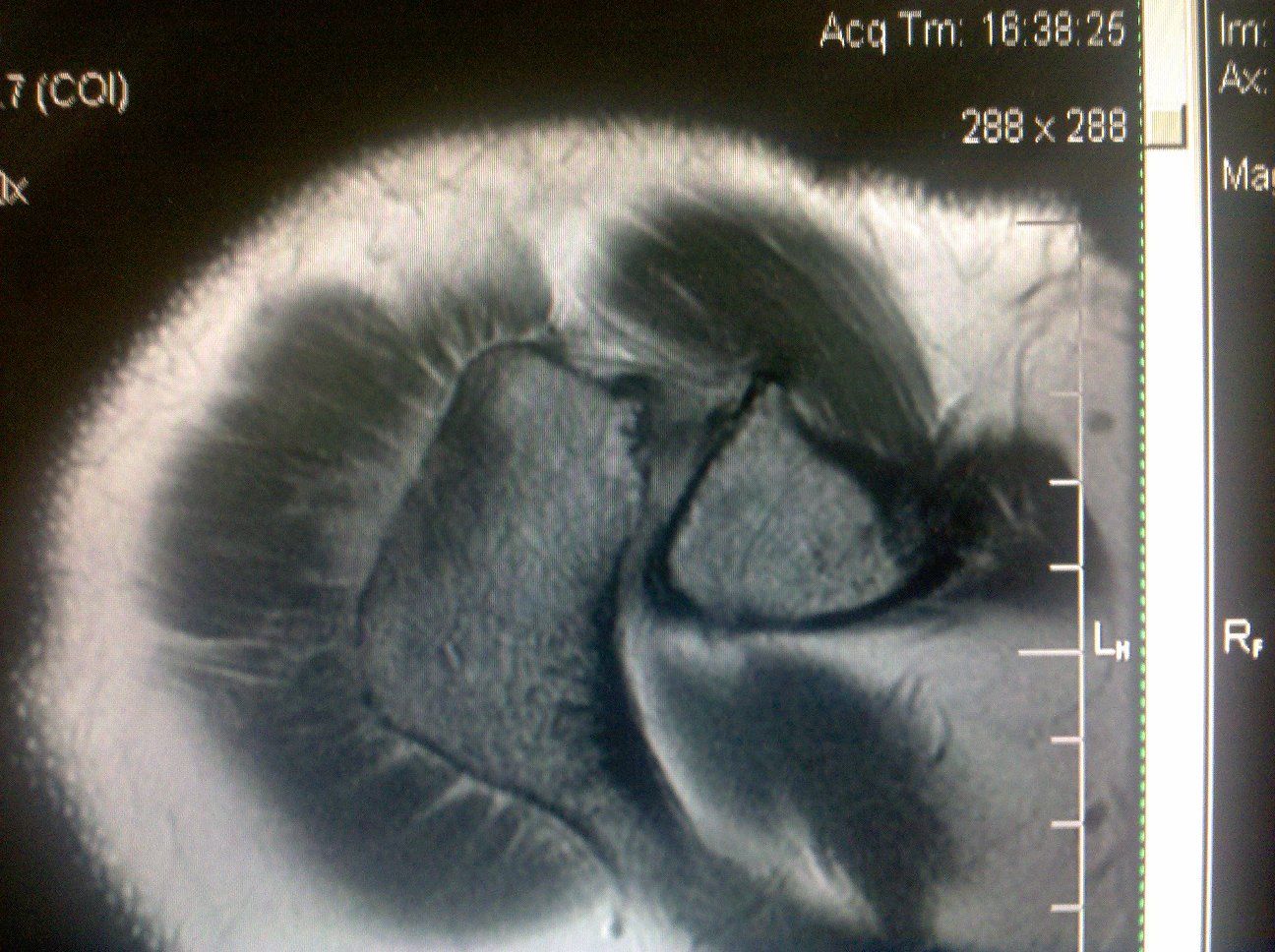
- See:
-
Distal Clavicle Excision
-
Modified Weaver Dunn Procedure:
- Discussion:
- AC joint is situated between the
clavicle and acromion;
- acromion has two ossification centers which fuse at age 22 yrs;
- it permits motion in three planes:
- AP gliding of acromion during protraction & retraction of scapula;
- tilting of acromion during abduction & adduction of arm;
- rotation of the clavicle;
- rotation occurs during abduction & adduction of shoulder.
- Anatomy:
- joint is reinforced by two sets of ligaments:
-
AC ligament
- directed horizontally, and functionally the AC joints control horizontal stability;
- palpable shallow depression between end of clavicle & acromion;
- superior AC lig is most important ligament in stabilizing AC joint for normal daily activities;
-
coracoclavicular ligaments:
- stronger, vertically directed contains
conoid and
trapezoid ligaments help to control vertical stability;
- coracoclavicular lig are suspensory ligaments of upper limb;
-
conoid:
- is the most important ligament for support of the joint against significant injuries and superior displacement;
- cone shaped which extends between the conoid tubercle on the posterior clavicle and the base of the coracoid;
-
trapezoid:
- resists AC joint compression;
- begins anteriorly and laterally to the conoid ligament on the clavicle and inserts on the coracoid process;
-
Sternoclavicular joint:
- see
S.C. joint injury in the adolescent;
- inherently more stable than AC joint;
- because of this stability & its more protected medial location;
- it is injured less frequently than the acromioclavicular joint.
- Radiology:
-
classification of AC separation:
-
acromioclavicular joint stresses views
- type I and type II injuries can be differentiated on stress radiographs;
- w/ pt standing, 10 lb weight is secured to affected upper limb;
- w/ grade II injury, suspended wt displaces AC joint articulation, which increases distance between clavicle & acromion;
- grade I injuries remain nondisplaced;
-
zanca view
-
scapular outlet view
- Exam:
- palpate the AC joint during flexion and extension of shoulder;
- distract the arm as it is placed in adduction;
- significant prominence of the distal clavicle indicates type V injury;
- Management of Specific Injuries:
-
AC joint arthrosis / distal clavicle excision
-
AC joint dislocation:
-
non operative treatment:
- in the report by TF Schlegel MD et al, the authors prospectively studied natural history of untreated acute grade III AC separations;
- 25 patients were treated nonoperatively with a sling for comfort through progressive early range of motion as tolerated;
- 10 additional uninjured subjects underwent strength testing to evaluate difference between dominant and nondominant sides;
- one patient underwent a surgical procedure at 2 weeks after injury because of cosmetic concerns;
- 20 of the 25 patients completed the 1-year evaluation and strength-testing protocol;
- 4 of the 20 patients (20%) thought that their long-term outcome was suboptimal, although for 3 of them it was not enough to warrant surgery;
- testing of the 20 patients revealed no limitation of shoulder motion in injured extremity and no diff between sides in rotational shoulder muscle strength;
- bench press was the only strength test that showed a significant short-term difference, with the injured extremity being an average of 17% weaker;
- ref: A Prospective Evaluation of Untreated Acute Grade III AC Separations. TF Schlegel MD. Am Jour of Sports Med 29:699-703 (2001)
-
modified weaver dunn procedure: (for chronic injuries)
- acute fixation w/ Rockwood screw:
The acromioclavicular joint in rheumatoid arthritis.
The influence of distal clavicle resection and rotator cuff repair on the effectiveness of anterior acromioplasty.
Osteolysis of the distal part of the clavicle in male athletes.
Radiological evaluation of the acromioclavicular joint.
Biomechanical study of the ligamentous system of the acromioclavicular joint.
Arthroscopic distal clavicle excision. Technique and early results.
Reconstruction of the Coracoclavicular Ligaments with Tendon Grafts. A Comparative Biomechanical Study.
A Modified Technique of Reconstruction for Complete Acromioclavicular Dislocation. A Prospective Study.
A cadaveric study examining acromioclavicular joint congruity after different methods of coracoclavicular loop repair.
Surgery about the coracoid: neurovascular structures at risk.

