

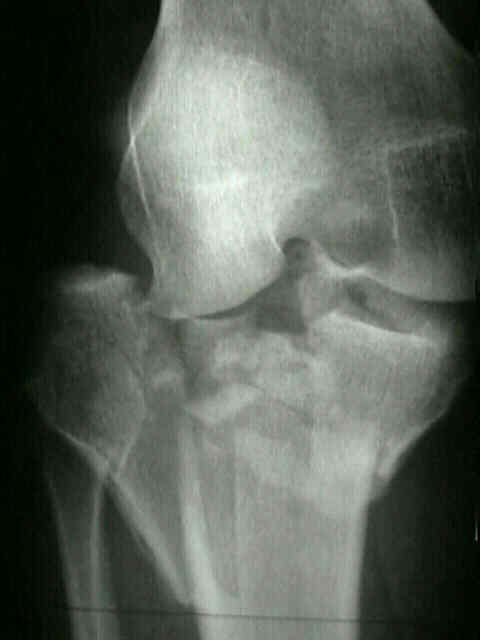
 - Discussion: Tibial Plateau Frx Menu
- bicondylar frx w/ distal oblique shaft frx;
- these frx have bicondylar frx along w/ dissociation of diaphysis from metaphysis;
- if the medial plateau fragment is intact, this frx can be treated with placement of a lateral plate and
and Ex Fix to prevent displacement;
- 35% of type VI fractures are open and 86% has extensive soft tissue injuries;
- look for compartment syndrome (approximately 30% of cases)
- consider possibility of spontaneously reduced knee dislocation;
- ref: Soft tissue injury of the knee after tibial plateau fractures.
- PreOp Planning
- consider CT scan to clearly define fracture patterns;
- soft tissue evaluation:
- pay attention to abrasions, bruising, and hemarthrosis since these are risk factors for wound breakdown;
- w/ ORIF w/ extensive periosteal stripping may result in a 20% incidence of wound breakdown & infection (some small series
report even higher rate of infection) that often leads to poor clinical results;
- compartment syndrome:
- insist on GEA anesthesia inorder to avoid dips in blood pressure (which occurs with spinal anesthesia) and inorder to allow for
immediate N/V exams;
- reference:
- Influence of Prior Fasciotomy on Infection After Open Reduction and Internal Fixation of Tibial Plateau Fractures.
- Timing of internal fixation and effect on Schatzker IV-VI tibial plateau fractures.
- Timing of definitive fixation of severe tibial plateau fractures with compartment syndrome does not have an effect on the rate of infection.
- Management:
- spanning fixators and surgical timing:
- Staged management of high-energy proximal tibia fractures (OTA types 41): the results of a prospective, standardized protocol.
- Compartment syndrome in Schatzker type VI plateau fractures and medial condylar fracture-dislocations treated with temporary external fixation.
- Timing of internal fixation and effect on Schatzker IV-VI tibial plateau fractures.
- Infection after spanning external fixation for high-energy tibial plateau fractures: is pin site-plate overlap a problem?
- The effect of knee-spanning external fixation on compartment pressures in the leg.
- External Fixation and Temporary Stabilization of Femoral and Tibial Trauma
- Staged Management of High-Energy Proximal Tibia Fractures
- Does Early versus Delayed Spanning External Fixation Impact Complication Rates for High-energy Tibial Plateau and Plafond Fractures?
- circular wire fixators: (safe zones)
- can be used to stabilize the diaphyseal-metaphyseal segment;
- circular wire fixators are unable to reliably stabilize the articular surface;
- articular fixation requires either lateral plating or insertion of cancellous lag screws inserted over washers;
- this fixation should precede application of the fixator;
- if possible screws should be inserted from lateral to medial or from anterior to posterior;
- complications:
- pin tract infections can lead to devastating knee sepsis and therefore pins needs to be inserted at least 2 cm from the joint line;
- in the study by Reid JS, et al, the authors determined in a cadaver study that proximal tibial transfixation wires away from
tib-fib joint are likely to be extra-articular if kept greater than 14 mm away from the subchondral bone.
- in the region of tib-fib joint, safe distance is difficult to determine since it cannot be known preop which knees have
torn septum;
- loss of fixation following frame removal;
- note that in complex fractures, the frame may have to be left in place for up to 3 months to ensure maturation of
fracture healing (gradual loss of reduction may occur with premature frame removal);
- references:
- Bicondylar Tibial Plateau Fractures Treated with a Hybrid Ring External Fixator: A Preliminary Study.
- Safe placement of proximal tibial transfixation wires with respect to intracapsular penetration.
- Internal versus External Fixation of Bicondylar Tibial Plateau Fractures.
- Hybrid external fixation of comminuted tibial plateau fractures.
- External fixation and limited internal fixation for complex fractures of the tibial plateau.
- The small pin circular fixator for proximal tibial fractures with soft tissue compromise.
- Treatment of bicondylar tibia plateau fractures using locked plating versus external fixation
- Open Reduction Strategy
- consider performing complete fasciotomy;
- single anterior incision (which is compatible with a TKR incision for the future) vs lateral and posteromedial incisions (better for
wound healing);
- references:
- Complications associated with internal fixation of high-energy bicondylar tibial plateau fractures utilizing a two-incision technique.
- Treatment of complicated tibial plateau fractures with dual plating via a 2-incision technique.
- The use of an anterior incision of the meniscus for exposure of tibial plateau frx requiring ORIF.
- Anterior Approach to the Knee with Osteotomy of the Tibial Tubercle for Bicondylar Tibial Fractures.
- Combined Anterior and Posterior Approaches for Complex Tibial Plateau Fractures.
- Early wound complications after operative treatment of high energy tibial plateau fractures through two incisions.
- The use of an anterior incision of the meniscus for exposure of tibial plateau fractures requiring ORIF.
- Anterior Approach to the Knee with Osteotomy of the Tibial Tubercle for Bicondylar Tibial Fractures.
- Combined Anterior and Posterior Approaches for Complex Tibial Plateau Fractures.
- Patella Osteotomy: a new approach for complex trauma around the knee.
- fixation strategy:
- k wire fixation:
- k wires are inserted to maintain provisional fixation;
- take care that k wire position does not interfere with plate application;
- ultimate goal is to have a synthese lateral locking plate with medial washer to provide fixation for both plateau frx;
- medial plateau:
- usually fixation of the medial plateau is easier than the lateral plateau;
- consider temporary fixation of the medial w/ a simple medial butress plate;
- even if there is a coronal split into the medial plateau, the butress plate will allow a near anatomic reduction which then
allows fixation of the lateral plateau using the medial joint line as a reference;
- posteromedial incision (for secondary coronal plane fracture);
- plane between the semitendinosis and gastrocnemius
- references:
- Posterior coronal plating of bicondylar tibial plateau fractures through posteromedial and anterolateral approaches in a healthy floating supine position.
- Posteromedial second incision to reduce and stabilize a displaced posterior fragment that can occur in Type V fractures.
- Postero-medial approach for complex tibial plateau injuries with a postero-medial or postero-lateral shear fragment.
- references:
- Frequency and Fracture Morphology of the Posteromedial Fragment in Bicondylar Tibial Plateau Fracture Patterns.
- Stabilization of the posteromedial fragment in bicondylar tibial plateau fractures: a mechanical comparison of locking and nonlocking single and dual plating methods.
- lateral plateau: (see synthes plates)
- lateral locking plate is applied in the usual manner;
- once the lateral plate proximal anterior and posterior locking screws are applied, the medial buttress plate is removed,
allowing a medial washer to be inserted over the central proximal screw;
- be cafeful of use of isolated lateral locking plate with posteromedial fractures with a predominantly coronal fracture line;
- references:
- Fracture pattern and fixation type related to loss of reduction in bicondylar tibial plateau fractures.
- Single lateral locked screw plating of bicondylar tibial plateau fractures.
- wound closure:
- expect that anterior compartment swelling will interefere with wound closure;
- consider proximal wound closure and leaving the distal half of the wound open to prevent compartment syndrome;
- "pie crust" technique is a simple technique to facilitate delayed wound closure;
- consider wound vac +/- bead pouch;
- ref: Multiple relaxing skin incisions in orthopaedic lower extremity trauma.
- Post Operative Care and Complications
- vascular complications:
- Evaluation of Popliteal Artery Injury Risk With Locked Lateral Plating of the Tibial Plateau
- Injury to the Anterior Tibial System During Percutaneous Plating of a Proximal Tibial Fracture
- IM Nailing:
- Retropatellar nailing and condylar bolts for complex fractures of the tibial plateau: Technique, pilot study and rationale.
- A comparative study for complex tibial plateau fractures: nailing and compression bolts versus modern and traditional plating.
- Biomechanical comparison of intramedullar versus extramedullar stabilization of intra-articular tibial plateau fractures.
- Patella osteotomy: a new approach for complex trauma around the knee.
------------------------------------------------------------------------
Treatment of Complex Tibial Plateau Fractures with the Ilizarov External Fixator. Buckle R, et al. J Orthop Trauma 1993;7:167.
Early Results of a New Technique for Treatment of High Grade Tibial Plateau Fractures. Christensen K, et al. J Orthop Trauma 1990;4:226.
Medial external fixation with lateral plate internal fixation in metaphyseal tibia fractures. A report of eight cases associated with severe soft-tissue injury.
Retropatellar nailing and condylar bolts for complex fractures of the tibial plateau: technique, pilot study and rationale.
The management of complex fractures of the proximal tibia with minimal intra-articular impaction in fragility patients using intramedullary nailing and compression bolts.
A comparative biomechanical study for complex tibial plateau fractures: nailing and compression bolts versus modern and traditional plating.
Biomechanical comparison of intramedullar versus extramedullar stabilization of intra-articular tibial plateau fractures.