Ortho-Preferred
Tracking Pixel
presents
Wheeless' Textbook of Orthopaedics

Syndesmotic Injuries of the Ankle   


- See:
      - technique of snydesmotic fixation:
      - syndesmotic sprain

- Anatomy:
    - syndesmosis is made up of anterior-inferior tibiofibular ligament, interosseous ligament, and posterior-
            inferior fibular ligaments, inferior transverse tibiofibular ligament, and interosseous ligament;
            - these stabilize the mortise by opposing the fibula in the fibular notch (incisura fibularis tibiae);
    - section of the anterior tibiofibular ligament results in diastasis of 2.3 mm;
    - section of anterior tibiofibular ligament and interosseous ligament will result in diastasis of 4.5 mm;
    - when all 3 ligaments are sectioned, diastasis measures 7.3 mm;
    - syndesmotic injuries are unusual in displaced Weber B fractures;
    - in the anatomic study by MH. Snedden and JP. Shea, the authors noted that the interosseous ligament, may have a
            variable attachment on fibula, differing between specimens in its distance above the synovial reflection or joint line;
            - low fibula fracture would disrupt the interosseous ligament, can explain the anatomic basis for infrequent diastasis
                     in these ankle fractures;
    - Diastasis With Low Distal Fibula Fractures An Anatomic Rationale. Snedden COOR 2001 January;2001(382):197-205

- Objective Diagnosis of Syndesmotic Injury:

- Injury Patterns:
    - isolated syndesmotic injury:
    - syndesmotic injury & fibular frx;
            - w/ syndesmosis & fibula disruption, talus can shift laterally 2 to 3 mm, even w/ deep deltoid ligament intact;
    - syndesmotic injury + medial injury:
           - > 3 mm displacement indicates that either the deep deltoid ligament or medial malleolus must be disrupted;
           - if medial malleolus is frxed & deltoid ligament is intact, rigid fixation of fibula & tibia should make syndesmosis fixation unnecessary;


- Indications for Syndesmotic Fixation:
    - combination of irreparable medial joint injury along w/ disruption of the syndesmosis > 4.5 cm proximal to the joint (Weber C Frx),
           is an indication for surigical fixation;
           - hence standard teaching is that w/ rigid ORIF of the medial malleolus frx, a syndesmotic screw would generally not be required);
           - between 3 to 4.5 cm indication for fixation remains unclear;
    - in contrast to the standard teaching, the report by P. Tornetta MD (JBJS Jun 2000, Vol 82-A, No 6) demonstrated using an in vivo radiographic model that
           in bimalleolar fractures, the medial injury may be an osseous avulsion, leaving the deltoid intact on the displaced fragment, or it may be a
           combination of ligamentous and osseous injury with disruption of the deep portion of the deltoid ligament;
           - in the later case, ORIF of the medial malleolus may not restore function to the deltoid ligament;
           - in this case, it is unclear whether syndesmotic fixation would be required;
    - in the report by JG Kennedy et al (JTO Vol 14, No 5, p 359-366), the authors examined the effect of syndesmotic screws in low Weber C fractures;
           - low Weber C fractures are defined as being within 5 cm of the jiont;
           - 26 patients had ankle ORIF with syndesmotic fixation and 19 had ORIF w/o a syndesmotic screw;
           - there was no significant difference between either group using subjective and objective criteria;
    - high fibular frx
           - even w/ anatomic fixation of medial malleolar frx, syndesmotic screw fixation is indicated for fibular frxs occurring more than 15 cm above the joint;
    - syndesmotic fixation is recommeded w/ medial ligamentous injury, syndesmotic disruption, & talar shift w/o frx
           of fibula (diastasis);  
    - case example:
           - 40 year old prisoner who sustained this Weber C frx which was fixed w/o a syndesmotic screw;
                  - 7 years later the patient had significant arthritis and significant pain;
                  - notice the heterotopic calcification along the interosseous membrane;

- Contra-indications for Syndesmotic Fixation (w/ Syndesmotic Injury):
    - w/ < 3 cm of sydesmotic disruption above plafond, there is little or no alteration was seen of ankle loading characteristics;
    - anatomic reduction of fibula, esp if frx is w/in 4 cm of joint, tends to reduces talus in Mortise & restores syndesmotic stability;
    - if medial malleolus is frxed & deltoid ligament is intact, ORIF of fibula & tibia should make syndesmosis fixation unnecessary;

- Fixation Techniques:
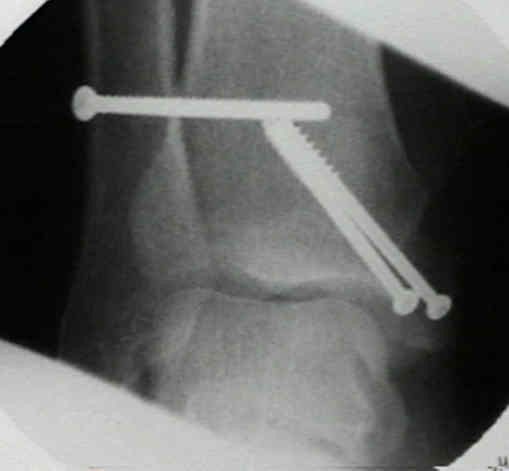
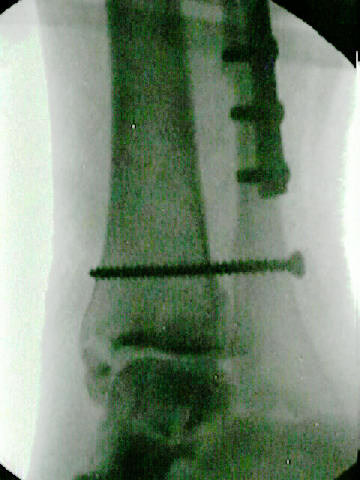
    - screw insertion technique for snydesmotic fixation: 

    - K wire fixation:
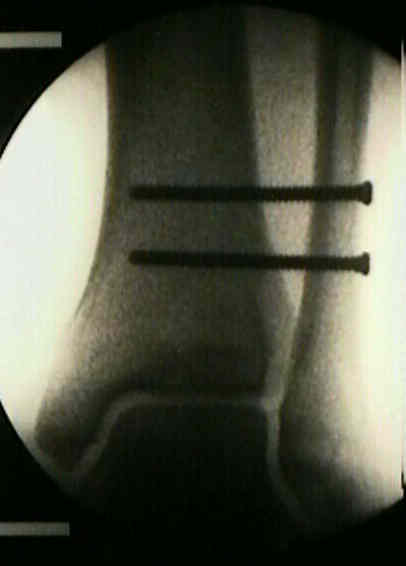
          - two 1.5 mm K wires can be inserted obliquely across the distal tibio-fibular syndesmosis;
          - is a less rigid form of fixation, which allows more physiologic ankle function, and does not require early hardware removal;
    - suture fixation:
          - involves the creation of two small drill holes through the fibula and tibia (separated 7-10 mm) above the ankle syndesmosis (between 2-5 cm),
                  through which is passed a single No 5 Ethibond suture to form a loop;
                  - the suture is tied over the fibula, securing the fibula to the tibia;
          - advantages: there is no need for hardware removal and nor is there risk of hardware failure;
          - in the study by RS Miller et al (JTO 1999), the suture technique showed similar strength characteristics to tricortical screw fixation techniques;
          - references:
                  - Comparison of tricortical screw fixation vs a modified suture construct for fixation of ankle syndesmotic injury:  A biomechanical study. JOT Vol 13. p 39-42.
                  - Repair of the tibiofibular syndesmosis with a flexible implant. WH Seitz et al.  Journal of Orthopaedic Trauma. Vol 5. 1991. p 78-82.
                  - Comparison of a Novel FiberWire-Button Construct versus Metallic Screw Fixation in a Syndesmotic Injury Model


Mechanical considerations for the syndesmosis screw. A cadaver study.

Instability of the distal tibiofibular syndesmosis after bimalleolar and trimalleolar ankle fractures.

The tibiofibular syndesmosis. Evaluation of the ligamentous structures, methods of fixation, and radiographic assessment.

Operative treatment of syndesmotic disruptions without use of a syndesmotic screw: a prospective clinical study.
Clinical use of a syndesmosis screw in stage IV pronation-external rotation ankle fractures. Orthop Rev. Vol 23, 1994. p 23-28.

Ankle mortise stability in Weber C fractures.  Indications for syndesmotic fixation.  J. Orthop. Trauma. Vol 5, 1991. p 190-195.

The influence of a diastasis screw on the outcome of Weber type C ankle fractures. HR Chissell, J Jones.   JBJS 77-B, 1995. p 435-438.

Competence of the Deltoid Ligament in Bimalleolar Ankle Fractures After Medial Malleolar Fixation* Tornetta  JBJS Jun 2000, Vol 82-A, No 6. p 843

Tibiotalar joint dynamics: indications for the syndesmotic screw: a cadaveric study.  WC Burns. Foot Ankle 1993. Vol 14. p 153.

A biomechanical evaluation of clinical stress tests for syndesmotic ankle instability.

Instability of the tibio-fibular syndesmosis: have we been pulling in the wrong direction?

Examination and Repair of the AITFL in Transmalleolar Fractures.

Outcome after fixation of ankle fractures with an injury to the syndesmosis

No difference in functional and radiographic results 8.4 years after quadricortical compared with tricortical syndesmosis fixation in ankle fractures.

Functional outcomes after syndesmotic screw fixation and removal.

Outcome after unstable ankle fracture: effect of syndesmotic stabilization.

Functional and radiographic results of patients with syndesmotic screw fixation: implications for screw removal.


Original Text by Clifford R. Wheeless, III, MD.

Last updated by Clifford R. Wheeless, III, MD on Sunday, August 22, 2010 8:27 pm