

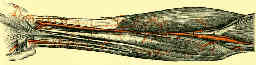
- Anatomy: (see forearm flexors)
- origin:
- humeral head: medial epicondyle of humerus & common flexion tendon;
- ulnar head: medial side of coronoid process of ulna;
- insertion: middle 1/3 of lateral surface of radius;
- synergists: pronator quadratus;
- action: pronation of forearm and flexion at the elbow;
- nerve supply: median, C7 > C6 ;
- Pronator Teres Syndrome:
- pts with the pronator teres syndrome have numbness in median nerve distribution w/repetitive pronation/supination of the
forearm, not flexion and extension of the elbow;
- early fatigue of the forearm muscles is seen with repetitive stressful motion, especially pronation;
- EMG may show only mildly reduced conduction velocities;
- despite their anatomic proximity, pts w/ pronator teres syndrome do not have a higher incidence of AIN syndrome;
- other sites of compression:
- ligament of Struthers
- lacertus fibrosis
- pronator teres muscle,
- proximal arch of the FDS
- rare causes such as following tendon transfers for radial palsy;
- dissimilarity to CTS
- positive Tinel's in forearm rather than at wrist
- negative phalen's test
- dysesthesia of palmar triangle
- pain on resistance to pronation
- pain in forearm on resistance to isolated flexion of the PIP joint of long and ring fingers
Transfer of the pronator teres tendon to the tendons of the flexor digitorum profundus in tetraplegia.
The pronator teres syndrome: compressive neuropathy of the median nerve.
Mechanical evaluation of the Pronator Teres rerouting tendon transfer.