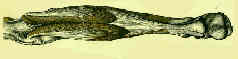
note that active plantarflexion may occur due to activity of tibialis posterior, peroneals, and long toe flexors;
diagnosis is clinched w/ one of two tests;
hyper-dorsiflexion sign
the patient is placed in the prone position, and the knees are flexed to 90 deg;
the examiner then passively dorsiflexes both feet maximally and compares the injured to the non injured side;
Thompson Test
have the patient prone w/ both feet extending past end of examing table;
calf muscles on the affected side are squeezed by the examiner;
if tendon is intact, the foot will plantar flex, & conversely if tendon is ruptured, the foot will not contract;
this text may lose accuracy after one week from injury;
O'brien's needle test
25 gauge needle is inserted at right angle thru skin of calf muscle just medial to midline at point 10 cm proximal to superior border of calcaneus;
needle tip should be just w/ in substance of the tendo calcaneus;
motion of the hub of the needle in a direction opposite that of the tendon during passive dorsiflexion and plantarflexion of the foot confirms an intact tendon distal to the level of needle insertion;
location of tear
palpate tendon for site of maximal tenderness and fullness;
usually tears occur 2-3 cm above the calcaneal insertion;
estimate size of defect
a large defect may have a worse prognosis w/ non operative treatment (as compared to a rupture w/ a small defect)