

- See: Compartment Syndrome
- Discussion:
- type of forearm ischemic contracture resulting from brachial artery injury usually associated w/ supracondylar frx of humerus;
- may see loss of motor & sensory function, however, classic involvment is w/ anterior interosseous branch of median nerve;
- pathology:
- contracture results from insufficient arterial perfusion & venous stasis followed by ischemic degeneration of muscle;
- irreversible muscle necrosis begins after 4-6 hrs;
- resulting edema impairs circulation, leads to forearm comapartment syndrome, which propagates progressive muscle necrosis;
- muscle degeneration is most affected at the middle third of muscle belly, being most severe closer to bone;
- there is less involvement toward the proximal & distal surfaces;
- necrosis of the muscle with secondary fibrosis that may develop followed by calcification in its final phase;
- anatomy:
- distal to lacertus fibrosus brachial artery branches into radial & ulnar artery;
- radial artery is superficially located, whereas ulnar artery is deeply situated, traversing deep to pronator teres muscles;
- ulnar artery gives rise to the common interosseous artery, which divides immediately into anterior & PIN branches;
- flexor digitorum longus and the flexor pollicis longus muscles derive their blood supply thru anterior interosseous artery;
- pathoanatomy:
- infarct has ellipsoid shape w/ its axis along anterior interosseous artery & its central point slightly above middle of the forearm;
- therefore, the muscles most dependent on the anterior interosseous artery (FDP, FPL, FDS, and the pronator teres;
- FDP and FDS muscles become contracted and are replaced by scar, which leads to wrist flexion contracture and clawing of the fingers;
- in addition to muscle necrosis, there will also be injury to the median and ulnar nerves leading to high ulnar nerve and median nerve palsy;
- fingers:
- may lie in intrinsic minus position (due to high nerve palsy)
- alternatively, the fingers may lie in an intrinsic plus position (MP's flexed, PIP extended), if there has been a concomitant compartment syndrome of the hand resulting
in intrinsic contracture;
- Case Example:
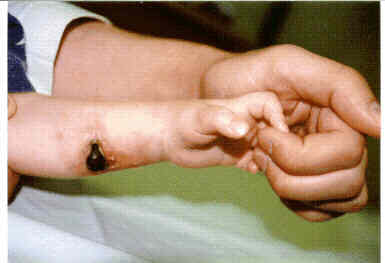
- 2-year-old male who sustained a simple distal radial torus frx;
- he was treated w/ a sugar tong splint, was sent home, and cried all night;
- several days later, it was apparent that he sustained a 3rd degree burn to the forearm, as well as a Volkman's ischemic contracture;
- Prevention:
- requires restoration of blood flow;
- reduction of compartmental pressure
- Management:
- proper initial splinting of hand in the function position;
- release of forearm flexors;
- muscle slide
- tendon lengthening;
- test for intrinsic tightness
Pattern of contracture and recovery following ischaemia of the upper limb.
Volkmann's contracture in children: aetiology and prevention.
Volkmann's ischemic contracture. A case report.
The evolution of the compartment syndrome since 1948 as recorded in the JBJS (B)