

- Discussion:
- need to reflect capsule medially & laterally from upper 1 cm of proximal tibia;
- performed circumferentially using either elevator or osteotome;
- this capsular reflection relieves minor contractures and provides access for retractors to protect the posterior structures;
- any rim osteophytes from the femur and tibia are removed;
- articular exposure:
- evert the patella and flex the knee;
- use scissors to transect the patello-femoral ligament off the femur;
- synovectomy: is performed at this point (if appropriate):
- incise ACL which allows the tibial to be subluxated forward to allow complete visualization of plateau surfaces;
- rongeur is used to remove osteophytes in medial & lateral aspects of femoral condyles as well and intercondylar space;
- remove any osteophytes from intercondylar notch of femur, particularly if prosthesis is designed to retain PCL;
- trim any remaining osteophytes from the articular margin of tibia and patella;
- fat pad excision references:
- Influence of the infrapatellar fat pad resection in a synovectomy during total knee arthroplasty in patients with rheumatoid arthritis.
- Patellar tendon length after knee arthroplasty with and without preservation of the infrapatellar fat pad.
- The effect of retropatellar fat pad excision on patellar tendon contracture and functional outcomes after total knee arthroplasty.
- Hoffa's fat pad resection in total knee arthroplasty.
- The effect of infrapatellar fat pad resection on outcomes post-total knee arthroplasty: a systematic review
- synovectomy references:
- Inflammation related to synovectomy during total knee replacement in patients with primary osteoarthritis: a prospective, randomised study.
- The effect of synovectomy on bleeding and clinical outcomes for total knee replacement
- MCL and Deep Capsular Exposure: (MCL)
- medial subperiosteal sleeve is developed and elevated to beyond the mid coronal line to enter semimembranosus bursa;
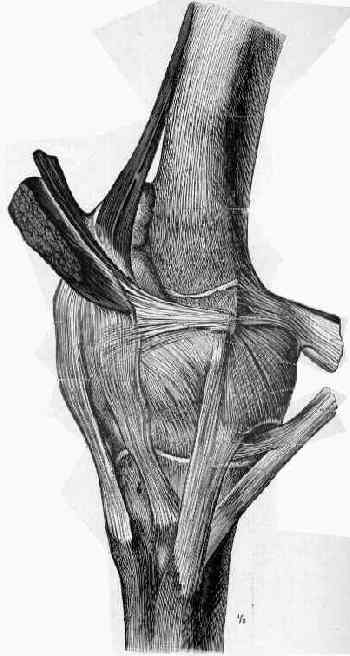
- begin using a knife, but once the dissection proceeds further medially, complete capsular
elevation w/ curved 1/2 inch osteotome;
- strip approximately 1 cm beneath the joint line;
- any rim osteophytes from the femur and tibia are removed;
- cautions:
- it is important to distinguish between a fixed varus knee and a knee w/ pseudolaxity due to loss
of the medial joint space;
- in later case, the MCL may be attenuated and can easily be "overstripped" during initial exposure
(when this happens, a larger spacer is needed to restore stability);
- w/ a fixed varus knee, further capsular elevation may be required;
- Saeki K, et al. evalauated the effect of MCL release in TKR;
- 6 knees from cadavers were tested for change in stability after release of MCL w/ PCL retaining and substituting TKR;
- superficial MCL was released, followed by release of the PCL;
- after MCL release, valgus laxity was greater at 30°, 60°, and 90° flexion after PCL sacrifice than it was
when PCL was retained;
- posterior-stabilizing post added little to varus and valgus stability;
- references:
- Stability After Medial Collateral Ligament Release in Total Knee Arthroplasty
- The role of the deep medial collateral ligament in controlling rotational stability of the knee.
- Latereal Capsular Exposure:
- this part of the case is easier once the knee is flexed and the patella is everted;
- transect the anterior ligamentous attachments of the lateral meniscus to the tibia;
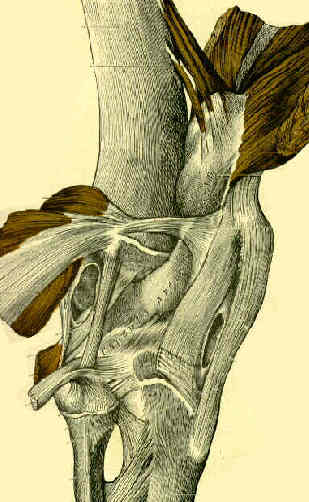
- retractor is placed underneath the patella, to place patella tendon under tension;
- w/ care to avoid injuring the tendon and its insertion into the tubercle, use the knife to remove adhesions
between the patellar tendon and the proximal tibia (proximal to the tibial tubercle);
- as the dissection proceeds laterally, switch to an osteotome;
- use an osteotome to circumferentially strip the capsule and the insertion of IT tract off the proximal
1 cm of the lateral tibia;
- this step is often best performed after the proximal tibial cut (while the knee is flexed and the
patella is everted);
- lateral inferior geniculate artery is ligated at the joint line;
- w/ a valgus knee, further lateral dissection may be required;
- excision of patello-femoral ligaments:
- this is necessary for patellar eversion;
- attach a Kocher clamp to cuff of retinaculum attached to medial side of patella;
- retract the Kocher to partially evert the patella so that the patellofemoral ligaments are placed under tension;
- use curved Mayo's to spread under the patellofemoral ligament and then incise it
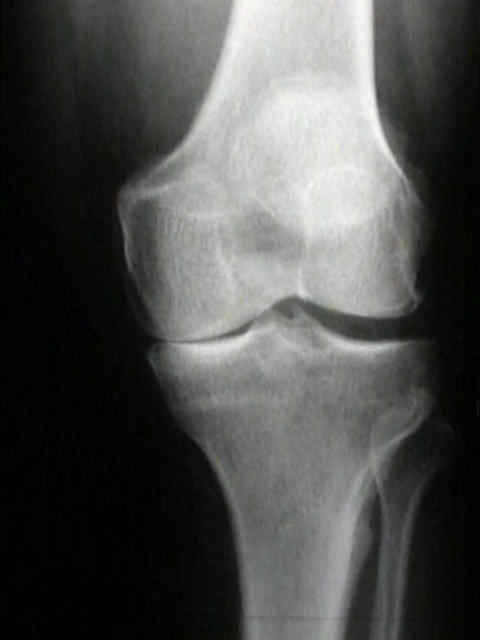
Can an anterior quadriceps release improve range of motion in the stiff arthritic knee?
Stripped knee capsule does not increase range of motion in total knee arthroplasty