

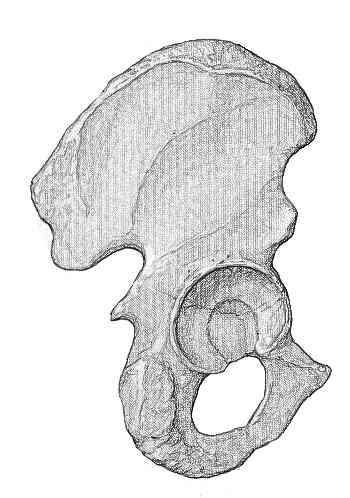
 - See:
 - operative considerations for hip dyplasia
- acetabular component revision
- Discussion:
- restoration of the normal hip center in acetabular reconstruction encourages restoration
of normal biomechanics;
- medial placement:
- moving hip center medially improves efficiency of hip abductors and will reduce forces
acting on the hip in the coronal plane;
- in osteoarthritis, acetabulum is often overgrown by osteophytes that push femoral head laterally,
superiorly, and posteriorly;
- in order to re-establish optimal hip mechanics, the hip center must be placed medially,
inferiorly, and anteriorly;
- ref: Benefit of cup medialization in total hip arthroplasty is associated with femoral anatomy.
- lateral placement:
- placing the socket laterally creates increased joint reactive forces;
- lateral placement leads to uncoverage of the superior acetabular cup (or inappropriate abduction of the cup to achieve coverage);
- anterior placement:
- this will reduce saggital plane resultant forces about the hip and improves efficiently of the hip extensor muscles;
- superior placement:
- placing it directly superior requires the use of a long neck prosthesis to restore abductor moment arm;
- may slightly improve efficiency of extensor muscles but may have a more significant negative effect on hip abductor muscles
The definition and measurement of acetabular orientation.