



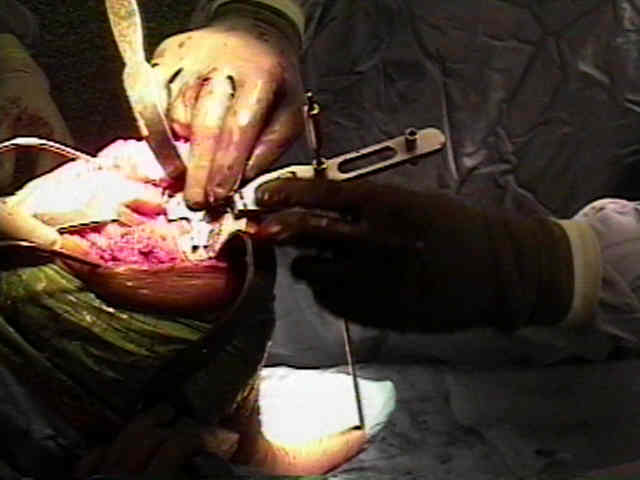
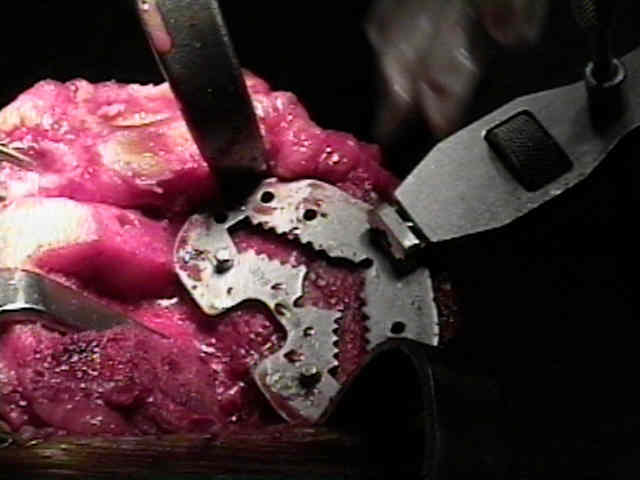

- Sizing of the Tibial Component:
- generally, the tibial component is either larger or at least the same size as the femoral component;
- femoral overhang is a significant source of postoperative TKR pain;
- ref: Overhang of the Femoral Component in Total Knee Arthroplasty: Risk Factors and Clinical Consequences
- generally, the surgeon chooses the largest tibial component which allows for appropriate tibial rotation.
- ref: Maximizing Tibial Coverage Is Detrimental to Proper Rotational Alignment
- rotation of tibial component:
- avoid internal rotation of the tibial component:
- medially rotated tibial & femoral components have a high incidence of assoc postop patellar dislocation;
- if there is tendency for lateral subluxation, position of tibial component can be adjusted to more external rotation, producing
relative IR of tibial tubercle, lessening angle between quadriceps & patellar tendon, & thus lessening tendency of patella
to dislocate laterally; (see Q angle);
- note that too much external rotation of the tibial component can overhang laterally and cause impingement on the popliteus tendon;
- medial lateral translation:
- goal is to provide maximum coverage &, when possible, have component extend to the cortical margins;
- laterally dislocated soft tissues tend to push trial component medially, which is resolved by adequate retraction;
- overhang:
- medial overhang is usually avoided but the literature shows that overhang by itself does not correlate with pain;
- slight lateral translation of the tibial component helps to centralize patellar tracking;
- note that too much external rotation of the tibial component can overhang laterally and cause impingement on
the popliteus tendon;
- of note, femoral overhang has been shown to be a much more important cause of pain than tibial overhang.
- references:
- Tibial component overhang in total knee replacement: incidence and functional outcomes.
- The effect of tibial component sizing on patient reported outcome measures following uncemented total knee replacement.
- The impact of tibial component overhang on outcome scores and pain in total knee replacment.
- Overhang of the femoral component in total knee arthroplasty: risk factors and clinical consequences.
- anterior posterior translation:
- goal is to provide maximum coverage;
- if symmetric component is sized to fit AP length of medial plateau, comonent will either overhang posteriorly on the lateral
plateau or have a tendency to internally rotate;
- the solution is to compromise in AP coverage, rather than allow overhang or internal rotation;
- appropriately sized component is then placed as posteriorly as possible;
- this will in effect shift the tibial tubercle anteriorly, which will decrease patello-femoral contact pressures
- ref: Anteroposterior positioning of the tibial component and its effect on the mechanics of patellofemoral contact.


