

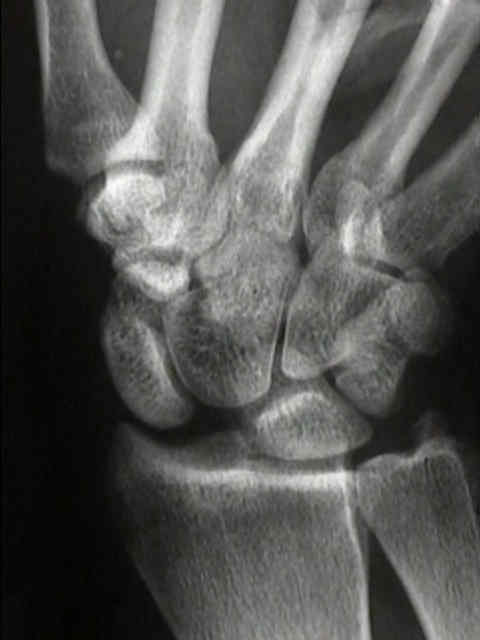
 - Discussion:
- injury must occur to both interosseous and capsular ligaments for rotational instability of the scaphoid to occur;
- dorsal approach to the wrist:
- reduce scaphoid into the extended position;
- surgeons gloved finger presses the distsal pole of scaphoid into an extended position;
- K wire is inserted across the scapho-capitate interval while the scaphoid is held in the extended position;
- reduce lunate out of DISI position;
- K wire can be directly inserted into the lunate (dorsal to volar direction);
- K wire is then pulled dorsally and angled superiorly (which brings the lunate into a reduced position)
- scapholunate interval is reduced;
- tenaculum clamp is used to directly compress the scapholunate interval;
- K wire is inserted across the scapholunate and SC intervals;
- references:
- Kirschner wire fixations for scapholunate dissociation: a cadaveric, biomechanical study.
- The use of temporary screw augmentation for the treatment of scapholunate injuries.
- bone anchors insertion:
- bone anchors are inserted into the distal aspect of the scaphoid and lunate;
- SL ligament is repaired:
- capsulodesis augmentation is added if needed
- references:
- Outcome after repair of the scapholunate interosseous ligament and dorsal capsulodesis for dynamic scapholunate instability due to trauma.
- Treatment of scapholunate dissociation: ligamentous repair associated with modified dorsal capsulodesis.
- reference:
- Biomechanical Analysis of Scapholunate Ligament Repair Techniques
- Repair and/or reconstruction of scapholunate interosseous ligament in lunate and perilunate dislocations.
- Treatment of scapholunate dissociation. Rotatory subluxation of the scaphoid.
- Scapholunate interosseous reconstruction and imbrication of palmar ligaments.
- Preliminary lunate reduction and pinning facilitates restoration of carpal height when treating perilunate dislocation, scaphoid fracture and nonunion, and scapholunate dissociation.
- Capsulodesis of the wrist for scapholunate dissociation.
- Capsulodesis for the treatment of chronic scapholunate instability.
- Three-Ligament Tenodesis for the Treatment of Scapholunate Dissociation: Indications and Surgical Technique.
- Treatment of acute scapholunate ligament injuries with bone anchor.