

- Discussion:
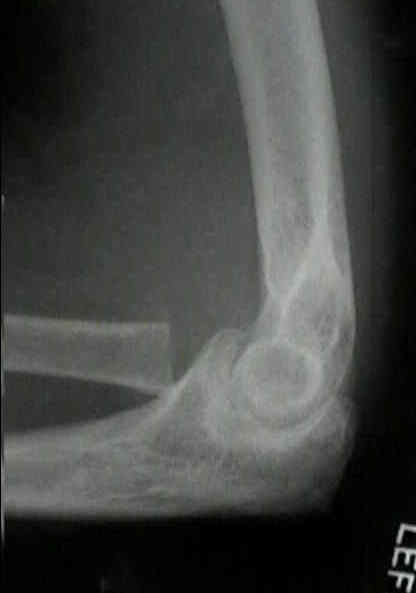
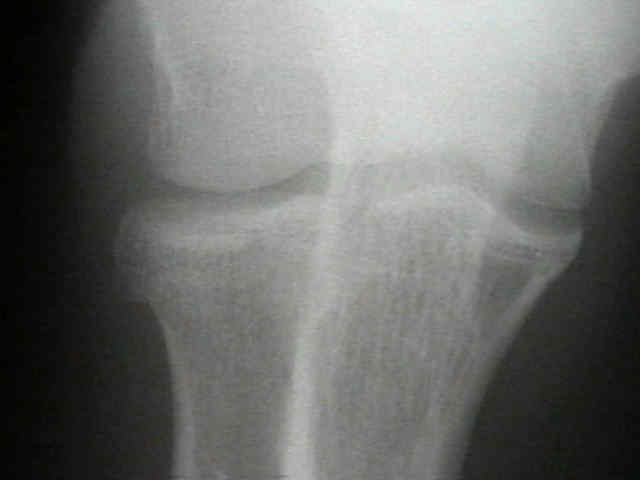
- marginal radial head frx w/ displacement, depression, or angulation.
- by definition has less than 30% of articular involvement and more than 2 mm of displacement;
- motion may be blocked by articular step off;
- Non Operative Treatment:
- decisions regarding treatment are made on basis of exam of elbow after administration of local anesthetic block;
- need to determine whether restriction of forearm rotation is from displaced fracture fragments vs pain;
- patients that cannot fully rotate the forearm after injury because of discomfort need to have hematoma aspiration and injection of lidocaine without epinephrine;
- w/ the elbow anesthetized, it is possible to distinguish motion limited by fracture fragments from motion limited by pain;
- note that often a reduction can be facilitated by application of firm pressure over anterolateral fracture segment, as the forearm is repeatedly supinated and pronated;
- w/ no mechanical block, or w/ at least 20-140 deg of flexion and 70 deg of pronation and supination, then frx is be treated similar to type I frx;
- immobilize elbow & wrist for 2-3 wks & then allow & encourage ROM;
- early mobilization, however, should be considered cautiosly when frx involves a large segment of the articular surface (1/3);
- in active individual, frx involving > 1/3 of articular surface should be rxed w/ sling or splint support for minimum of 2 wks;
- Operative Treatment:
- indications for surgery:
- articular step off more than 2 mm that cannot be closed reduced;
- failure to achieve functional ROM after administration of local anesthetic block is indication for operative treatment, esp in younger pts;
- failure to achieve a satisfactory ROM after administration of local anesthetic block is indication for operative rx, esp in younger pt;
- radial head excision:
- immediate, complete radial-head resection is to be avoid in Type-II fracture.
- results of acute resection of frx frag are unpredictable;
- delayed radial-head excision:
- because late excision of radial head is as good as early excision, non operative management is indicated initially.
- consider excision if any tilt or displacemnt > 1/4 of the head;
- ORIF of Radial Head Fractures
- Managment of Associated Injuries: (complex fractures)
- following radial head fixation, determine whether lateral stability exists, and whether LCL repair is indicated;
- if Essex-Lopresti injury is present, the distal ulna is splinted in supination (and in some cases is crossed pined)
The surgical treatment of isolated mason type 2 fractures of the radial head in adults: comparison between radial head resection and open reduction and internal fixation.
Open Reduction and Internal Fixation of Fractures of the Radial Head.
Primary Nonoperative Treatment of Moderately Displaced Two-Part Fractures of the Radial Head.
Transverse Coronoid Fracture: When Does It Have to Be Fixed?