

- See:
- Humeral Shaft Fractures in Children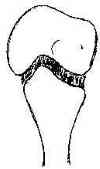
- Throwing Shoulder
- Discussion:
- most of these injuries are either Salter I or II fractures;
- frx separations of proximal humeral epiphysis occur most often between ages of 11 and 15 years;
- 80% of longitudinal growth of humerus occurs in proximal physis;
- large percentage of growth allows significant remodelling following injuryies of proximal humeral physis;
- Anatomy of Proximal Humeral Physis
- references:
- Growth plate activity in the upper extremity.
- Growth and predictions of growth in the upper extremity.
- associated injuries:
- brachial plexus injuries;
- look for decr sensation to pain;
- ref: Brachial Plexus Palsy Following Proximal Humerus Fracture in Patients Who Are Skeletally Immature.
- classification:
- type I epiphyseal injury:
- in newborns, frxs are usually Salter Harris type I injuries;
- type II epiphyseal frx: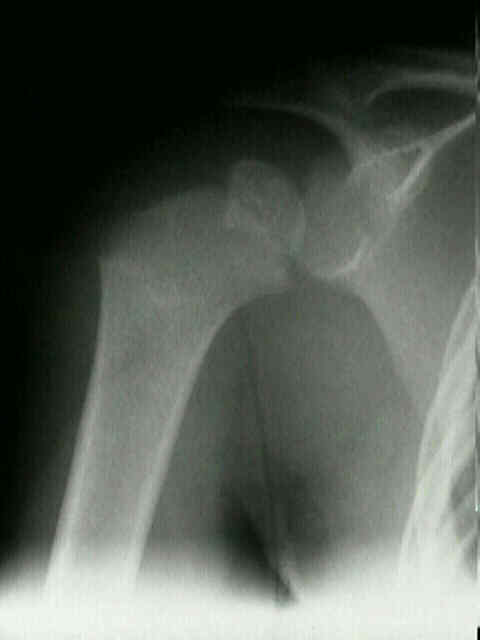
- in older children, they are most always Salter Harris type II;
- type III, IV, and V frx:
- rare because of greater mobility of the glenohumeral joint;
- references:
- Proximal humerus Salter type III physeal injury with posterior dislocation.
- Salter-Harris type III fracture-dislocation of the proximal humerus.
- diff dx of proximal humeral injuries:
- tumor of proximal humerus
- little league shoulder
- clavicle frx;
- normal varient (accentuated w/ humerus externally rotated)
- Diagnostic Studies:
- in the new born consider ultrasound inorder to diagnose this injury;
- Non Operative Treatment:
- young children: (less than 5 years of age);
- up to 70 deg of frx angulation and minimal apposition is acceptable;
- use shoulder immobilizer, if reduction is accetable;
- w/ displaced frxs, reduction is attempted by traction & gentle manipulation;
- children from 5 to 12 years:
- upto 45 deg of fracture angulation and 50% apposition is acceptable;
- displaced frx will tend to redisplace if arm is placed in a shoulder immobilizer;
- closed reduction may be required for significantly displaced or angulated fractures in children near the end of growth;
- frx can be immobilized w/ arm at side or in slight abduction;
- teenager:
- up to 25 deg fracture angulation and 30% apposition is acceptable;
- pathologic frx:
- w/ pathologic frxs (from ABC or unicameral bone cysts) consider immobilizing arm & allowing frx to heal before any other treatment;
- references:
- Fractures of the proximal humerus in children. Nine-year follow-up of 64 unoperated on cases.
- Operative Versus Nonoperative Treatment of Displaced Proximal Humeral Physeal Fractures: A Matched Cohort
- Operative Indications:
- operative treatment is rarely indicated;
- displaced frxs w/ intra-articular extension (SH IV) or frxs assoc w/ N/V injuries are indications for surgical treatment;
- see: percutaneous pinning
- references:
- Intramedullary nailing versus percutaneous pin fixation of pediatric proximal humerus fractures: a comparison of complications and early radiographic results.
- Operative Versus Nonoperative Treatment of Displaced Proximal Humeral Physeal Fractures: A Matched Cohort
Fractures of the proximal humeral epiphysis. Their influence on humeral growth.