

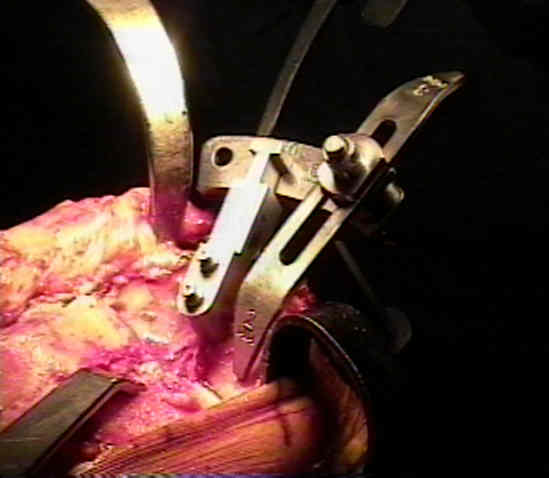
 - See:
 - tibial component
- proximal tibial cut
- extra-medullary cutting guide;
- Discussion:
- viewed in saggital plane, line drawn between anterior & posterior rims of the tibial plateaus is approx 10 deg posteriorly;
- this radiographic tilt does not take the menisci into consideration (which minimize the tilt to about 3 deg);
- this tilt produces a component of shear during simple stance;
- this posterior tilt actually minimizes the magnitude of shear stress when compressive stress increases during flexion;
- Operative Considerations for Posterior Tibial Slope:
- sagittal alignment of the tibial component is determined by amount of posterior slope of the proximal tibial cut;
- most current systems strive for 3-7 deg of posterior slope, because bone in the anterior portion of the cut surface is weaker;
- if proximal tibia is cut perpendicular to long axis of tibia in saggital plane, tibial component subsidence is more likely;
- implant considerations:
- if implant has a thickness = anteriorly and posteriorly, then tibia must be resected w/ a downward slope of approx 10 deg;
- if tibial implant has built in slope (that is the anterior portion is thicker than the posterior portion), then the tibia may be resected at 90 deg;
- excessive posterior slope:
- posterior sloping of prosthetic joint line should not be over done, since it may lead to posterior tibiofemoral subluxation (excessive flexion gap);
- excessive posterior slope combined w/ a deep proximal tibial cut may result in valgus instability (from loss of posterior oblique ligament) and may result in loss
of the PCL (in which case a posterior stabilized prosthesis will be required);
- inadequate posterior tibial slope:
- under no circumstances should tibia be cut with an upward slope since this diminishes size of flexion space posteriorly;
- a transverse tibial cut more bone is removed anteriorly than posteriorly, which may result in anterior subsidence;
- quality of anterior cancellous bone quality of anterior cancellous bone decreases rapidly as one progresses downward below joint surface;
- to prevent subsidence into soft bone, one needs to preserve as much anterior bone as possible and use a posteriorly sloped resection line
Effect of the tibial cut on subsidence following total knee arthroplasty.
Effect of Tibial Slope or Posterior Cruciate Ligament Release on Knee Kinematics.
The influence of tibial slope on maximal flexion after total knee arthroplasty.
Posterior slope of the tibial implant and the outcome of unicompartmental knee arthroplasty.
The Effect of Posterior Tibial Slope on Range of Motion After Total Knee Arthroplasty.
Angled Polyethylene Insert Exchange for Sagittal Tibial Malalignment in Total Knee Arthroplasty
Factors affecting flexion gap tightness in cruciate-retaining total knee arthroplasty.