

- Discussion:
- most commonly presents at 14 to 36-months;
- bowleg deformity in children w/ short stature & may indicate skeletal dysplasia;
- developmental knee alignment:
- normal knee alignment progresses from 10-15 deg of varus at birth to maximal valgus angulation of 10-15 deg at age of 3-3.5 yrs;
- neutral alignment:
- neutral femoral-tibial alignment occurs at 12-14 months old;
- Greene: neutral femoral-tibial alignment at 14 months old;
- Exam:
- degree of varus& tibial torsion are specifically measured & recorded;
- a practical method of following the varus deformity is to trace the outline of the child's legs on the paper cover the examination table;
- parents can hold on to this until the next visit;
- alternatively, hold the child's ankle together and measure the distance between the knees;
- knee motion and ligamentous instability are also assessed;
- in older child w/ untreated infantile tibia vara, mild laxity of LCL is common, but 14-36 mo. old child w/ this condition usually has ligamentous stability that
is within normal limits;
- Radiographs:
- physiologic bowing typically show flaring and bowing of tibia and femur in a symmetric fashion and is normal in children < 2 years of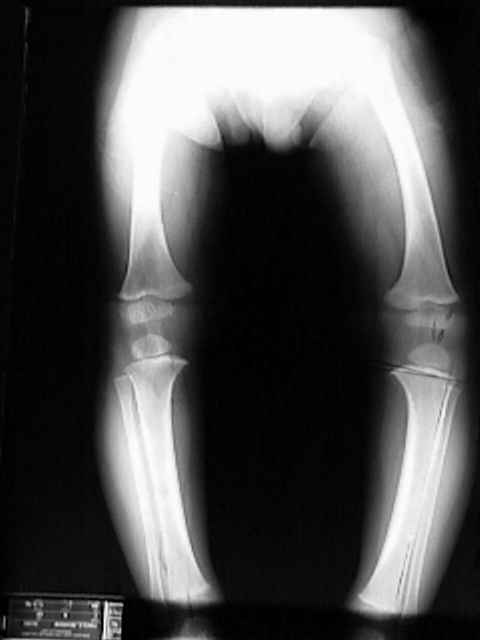
age (maximal at about 18 mo);
- physiologic genu valgum, or knock knees, develops next, w/ maximal deformity occurring at 3 years of age;
- gradual correction to ultimate alignment of slight genu valgum occurs by 9 years of age in the great majority of patients;
- references:
- Physiological bowing and tibia vara. The metaphyseal-diaphyseal angle in the measurement of bowleg deformities.
- Differential Dx:
- Physiologic Bowing:
- most common cause of genu varum;
- becomes most apparent during the second year but almost always disappears by age 3;
- involves both the femur and the tibia;
- can be assocated with internal tibial torsion;
- some orthopaedists will attempt to diminish this type of varus w/ casting;
- references:
- Normal limits of knee angle in white children--genu varum and genu valgum.
- Distal tibial deformity in bowlegs.
- Blounts Disease:
- Trauma:
- Osteogenesis Imperfecta
- Osteochondroma
- Hypophosphatemic rickets:
- its sex-linked dominant inheritance may lead to early diagnosis;
- short stature & genu varum are apparent;
- ht at initial dx is usually <10 % & always< 25th
- abnormal genu varum is seen in 95 % of these pts;
- characterized by widening or rachitic-like changes at physis;
- low serum phosphorus levels distinguish hypophosphatemic rickets from metaphyseal chondrodysplasia;
- Metaphyseal chondrodysplasia:
- an inherited disorder of bone growth that also causes bowing of lower extremities;
- characterized by widening or rachitic-like changes at physis;
- in Schmidt subtype (most common), height and limb alignment are w/in norml limits at birth, but genu varum persists & retarded growth is seen in preschool yrs;
- low serum phosphorus levels distinguish hypophosphatemic rickets from metaphyseal chondrodysplasia
Normal limits of knee angle in white children--genu varum and genu valgum.
Use of the Metaphyseal-Diaphyseal Angle in the Evaluation of Bowed Legs.
Tibia vara caused by focal fibrocartilaginous dysplasia. Three case reports.
Varus deformity of the distal end of the femur secondary to a focal fibrous lesion.
The development of the tibiofemoral angle in children.
Genu varus and valgus in children.
Variability of the Metaphyseal-Diaphyseal Angle in Tibia Vara: A Comparison of Two Methods.