

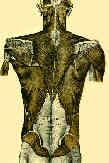
 - origin: broad aponeurosis that originates on the spinous processesof the lower 6 thoracic and all lumbar vertebrae;
 posterior crest of ilium, posterior surface of sacrum, lower 3 or 4 ribs, and an attachment of the tip of the scapula;
- insertion: flat tendon that twists upon itself to insert into the intertubercular groove of the humerus, just anterior to and
parallel with the tendon of pectoralis major;
- nerve supply: thoracodorsal from brachial plexus, C6, C7, C8;
- action: extends, adducts and medially rotates the humerus at the shoulder; draws the inferior angle of the scapula
inferior and medial; (draws shoulder downward and backward);
- synergists: rhomboids, pectoralis major, teres major
Ideas and Innovations: Bilateral Latissimus Dorsi V-Y Musculocutaneous Flap for Closure of a Large Meningomyelocele.
The latissimus dorsi flap for reconstruction of the brachium and shoulder.
The latissimus dorsi musculocutaneous flap for extremity reconstruction in orthopedic surgery.
Latissimus dorsi transfer for the treatment of irreparable tears of the rotator cuff.
Functional evaluation of the shoulder after transfer of the vascularized latissimus dorsi muscle.
Elbow flexorplasty: a comparison between latissimus dorsi transfer and Steindler flexorplasty.
Latissimus dorsi free muscle flap in lower-extremity reconstruction.
The latissimus dorsi muscle: a fresh cadaver study of the primary neurovascular pedicle.