


- See:
- Polyethylene Wear: Discussion
- Total Knee Replacement Menu:
- Resistance to Wear:
- conformation of the bearing surfaces is important because it is factor in the determination of contact stress;
- increases in material strength, will usually result in increases in stiffness and increases in contact stresses;
- hence, it is important that gains in gains in strength offset increases in surface contact;
- increases in the modulus of the polymer (or increases in the density) will have effect of increasing contact stress and may result in increased wear;
- higher contact stresses between ultra-high molecular wt poly & other biomaterials are thought to result in greater polymeric wear;
- over the lifetime of an implant, polyethylene becomes stiffer near the surface, and therfore, contact forces will increase w/ time;
- Adhesive / Abrasive Wear:
- predominate type of polyethylene wear (as compared to delamination);
- results when interatomic forces between mating wear surfaces become greater than intrinsic forces between molecules of the bulk material;
- primarily affects ultra-high molecular wt polyethylene;
- major attempt to solve this problem has been to alter surface that bears on the polyethylene;
- relatively thin ( < 6 mm) tibial plateau components of relatively nonconforming design are susceptible to a delamination type of wear;
- thicker components with more conforming articulations are expected to have less wear;
- thinner components result in higher stresses that lead to surface deformation;
- incongruent contact:
- occurs from the "round on flat" contact of some early total knee designs;
- these systems attempted to re-create normal knee kinematics;
- these knee systems induce high contact stresses in the polyethylene component which leads to wear;
- Undersurface Wear:
- occurs between the undersurface of the polyethylene component and the tibial base plate;
- quality of the locking mechanism (or the lack thereof) either prevents (or promotes) undersurface wear;
- Cautions:
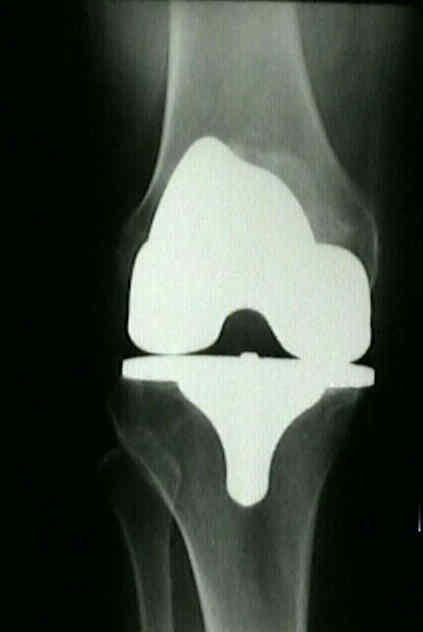
- following radiographs seemed to demonstrate severe polyethylene wear in the patient's right total knee, 8 years post surgery;
- it was felt that she would benefit from a liner exchange, but at surgery, the liner was found to be largely intact;
- the teaching point is to be sure that the radiographs are taken perpendicular to the knee joint


Adventures in mobile bearing knee design: A mid life crisis.
Backside Wear of Modular Ultra-High Molecular Weight Polyethylene Tibial Inserts