


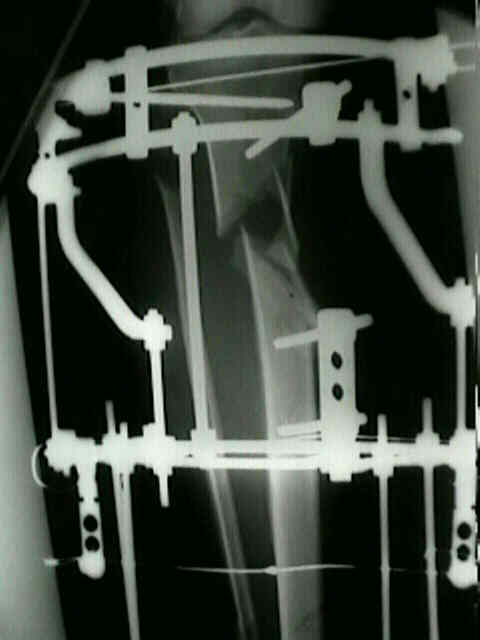

- See: Open Fractures of the Tibia:
- Discussion:
- Gustillo classification describes soft tissue injury, but does not necessarily describe fracture comminution;
- Grade I:
- wound less than 1 cm w/ minimal soft tissue injury;
- wound bed is clean
- bone injury is simple w/ minimal comminution;
- w/ IM nailing, average time to union is 21-28 weeks;
- ref: Treatment of isolated type I open fractures: is emergent operative debridement necessary?
- Grade II:
- wound is greater than 1 cm w/ moderate soft tissue injury;
- wound bed is moderatedly contaminated;
- fracture contains moderate comminution;
- w/ IM nailing, average time to union is 26-28 weeks;
- Grade III:
- following frx automatically results in classification as type III:
- segmental frx w/ displacement
- frx w/ diaphyseal segmental loss;
- frx w/ associated vascular injury requiring repair;
- farmyard injuries or highly contaminated wounds;
- in the report by Hill PF, et al, an ovine model was developed to study the outcome following IM nailing of a heavily contaminated fracture;
- those animals in the treatment group received wound debridement, lavage and the use of appropriate systemic antibiotics;
- despite this, infection developed at the osteotomy site and along the entire length of the implant in all animals;
- the authors conclude that that heavily contaminated fractures should not be treated by primary intramedullary nailing;
- high velocity GSW;
- frx caused by crushing force from fast moving vehicle;
- Early intramedullary nailing in an animal model of a heavily contaminated fracture of the tibia.
- grade III A frx:
- wound less than 10 cm w/ crushed tissue and contamination;
- soft tissue coverage of bone is usually possible;
- w/ IM nailing, average time to union is 30-35 weeks;
- grade III B frx:
- wound greater than 10 cm w/ crushed tissue and contamination;
- soft tissue is inadequate and requires regional or free flap;
- w/ IM nailing, average time to union is 30-35 weeks;
- grade III C:
- is frx in which there is a major vascular injury requiring repair for limb salvage;
- fractures can be classified using the MESS:
- in some cases it will be necessary to consider BKA following tibial frx
Gustilo-Anderson Classification
Classification of type III (severe) open fractures relative to treatment and results.
Interobserver agreement in the classification of open fractures of the tibia. The results of a survey of two hundred and forty-five orthopaedic surgeons [see comments].
Open fractures of the tibia in children.
Plates versus external fixation in severe open tibial shaft fractures. A randomized trial.
Severe open fractures of the tibia
Severe open tibial fractures: a study protocol.
Severe open tibial fractures. Results treating 202 injuries with external fixation.
Treatment of open tibial-shaft fractures. External fixation and secondary intramedullary nailing.
Segmental tibial defects. Comparing conventional and Ilizarov methodologies.