

- Discussion:
- osteonecrosis of proximal fragment;
- non union if proximal fragment is too thin;
- delayed union or nonunion occurs in 1-3% of pts & is treated by bone grafting or by repeat osteotomy when correction is lost;
- ref: Results of surgical treatment for non-union after high tibial osteotomy in osteoarthritis of the knee.
The treatment of nonunion of proximal tibial osteotomy with internal fixation.
- neurologic injuries:
- have been reported in 1% to 10% of pts;
- injury to peroneal nerve is increased when external fixation is used, osteotomy of fibular head has
been performed, or corrections greater than 15 deg have been attempted;
- incomplete correction:
- inadequate correction of the varus deformity will often lead to recurrence of symptoms;
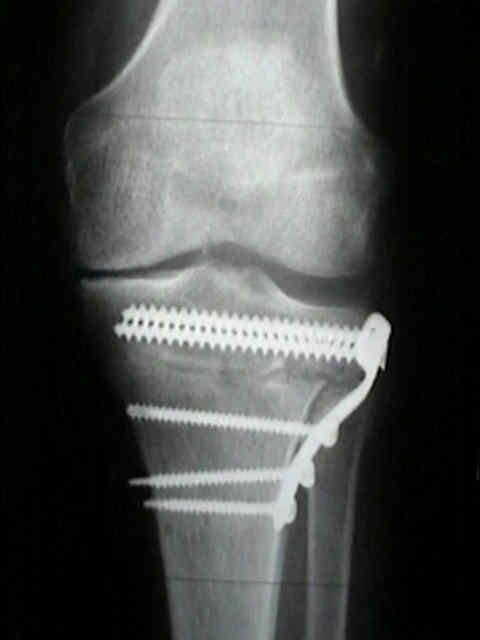
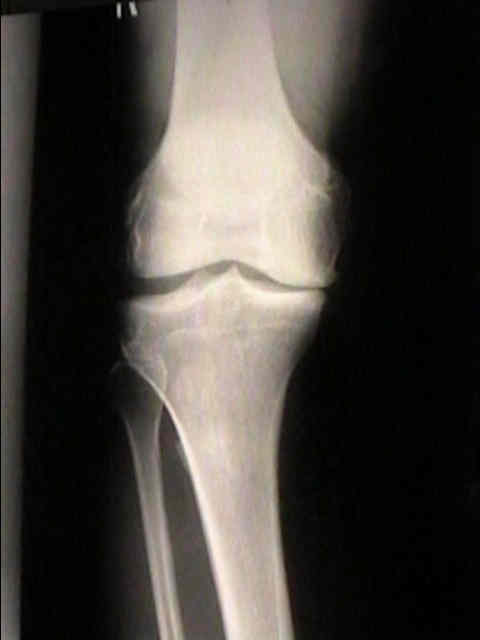
- fracture through proximal fragment with violation of joint space
- stay at least 2cm from joint line to prevent fracture
- deep venous thrombosis;
- compartment syndrome:
- may initially present as a "delayed peroneal nerve palsy";
- despite the strong denials from the anesthesiologists, a compartment syndrome can be completely masked by an epidural anesthetic;
- you only need to see the consequences of this one time to know the truth;
- case example:
- 14 yr old male w/ Vit D Resistant Rickets underwent a valgus opening wedge osteotomy for genu varum and received a
continuous epidural anesthetic;
- in the recovery room, the patient had 5/5 EHL function;
- over the ensueing 24 hrs, EHL function was lost, and the patient was felt to have a delayed peroneal palsy;
- at 3 days postop, the decision was made to explore the peroneal nerve, at which time it was noted that the patient had
complete necrosis of the anterior compartment;
- in retrospect, the patient's delayed peroneal palsy was a progressive compartment syndrome which was completely masked
by the epidural anesthetic