Tracking Pixel
presents
Wheeless' Textbook of Orthopaedics

Osteochondral Lesions of the Talus


Co-Authors:   Milford H. Marchant Jr., M.D.; Steven Anderson, M.D.; M.D.; Mark E. Easley, M.D.; James A. Nunley II., M.D.


History
        - Konig in 1888 described “Osteochondritis Dissecans” in the knee
                - Distinct lesion with detachment of articular cartilage from subchondral bone forming a loose body
        - Kappis in 1922 described similar process in talus
        - 1959 Berndt and Harty provided great insight into the pathoanatomy and pathophysiology

Talus - Anatomy Review
        - Receives forces 5 – 10 times the body weight during normal ambulation
        - 3/5 of surface is covered by articular cartilage
        - Articular Cartilage is 1 – 2 mm thick
        - No Muscular Attachments
        - Delicate Blood Supply
       
Etiology
        - Primary Cause = Trauma
                - Controversial
                - Berndt and Harty through cadaveric studies showed that the OLT was likely a result of trauma
                - Transchondral Fracture of Talar Dome
                        - Medial Lesions were created when the posteromedial talar dome impacted
                                the tibial articular surface during combined plantar-flexion, inversion and external rotation
                        - Lateral Lesions generated when the anterolateral talar dome impacted
                                the fibula during inversion and dorsiflexion
        - Other Causes
                - Ischemic Necrosis
                - Embolic phenomenon
                - Ossification Defects
        - Predisposing Factors
                - Endocrine Disorders
                - Peripheral vascular disease
                - Genetic Predisposition?
                        - 10-25% Bilateral Lesions

Prevalence
        - Average Age Ranges 20 – 35 years
        - Male 70% : Female 30%
        - 6% of pts with any hx of Ankle Sprains, have OLTs
        - 38% of pts w/ SER-IV ankle injuries, have OLTs
        - 16 – 23% of pts undergoing lateral ligament reconstruction, have OLTs


Evaluation
        - Presentation
                - Acute inversion injury
                - Chronic Ankle pain
                        +/- history of trauma
                        +/- instability
                - Known History of OLT +/- prior treatment
        - Symptoms
                - Pain
                - Catching, grinding
                - Feelings of instability and give-way episodes


Diagnosis and Staging
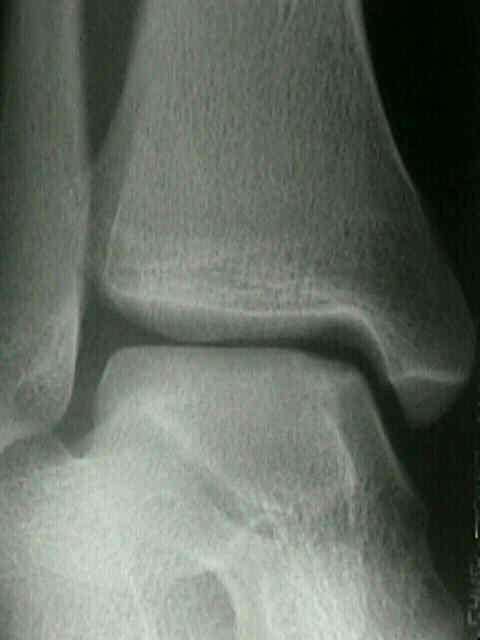
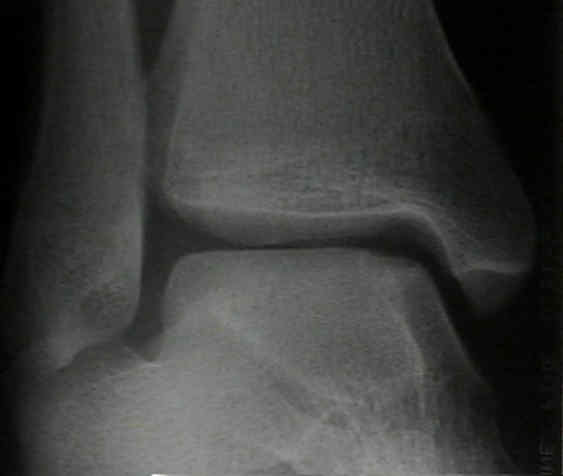
        - Radiography
                - X-ray – initial evaluation
                - MRI – modality of choice for suspected lesions
                - CT-Scan – modality of choice for known lesions


Figure 1

Figure 2

Figure 3


        - Arthroscopy
                - Gold standard for diagnosis and determining optimal treatment modality


Figure 4


        - Staging
                - Radiographic (Berndt and Harty)
                        1. Trabecular compression fracture of subchondral bone
                        2. Partially detached osteochondral fragment
                        3. Completely detached, non-displaced fragment
                        4. Detached and displaced fragment
                - Arthroscopic Staging (Pritsch et al. JBJS-Am. 1986)
                        1. Intact, firm, shiny cartilage
                        2. Intact, soft cartilage
                        3. Frayed Cartilage

                - Radiographic and Arthroscopic findings did not always correlate.
                        - Many are now using Berndt & Harty Staging with arthroscopic evaluation
                        - Advanced Radiographic modalities are also helpful

                - CT Staging (Ferkel et al. Orthop Trans. 1990)
                        Stage 1 – Cystic Lesion within the Talar dome
                        Stage 2a – Cystic lesion with communication to the Talar dome
                        Stage 2b – Open articular surface lesion with overlying non-displaced fragment
                        Stage 3 – Non-displaced lesion with lucency
                        Stage 4 – Displaced fragment
                - Magnetic Resonance Staging (Hepple et al. Foot & Ankle Int.   1999)
                        1. Articular Cartilage Damage only
                        2. Cartilage injury with underlying fracture
                                a. Surrounding bony edema
                                b. Without edema
                        3. Detached but non-displaced fragment
                        4. Detached and displaced fragment
                        5. Subchondral cyst
       
                Mintz et al.   Arthroscopy.   2003.
                        - Compared MRI with Arthroscopic findings for the purpose of grading
                        - 92 patients with persistent ankle pain & swelling
                        - 100% specificity in identification and localization of lesions.
                        - Accurate Grading in 83% of cases
                                - 95% sensitive and 100% specific in
                                        Disease positive (grade 0 – 1) vs. Disease negative (grade 2 – 5) analysis

Classic Lesions
        - Anterolateral
                - Shallow
                - Traumatic
        - Posteromedial
                - Deep
        - Central lesions have also been described


Treatment Planning
        - Acute vs. Chronic symptoms along with Radiographic Staging / Severity of Lesion dictate treatment
                - Acute Injuries
                        - Initial management if no radiographic evidence of fx or OLT
                        - Activity Restrictions
                        - Ice
                        - Trial of Immobilization
                        - Compression
                        - Elevation
                - Chronic Injuries
                        - Essential to define the severity of the lesion
                        - Low-Grade:   Operative vs. Non-operative
                                - Condition of articular cartilage in question
                                - With MRI Grade I – II lesions most attempt a 4 – 6 month trial of conservative therapy +/- immobilization
                                - Immobilization for 4 – 8 weeks
                                - Persistent symptoms after conservative therapy = Arthroscopy
                        - High Grade:   Operative Management
                                - Lesion stability during arthroscopic evaluation
                                - With MRI Grade III – V injuries = arthroscopic intervention
                                - Depending on the location, size, and character of the lesion various reconstructions may be performed
        - Other Factors
                - Location of the Lesion
                - Quality of Subchondral Bone
                - Ankle Instability
                - Prior Interventions
       
Treatment Modalities
        - Non-Tissue Transplantation
                - Internal Fixation
                - Arthroscopy
                        - Excision
                        - Curettage / Abrasion
                        - Drilling
                        - Micro-fracture
                     
                Robinson et al (JBJS 2003)
                        - 65 patients
                        - Improvement seen with arthroscopic treatment in MRI grade I – IV.
                        - Grade V cystic lesions had high incidence of poor outcome (53%).


Figure 5


        - Tissue Transplantation
                - Modalities
                        - Autologous Bone Grafting
                        - Autologous Chondrocyte Transplantation
                        - Osteochondral Autograft Transplantation (OATs)
                                - Single Osteochondral Plug
                                - Mosaicplasty
                        - Osteochondral Allograft Transplantation
                - Benefits
                        - Provides the ability to fill in a larger defect


Osteochondral Autograft Transplantation
        - Benefits
                - Non-immunogenic graft
                - No increase in disease transmission
                - Provides an articulating surface
                - Prevents excessive weight bearing loads on the remaining portion of the talus which would accelerate ankle joint arthritis
        - Structural Limitations
                - Lesion size = Limited “extra” cartilage
                - Only Carticel can fill irregular shaped lesions
                - Flat surface required
                - Attempts at angular repairs have been challenging


Figure 6


Osteochondral Lesions of Talus - Allograft Transplantation:
        - Allograft Transplantation is proving to be beneficial for large osteochondral defects
                        where duplication of the anatomy would be difficult with autologous tissue.

        - Talus allograft is size matched = Custom fit
                - Able to treat the “shoulder lesion” (See Figure)
                        - Defect involving more than one articulating plane
        - Benefits
                - In Fresh Allografts, Viable Chondrocytes are present within
                                an intact Hyaline Cartilage Structure
                        - Arthroscopy and Mosaicplasty rely on fibrocartilage ingrowth
                - Shorter procedure
                - No second operative site for harvest
                        - Compared to OATs or Mosaicplasty
                - Single surgical procedure
                        - Compared to Autologous Chondrocyte Transplants (Carticel)

        - Risks
                - Transmission of Disease
                - Immune Response
                - Resorption and fragmentation of the graft
                - Procedure-based risk
                        - Osteotomy Non-union
                        - Post-op Arthritis


Original Text by Clifford R. Wheeless, III, MD.