presents
Wheeless' Textbook of Orthopaedics
Tracking Pixel
Search Site by Word
My Account

Type III Radial Head Fracture


- Discussion:
    - comminuted fractures of the entire head;
    - classification:
            - type A:
                  - fracture of the entire radial neck, with the head completely displaced from the shaft;
            - type B:
                  - articular fracture involving the entire head, which consists of more than two large fragments;
                  - each fragment is completely displaced from the shaft;
            - type C:
                  - fracture with a tilted and impacted articular segment, which must be reduced;
                  - articular fragments displaced from the shaft.
            - complex fractures:
                  - radial head frx & elbow dislocation :
                        - injury to medial collateral ligament w/ dislocation can be subtle;
                        - apply valgus stress to judge instability;
                  - radial head frx & MCL instability :
                  - Essex Lopresti Fracture

- Radiographs:
    - proximal translation of the radius;
          - it is important to have adequate views of the wrist early on inorder to follow proximal radial translation later on;


- Treatment Options:
    - w/ acute longitudinal radioulnar dissociation (Essex Lopresti Fracture), attempt to preserve radial head;
    - excision of radial head:
          - unlike type II fractures, these fractures do not do well w/ delayed excision;
    - radial head implants:
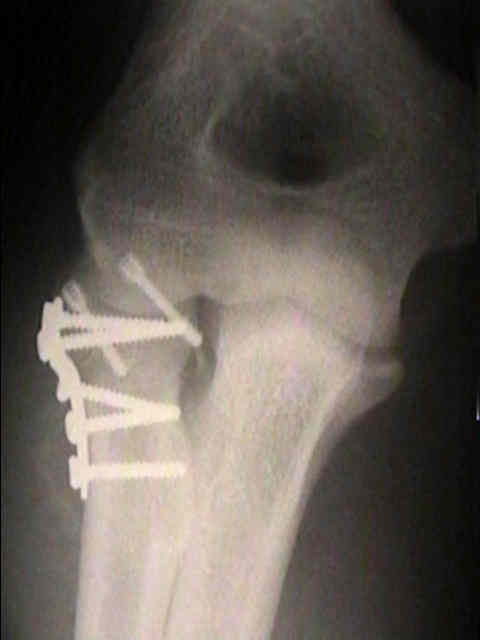
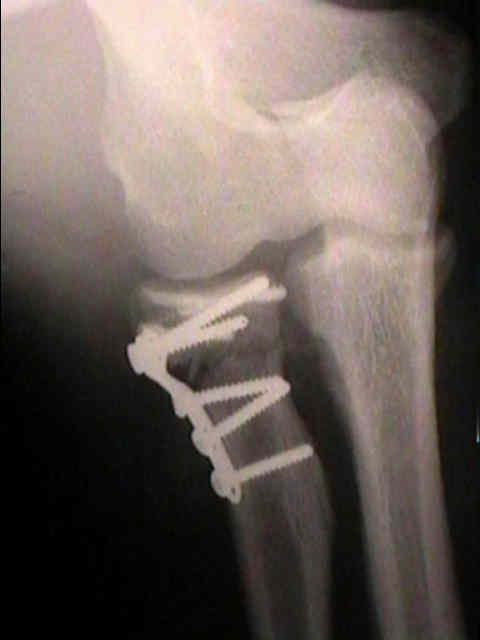
    - internal fixation:
          - AO screws: 1.5, 2.0 or 2.7 mm cortex, depending on size of fragment;
          - most often 2.7 mm miniscrews are chosen and are countersunk to avoid screw prominence;
                  - if a coutnersink is to be used, be sure that the screw is not too long, so as the screw tip does not extend beyond the cortical surface;
          - over drilling of the proximal fragment is not required (can result in fragment comminution), especially if the fragment is held in compression during screw insertion;
                  - for lag screw effect, 2.7 mm drill-gliding hole is made thru the near cortical fragment, which is followed by 2 mm drill hole;
          - minicondylar plate;
                  - indicated if the head requires attachment to the neck;
                  - consider use of 2.0 or 2.7 mm L-shaped plate;


- Surgical Approach:
    - posterolateral approach: (Kocher Approach)
          - approach the fascial plane between the ECU and anconeus muscle
          - direct lateral approach is preferred by some surgeons because it spares the lateral ulnohumeral ligament;
    - exposure can be enlarged w/ osteotomy of lateral epicondyle & its reflection anteriorly with the extensor muscle origins;
            - radial nerve is identified in the substance of the supinator;
            - temporary fixation with K wires following reduction;
    - safe zone for implant insertion:


- Complications:
    - avascular necrosis:
            - may occur following ORIF of comminuted fractures when most of the soft tissue attachements have been stripped;
            - when this complication occurs and is symptomatic, a delayed excision may be performed once the capsulo-ligamentous structures have healed;
    - non union:
            - in the presentation by D. Ring et al (15 th Annual Meeting of Orthopaedic Trauma Association, 1999), the authors noted 7 patients with radial
                    head non union following ORIF on 70 patients;
                    - the authors point out that the limited blood supply may lead to the relatively high occurance of non union;


- Case Example:


Comminuted Fractures of the Radial Head. Comparison of Resection and Internal Fixation.


Original Text by Clifford R. Wheeless, III, MD.