

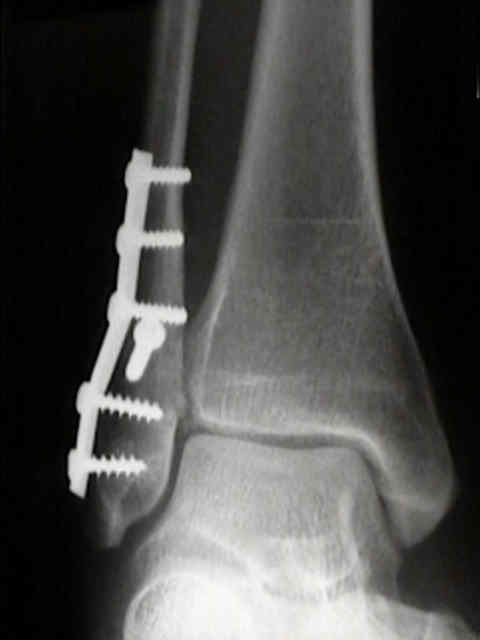
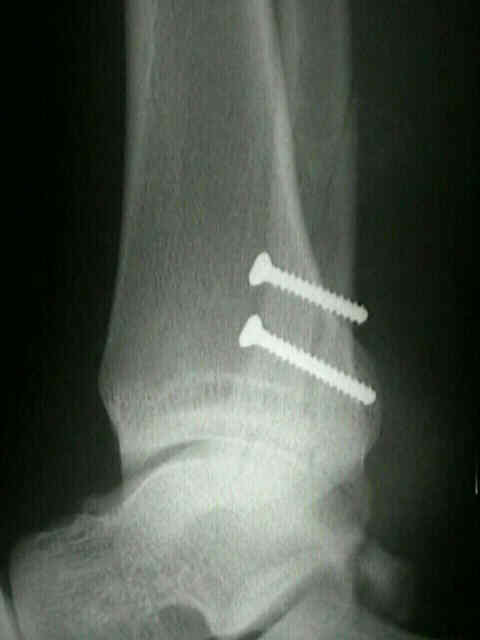
- Discussion:
- supination external rotation fractures are the equivalent of Weber B frx;
- it is the most common type of frx of fibula is caused by supination and external rotation, resulting in oblique frx at
level of sydesmosis
- supination of foot is combination of inward rotation at ankle, adduction of hindfoot, and inversion of the forefoot;
- as supinated foot externally rotates (or leg internally rotates on planted, supinated foot), lateral structures and anterior
syndesmotic ligaments tighten;
- SER fractures: classification and sequence of injury:
- note that rarely a SER fracture may occur well above the syndesmosis, in which case the SER fracture is not the equivalent of
a Weber B frx;
- Weber B Subtypes:
- B1 Isolated
- B2 w/ medial lesion (malleolus or ligament)
- B3 w/ a medial lesion and fracture of posterolateral tibia
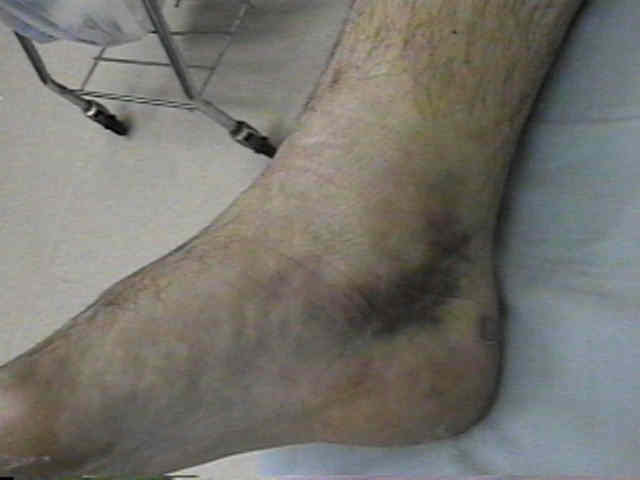
- Exam Findings:
- note amount of swelling (which might require delay of surgery);
- posterior and/or medial ankle tenderness;
- medial ecchymosis (which appears after 24 hrs when the deltoid ligament has been disrupted);
- always check for tenderness in the proximal fibular and/or midfoot;
- ref: Does Medial Tenderness Predict Deep Deltoid Ligament Incompetence in Supination-External Rotation Type Ankle Fractures?
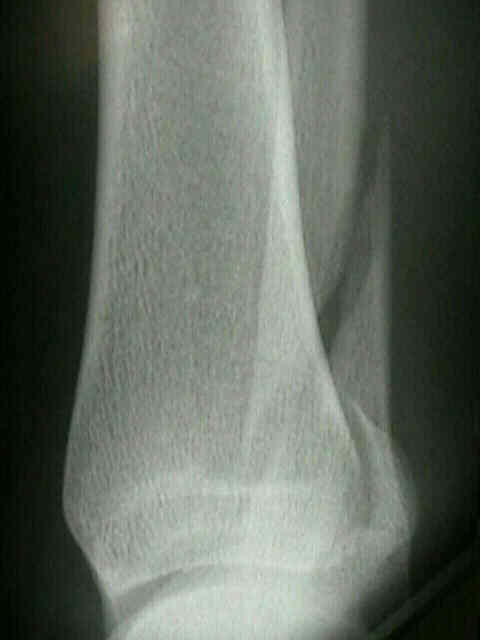
- Radiographs:
- the easiest way to identify a SER fracture is to look for the characteristic posterior spike on the distal fragment;
- w/ high energy injuries (such as parachute injuries), the sprial fibular frx may begin somewhat higher than is seen
w/ low energy injuries;
- Non Operative Treatment:
- indicated for stable Weber B frx
- ref: Comparison of two conservative methods of treating an isolated fracture of the lateral malleolus.
- Indications for Operative Treatment:
- unstable Weber B fracture:
- includes SER IV frx (w/ either medial malleolus frx or deltoid ligament disruption);
- presence of medial tenderness, > 5 mm of medial clear space is seen on static or stress radiograph, indicates injury of the
deltoid ligament;
- treat as bimalleolar frxs, w/ ORIF of lateral malleolus;
- in absence of a medial malleolar frx, routine exploration of medial side of the ankle is not necessary unless there is evidence that
portion of the deltoid ligament or the tibialis posterior has entered the joint and is blocking reduction of the talus;
- as noted by Thordarson, et al. (1997), displacement (or shortening) of the fibula more than 2 mm will lead to significant increases
in joint contact pressures;
- references:
- Ankle fractures: supination-eversion fractures of stage IV. Primary and late results of operative and non-operative treatment.
- Ankle fractures. Supination-eversion fractures stage II. Primary and late results of operative and non-operative treatment.
- The effect of fibular malreduction on contact pressures in an ankle fracture malunion model.
- Stress Examination of Supination External Rotation-Type Fibular Fractures.
- Operative Versus Nonoperative Treatment of Unstable Lateral Malleolar Fractures: A Randomized Multicenter Trial
- When is a simple fracture of the lateral malleolus not so simple? how to assess stability, which ones to fix and the role of the deltoid ligament.
- Surgical Treatment:
- preoperative planning:
- fracture dislocations of the ankle
- open ankle fractures
- trimalleolar frx
- syndesmotic injury
- its important to not to confuse sydesmotic widening from medial clear space widening;
- references:
- Syndesmotic fixation in supination-external rotation ankle fractures: a prospective randomized study.
- The management of acute distal tibio-fibular syndesmotic injuries: Results of a nationwide survey.
- positioning:
- for ORIF of the fibula, it is helpful to place the patient on a bean bag in a semi-lateral position, and if a good seat belt is
placed across the patient's waist, then the OR table can be tilted to the opposite side;
- anesthesia:
- Spinal Anesthesia Mediates Improved Early Function and Pain Relief Following Surgical Repair of Ankle Fractures
- medial malleolus fixation:
- vertical malleolar frx
- horizontal-oblique frx
- consider fixation of the medial malleolus prior to lateral fixation, since the fixation is usually perfectly anatomic and rigid and
is unlikely to displace during fixation of the lateral malleolus;
- initial fixation of the lateral malleolus may displace if the ankle is rotated as the medial side is fixed;
- fibular fixation:
- surgical approach
- reduction:
- fixation techniques:
- fixation w/ two lag screws:
- can only be used in younger patients w/ long oblique frx;
- allows for a smaller incision;
- the hardware is not prominent and usually does not have to be removed;
- lag screws will not interfere w/ syndesmotic screws (if they are needed);
- lateral plate and lag screw: (plate position)
- disadvantages:
- prominent lateral screws may cause symptoms or wound necrosis;
- may not allow adequate fixation in osteoporotic bone;
- may interfere w/ syndesmotic screw insertion (especially when two syndesmoic screws are to be used);
- posterior antiglide plate:
- achieves strong fixation (even in osteoporotic bone);
- generally hardware does not cause symptoms nor does it cause wound necrosis;
- does not interfere w/ syndesmotic screw insertion;
- syndesmotic injury: needs to be evaluated prior to wound closure;
- Syndesmotic instability in Weber B ankle fractures: a clinical evaluation.
- postoperative care:
- Use of a cast compared with a functional ankle brace after operative treatment of an ankle fracture. A prospective, randomized study.
- Compression stockings in the management of fractures of the ankle: a randomised controlled trial.
- Early Weightbearing and Range of Motion vs Non-Weightbearing and Immobilization After Open Reduction and Internal Fixation of Unstable Ankle Fractures: A Randomized Controlled Trial
- Case Examples
Fractures of the Ankle and the Distal Part of the Tibia.
Torsional strength of the ankle in vitro. The supination-external-rotation injury.
Rush rods versus plate osteosyntheses for unstable ankle fractures in the elderly.
The Dorsal Antiglide Plate in the Treatment of Danis-Weber Type-B Fractures of the Distal Fibula.