

- See: Proximal Humeral Physeal Injuries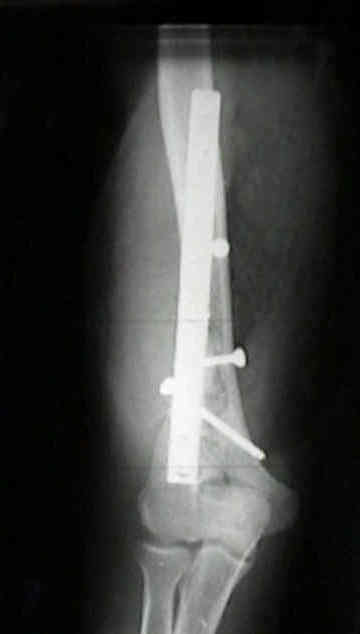

- Discussion:
- classification of proximal humeral fractures:
- anatomic neck fracture:
- one part fracture
- two part fractures
- two part surgical neck fracture
- two part tuberosity fractures:
- lesser tuberosity frx;
- greater tuberosity frx;
- three part fractures
- four part fracture:
- fracture dislocation:
- head split fragment:
- Clinical and Radiographic Outcomes After Surgical Treatment of Proximal Humeral Fractures with Head-Split Component.t
- displacing forces:
- following frx of humerus, frx fragments may be displaced as a result of pull of muscles inserting into two parts;
- w/ frx of surgical neck, upper frag is usually abducted and externally rotated by the muscles inserting onto greater tubercle,
while lower frag is adducted & internally rotated by internal rotators; (see rotator cuff);
- in frx of shaft, angulation & overriding may result from muscular pull;
- fractures of the middle & lower third of humeral shaft are frequently associated w/ injuries of the encircling radial nerve;
- Radiographs:
- an axillary view is mandatory for proximal humeral fractures, as it is the view that shows the most angulation and displacement;
- ref: Conservative management of proximal humeral fractures: can poor functional outcome be related to standard transscapular radiographic evaluation?


- Non Operative Treatment:
- references:
- Functional results following frx of proximal humerus. A controlled clinical study comparing two periods of immobilization.
- Conservative treatment of fractures and fracture-dislocations of the upper end of the humerus.
- Operative versus non-operative treatment for two-part surgical neck fractures of the proximal humerus
- Operative Treatment of Proximal Humerus Fractures: 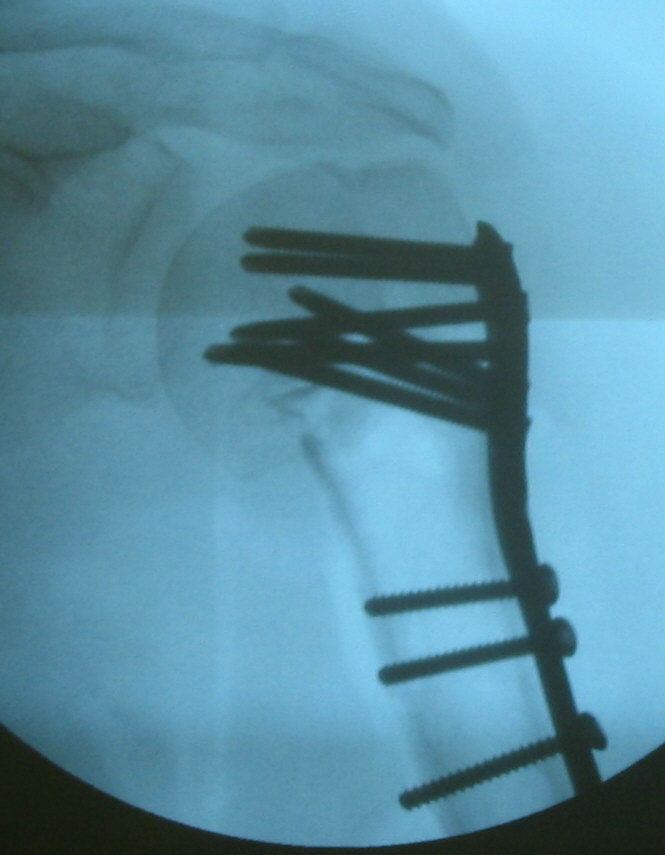
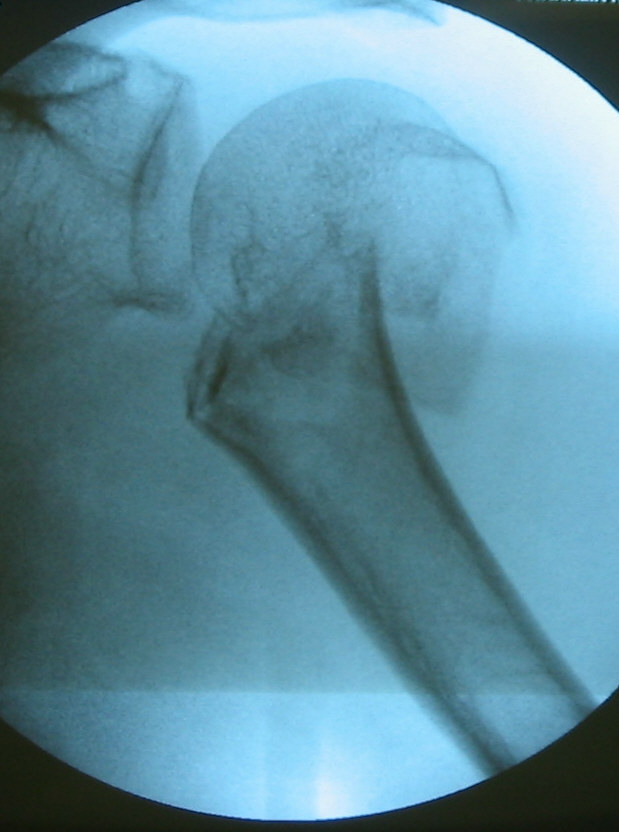
- Lateral Plating Technique
- Shoulder Replacement
- Complications:
- Non Union of Humeral Fractures:
- Avascular Necrosis:
- main indicators of AVN:
- calcar length ( <8 mm), medial hinge integrity, and anatomic neck fracture
- Initial post-fracture humeral head ischemia does not predict development of necrosis
- [Dislocated multiple fragment fractures of the head of the humerus. Does dislocation of the humeral head fragment signify a worse prognosis?].
- Predictors of humeral head ischemia after intracapsular fracture of the proximal humerus.
- Complex proximal humerus fractures: Hertel's criteria reliability to predict head necrosis.
- Vascular Complications:
- Axillary artery injury secondary to displaced proximal humeral fractures: a report of two cases.
- Axillary artery injury from humeral neck fracture: a rare but disabling traumatic event
- Axillary artery injury after proximal humeral fracture: a review of 2 cases.
- Vascular Injury Accompanying Displaced Proximal Humeral Fractures: Two Cases and a Review of the Literature
- Proximal humerus fractures with associated axillary artery injury.
- Proximal humerus fracture with injury to the axillary artery: a population-based study.
- Delayed Radial Nerve Injury from a Brachial Artery Pseudoaneurysm Following a Four-Part Proximal Humerus Fracture: A Case Report and Literature Review.
Job 31:22 (King James Version): Then let mine arm fall from my shoulder blade, and mine arm be broken from the bone.