

- See: Function and Activity after TKR
- Post Operative ROM:
- most important factor predicting ultimate ROM is range of motion before surgery;
- ref: Range of Motion Correlates with Patient Perception of TKA Outcome.
- patients with significant stiffness before surgery will have the most difficulty gaining range of motion;
- lateral retinacular release & sacrifice or retention of posterior cruciate ligament, do not significantly affect knee ROM after surgery;
- final ROM after knee arthroplasty is fairly similar among various prosthetic designs, and usually approximates 100-115 deg;
- Knee Extension: - Flexion Contracture Post TKR
- closed chain - press against the wall exercise;
- patient places his/her back and buttocks agaist the wall - standing and slight crouched;
- the operative leg is extended as much as possible with the foot on the floor;
- the patiet then extends the knee, trying to fire the quadriceps as much as possible;
- references:
- Flexion Contracture Persists If the Contracture is More Than 15° at 3 Months After Total Knee Arthroplasty
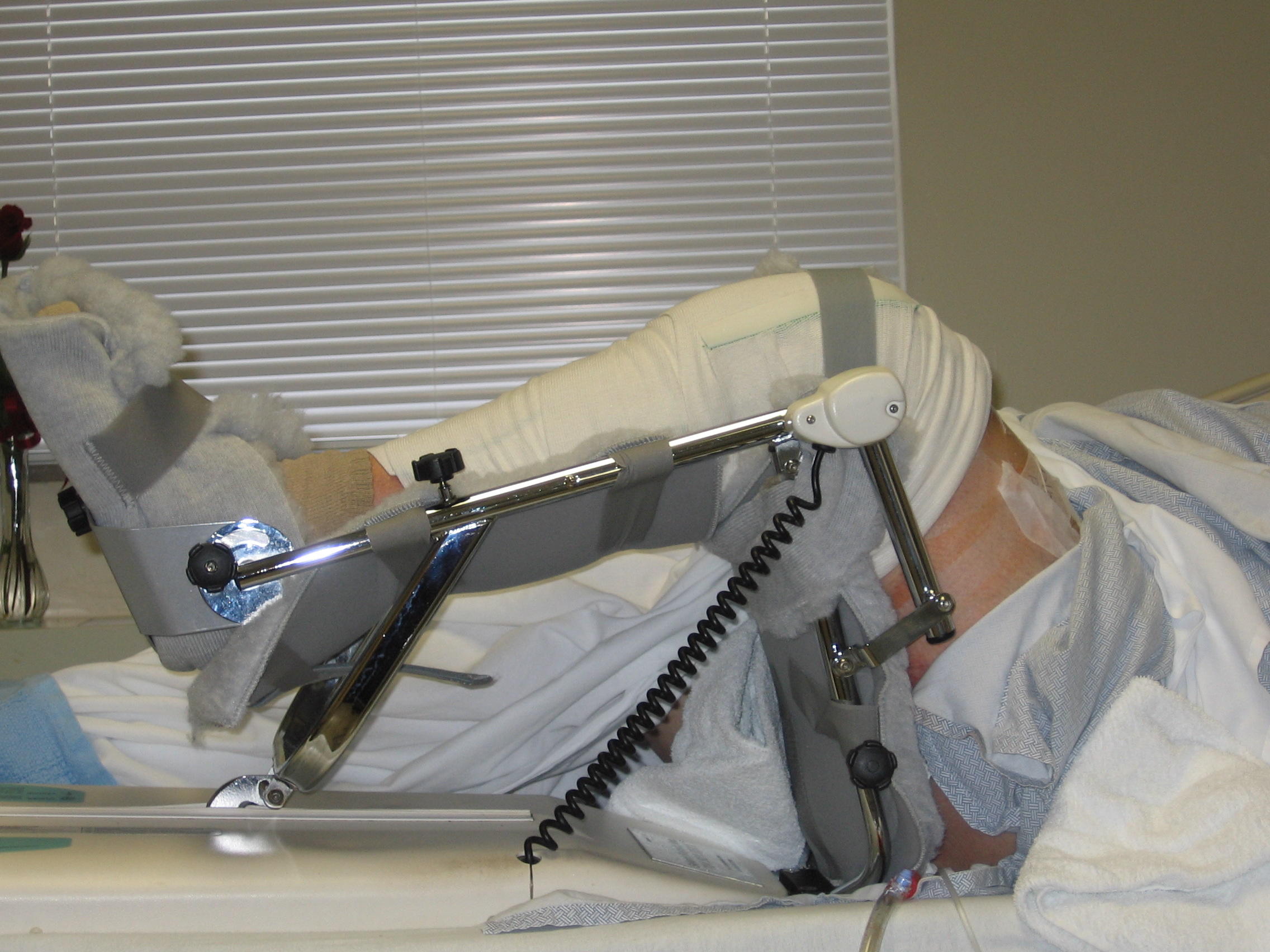
- Continuous Passive Motion:
- may decrease DVT/PE in TKR:
- use of CPM may result in faster recovery of motion immediately after surgery, but appears not to
ultimately increase ROM at one year post surgery;
- references:
- Beneficial effects of continuous passive motion after total condylar knee arthroplasty.
- A controlled evaluation of continuous passive motion in patients undergoing total knee arthroplasty.
- Deep-vein thrombosis and continuous passive motion after total knee arthroplasty.
- The influence of continuous passive motion on outcome in total knee arthroplasty.
- The role of continuous passive motion following total knee arthroplasty.
- The effect of continuous passive motion on wound-healing and joint mobility after knee arthroplasty.
- A Comparison of 2 Continuous Passive Motion Protocols After Total Knee Arthroplasty:
- Blood loss after total knee replacement. Effects of tourniquet release and continuous passive motion.
- Continuous passive motion improves active knee flexion and shortens hospital stay but does not affect other functional outcomes after knee arthroplasty.
- The use of Continuous Passive Motion (CPM) in the rehabilitation of patients after total knee arthroplasty.
- Continuous passive motion following total knee arthroplasty.
- Knee flexion significantly reduces blood loss and transfusion rate after uncemented total knee arthroplasty
- Blood loss after total knee replacement. Effects of tourniquet release and continuous passive motion.
- Early Loss of ROM:
- manipulation may be indicated in some cases of limited postoperative knee flexion (up to 7% of patients);;
- manipulation:
- in the study by Esler CNA, et al, manipulation under anesthesia was performed on 47 knees;
- patients were considered for manipulation if their flexion was less than 80 deg at at mean of 11 weeks postop;
- goal was to overcome intra-articular adhesions.
- delaying manipulation well beyond the timing of earlier studies was important in maintaining gains in flexion;
- it was found that the mean gain in flexion at one year was 33 deg;
- complications of manipulation:
- hemarthrosis;
- supracondylar femur fracture;
- wound dehiscence
- patellar tendon rupture;
- reference:
- Manipulation of total knee replacements. Is the flexion gained retained?
- The role of manipulation following total knee replacement.
- Total condylar knee replacement. A study of factors influencing range of motion as late as two years after arthroplasty.
- Stiffness After Total Knee Arthroplasty. Prevalence of the Complication and Outcomes of Revision.
- Management of Stiffness Following Total Knee Arthroplasty.
- Predictors of Range of Motion in Patients Undergoing Manipulation After TKA
- Stiffness after total knee arthroplasty: does component alignment differ in knees requiring manipulation? A retrospective cohort study of 281 patients.
- References:
Incidence and Reasons for Nonrevision Reoperation After Total Knee Arthroplasty
Anabolic steroids after total knee arthroplasty. A double blinded prospective pilot study