

- Discussion:
- pt w/ anterior dislocation keep affected arm at side of body in external rotation;
- shoulder will loose its usual roundness and will be full anteriorly to palpation;
- axillary nerve f(x) should be documented;
- rotator cuff is frequently damaged & should be examined after reduction;
- determine direction and degree of instability;
- Rotatory Stress Test:
- test begins on normal side;
- w/ the arm supported in the surgeon's axilla, and one han translates the shoulder anteriorly;
- the shoulder is then abducted and externally rotated;
- the shoulder is again translated anteriorly;
- w/ a normal inferior glenohumeral ligament, anterior translation should decrease markedly;
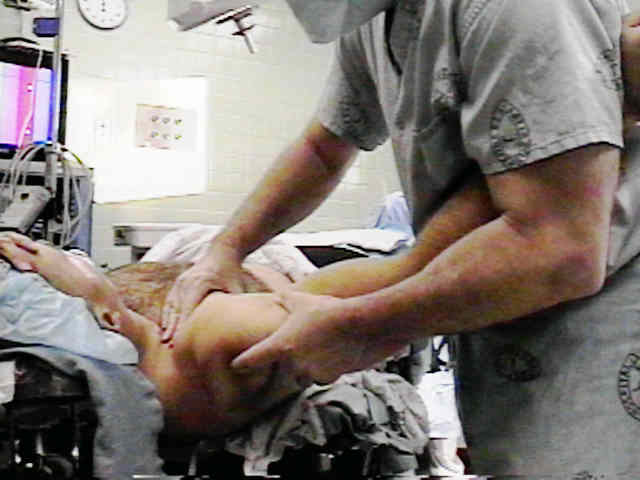
- Lateral Decubitus - Load and Shift Test: (Tasto JP (1998));
- patient is placed in the lateral decubitus position with the injured shoulder up;
- physician stands behind the patient, and immobilizes the elbow between his/her chest and arm which is hooked around the patients elbow (this hand can alterantively grasp the lower arm for loading);
- the surgeon's free hand is used to perform the anterior / posterior drawer test;
- Shoulder Stability Testing Using the Lateral Decubitus Position
- Sulcus Sign:
- felt to be pathognomonic of multidirectional instability.
- look for prominent depression below acromion when inferior traction is applied to wrist;
- Anterior Apprehension Sign: (for anterior instability)
- this test has been criticized for being unreliable;
- pts w/ anterior instability may demonstrate loss of external rotation w/ arms at 90 deg position secondary to apprehension;
- apprehension sign is manifested by guarding and apprehension when the arm is placed and stressed in a provocative position;
- one technique involves having the patient abduct and externally rotate the shoulder while placing his/her palm against a wall;
- the physician then grabs the shoulder w/ one hand and applies an anterior drawer test w/ the other hand;
- Posterior Apprehension Sign:
- the patient attempts to touch the low thoracic spine (which places the shoulder in internal rotation and adduction), and then a posterior drawer test is applied;
- a similar test can be performed with the shoulder in flexion, adduction, and internal rotation;
- Exam the Subscapularis:
- about 5% of shoulders that have had an anterior dislocation will sustain a significant injury to the subscapularis, which will contribute to further instability;
- Arterial Injuries:
- vascular damage at time of reduction occurs primarily in the elderly, particularly when an old anterior dislocation is mistaken for acute injury, and closed reduction is performed;
- artery may not withstand traction forces required to reduce an old dislocation
Classification and physical diagnosis of instability of the shoulder.
Diagnosis of shoulder instability by examination under anesthesia.
Clinical use of the olecranon-manubrium percussion sign in shoulder trauma.