

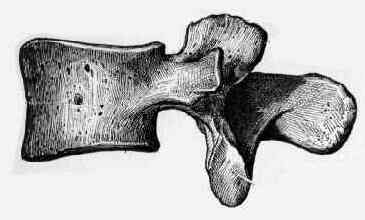
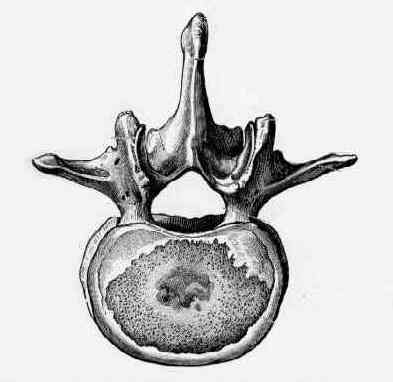


- Discussion:
- their heights are less than their horizontal diameters;
- pedicles are relatively short and project from the upper half of body;
- laminae are thick & droop below level of pedicles but do not overlap;
- spinous process is hatchet-shaped and projects horizontally, with its upper border well below the level of the upper end of body and its
lower border at about the level of the upper end of the body of the next lower vertebra;
- transverse processes are long & thin, & they slant slightly backward and upward;
- articular processes are heavy; in main, superior facets face almost medially & inferior facets face almost laterally, placing the line of the
interarticular joints in a nearly sagittal plane;
- movement most obviously permitted is flexion and extension;
- region between the superior articular process & remainder of lamina is often called the pars interarticularis;
- failure of ossification in this area may be responsible for condition known as spondylolysis;
- Radiographs::
- AP view:
- pt is supine with knees flexed to elminate the normal lordosis
- central beam is vertical to the center of the abdomen at level of the iliac crests;
- Lateral:
- patient is recumbent on either side with knees and hips flexed to eliminate the normal lumbar lordosis;
- central beam directed vertically to the center of body of L3 at the level of the patients waist;
- Oblique View:
- shows Scotty the Dog configuration of adjacent lumbar vertebra
- pt is recumbent w/ one side rotated 45 deg from horizontal;
- central beam is directed vertically toward the center of L3
Instrumentation of the lumbar spine. An overview.
Fracture of the posterior margin of a lumbar vertebral body.