

- See: Rickets:
- Discussion:
- this is the most frequently encountered form of rickets and consists of a genetic or acquired fault in the handling of phosphate in the proximal tubule;
- patholophysiology:
- decreased reabsorpion of phosphate by the renal tubule (causing hypophosphatemia) (otherwise the renal function is normal, ie BUN and Cr are normal);
- decreased absorption of calcium and phosphorous from the GI tract;
- genetics:
- hypophosphatemic Vitamin D-resistant rickets is one of the few disorders inherited as a sex-linked dominant trait;
- as in other sex-linked dominant disease, the degree of expressivity varies;
- diff dx:
- renal osteodystrophy
- metaphyseal chondrodysplasia
- hypophosphatasia:
- in contrast to vitamin D resistant rickets, hypophosphatasia shows a reduction in serum alk phos;
- Clinical Presentation:
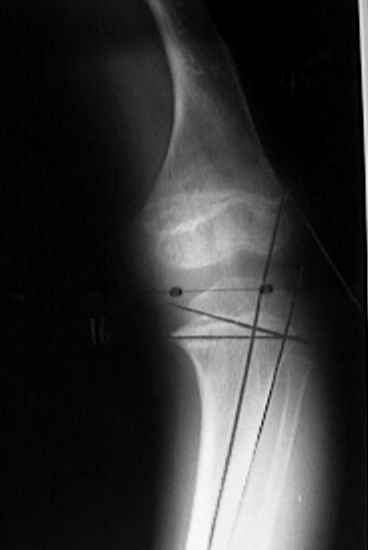
- classic picture is short stature, bowing of lower limbs (esp at knees causing genu varum) & rachitic changes in the long bones;
- ht at initial dx is usually <10 % & always< 25th
- coxa vara is also common in untreated patients;
- in some affected patients, the disorder is manifested only by a low serum phosphorus;
- in others there is also widening of epiphyseal plates and bowing of the legs;
- Radiographs: 
- Lab Data:
- serum phosphorus is low (see hypo PO4), serum Ca is usually normal (or low normal), and serum alk phos is elevated when turnover of bone is increased;
- patients w/ hypophosphatemic ricket have low concentrations of inorganic phosphorous, secondary to abnormal reabsorption of phosphate;
- serum BUN and Cr are normal (which distinguishes this from renal osteodystrophy);
- Treatment:
- administration of high doses of vitamin D (by itself) will have no beneficial effect;
- instead, it is more appropriate to manage these patients with neutral phosphate orally and 1,25-dihydroxyvitamin D;
- if oral phosphate supplements are given alone, secondary hyperparathyroidism may result;
- organic phosphate should be given every 4 hours along w/ supportive vit D therapy;
- surgical considerations:
- it is important to avoid "recumbency hypercalcemia" which is common in postoperative patients who are non wt bearing and who are taking Ca supp and vit D;
- untreated hypercalcemia in these patients leads to renal stones, mental changes, etc;
- Complications:
- hypercalcemia and secondary extraskeletal calcification may occur w/ overly aggressive therapy
The orthopaedic management of hypophosphatemic rickets.