

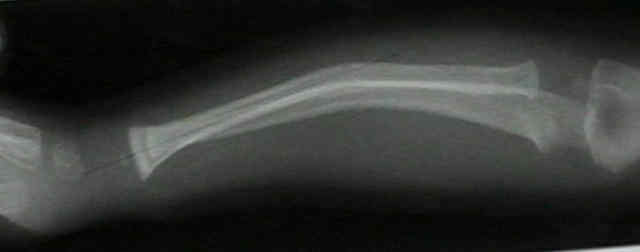
- See: Green Stick Frx
- Discussion:
- occurs most often in children less than 8 yrs of age as a result of a fall on an outstretched hand;
- anatomically the frx tends to occur just distal to insertion of pronator teres, and therefore distal fragment is supinated as compared to proximal fragment;
- greenstick frxs in mid-forearm have both angulatory & rotational component, both of which must be corrected w/ manipulation.
- plastic deformation may occur to either the ulna or radius;
- usual deformity is dorsal angulation of distal fragments w/ apex of fracture toward the volar aspect;
- Radiographs: 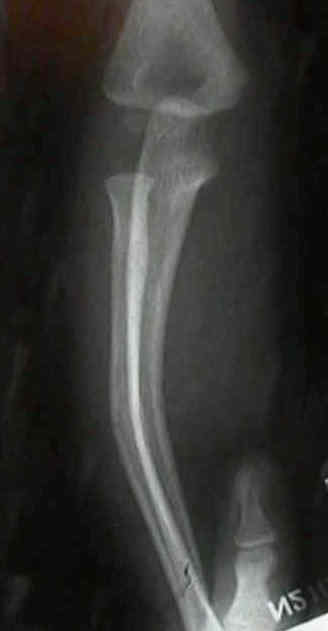
- rotational alignment:
- note differences in fracture cortical surfaces;
- note relationship of bicipital tuberosity to radial styloid;
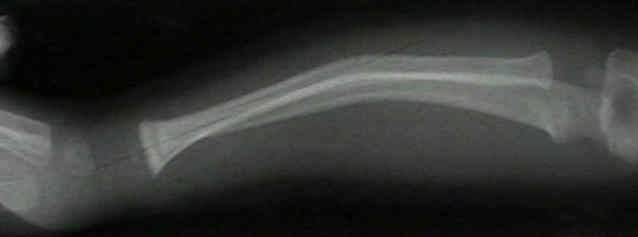
- Treatment:
- usual deformity is dorsal angulation of distal frag w/ apex of frx toward volar aspect;
- simple straightening of the bones and immobilization in the cast is not adequate, as the deformity will recur;
- intact cortex should be completely broken thru during a slow process of plastic deformation over 5 minutes;
- this may require GEA if forearm rotation is limited;
- reduction involves pronation of the distal fragment as well as correction of the apex volar angulation;
- children < age 4 can tolerate a larger deformity, since they have greater remodeling potential;
- following completion frx, periosteal tube remains intact and holds the fragments together in normal alignment (hence frx is relatively stable);
- long arm cast is applied w/ elbow in 90 deg of flexion & forearm in 45 deg pronation (to prevent supination of distal fragment)