

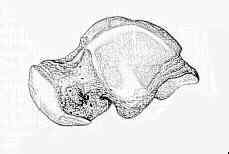
- Discussion:
- two processes, lateral & posterior, project from body of talus;
- either process may be fractured, either as isolated injury or assoc w/ other ankle or talar injuries;
- it is frequently confused w/ an ankle sprain;
- non union is a frequent complication of displaced lateral process frx;
- lateral process:
- broad based, wedge shaped prominence of lateral talar body with an articular surface dorsolaterally for fibula and inferomedially for anterior aspect of posterior facet;
- lateral talocalcaneal, cervical, bifurcate, and anterior talofibular ligaments originate from tip of this process;
- mechanism of injury:
- occur when the foot is dorsiflexed and inverted (such as occurs with "snow boarding")
- shearing stress is transmitted from calcaneus to lateral process, causing frx of variable size which may enter into posterior facet;
- associated injuries:
- subtalar dislocation
- verticle frx of medial malleolus
- talar neck frx
- classification: (Hawkins)
- non articular chip fracture;
- single large fragment involving both talofibular articulation & subtalar joint;
- comminuted frx involving both articulations;
- Clinical Findings:
- point tenderness over lateral process just anterior & inferior to the tip of lateral malleolus;
- may resemble an ankle sprain;
- pt may note persistent pain and loss of motion, if frx extends into posterior facet of subtalar joint
- Radiographs:
- frx may involve up to 1/3 of posterior facet of subtalar and/or ankle joint;
- note that radiographs will frequently underestimate the size of the frx fragment;
- Broden's medial & lateral oblique axial views will help evaluate posterior facet;
- mortise view:
- help define size of fragment & amount of articular involvement;
- taking the mortise view in plantar flexion along with 20-25 deg of internal rotation will place the lateral process in profile, and will flex the forefoot out of the way;
- CT scan: allows accurate sizing and assessment of articular displacement of posterior facet;
- Non Operative Treatment:
- size of frx fragment & degree of displacement will determine clinical outcome;
- larger fragments will be more likely to involvle posterior facet;
- undisplaced fractures: treated w/ non wt bearing cast immobilization for approximately 4-6 weeks;
- nonunion is frequent complication of displaced lateral process frx that are treated non operatively;
- Operative Treatment:
- unreduced, displaced frxs may lead to nonunion, w/ residual malalignment of the subtalar joint & persistent pain;
- large fragments are treated w/ ORIF;
- fractures larger than 1 cm and frx w/ more than 2 mm displacement probably should be treated surgically;
- small comminuted fragments: treated with excision of fragments;
- Complications:
- nonunion is frequent complication of displaced lateral process frx that are treated non operatively;
- sub talar arthrosis:
- whether treated operatively or non operatively, many patients will develop subtalar arthrosis & may require late sub-talar arthrodesis
Fracture of the lateral process of the talus: a review of thirteen cases.
Fracture of the lateral process of the talus: a report of thirteen cases.