

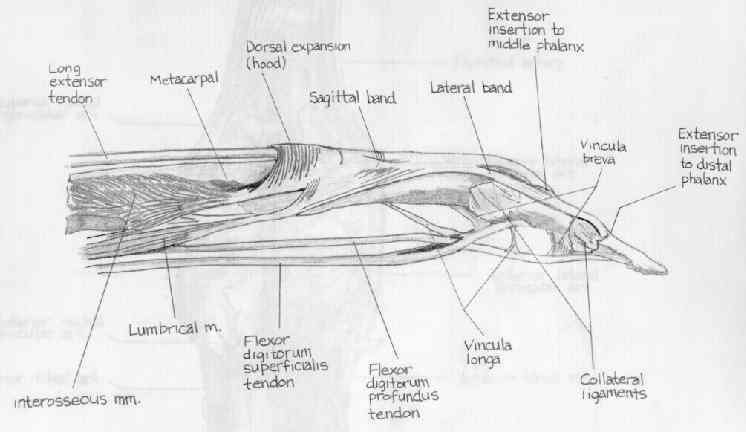
 - See: Phalangeal Injury
- Mechanism:
- results from forceful hyperextension of DIP joint w/ FDP in maximal contraction;
- classic examples include pts injured by the sudden jerk of a rope, such as starting a lawnmower
or retraining an animal;
- tendon may rupture directly from its insertion into bone, or it may avulse bone fragment from base of distal phalanx;
- it may also rupture at the musculotendinous junction;
- there is more soft tissue injury and hemorrhage than seen w/ simple laceration, & therefore there is more scarring
of flexor tendon sheath;
- ring finger is most often involved (75%);
- this is due to a weaker insertion, a common flexor muscle belly of middle, ring, and little fingers;
- anatomy:
- avulsed tendon ends retract proximally, & may become entrapped at chiasma of FDS at the level of PIP joint,
causing a flexion contracture of the PIP;
- tendon retracts to the base of the digit or into palm, depending on the force of the avulsion;
- vinculum prevents excessive retraction;
- lumbricals prevent proximal retraction of lacerated FDP past the mid-palmar area;
- diff dx:
- anterior interosseous nerve paralysis (index and long fingers);
- trigger finger
- swan neck deformity (can resemble chronic PIP rupture);
- classification:
- Type I - retracts to the palm;
- Type II - retracts to the PIP joint;
- Type III - bony fragment distal to A4;
- references:
- "Rugby finger"--Avulsion of the profundus of the ring finger.
- Avulsion of the profundus tendon insertion in athletes.
- Misleading fractures after profundus tendon avulsions: a report of six cases.
- Exam:
- attempt to feel the lump of the tendon in palm;
- consider AIN palsy
- references: A simple clinical test to differentiate rupture of flexor pollicis longus and incomplete anterior interosseous paralysis.
- Radiograph: 
- Indications for Repair:
- FDP is difficult to repair if tendon retracts into palm for longer than 7 days because tendon becomes swollen, vinculum
remains avulsed, & tendon cannot be rethreaded (which would comprimise PIP movement);
- attempts at repairing the tendon after 2 wks will be unsuccessful;
- if tendon has retracted into palm consider tendon excision and DIP fusion
- DIP fusion most indicated in index finger or use of free tendon graft;
- reference:
- [Traumatic avulsion of the flexor digitorum profundus tendon. Report of 20 cases].
- Operative Repair:
- goal is to reattach the flexor tendon to the point of avulsion;
- tendon is isolated proximally and the phalanx is exposed distally;
- tendon is rethread using a silicone flexible tendon;
- avoid A4 pulley disruption (which will impair DIP flexion);
- in type I tendon rupture (w/ retraction into palm), the vinicular system has been disrupted, and the tip of the profundus
tendon will be avascular;
- hence, the distal end of the tendon should be trimmed;
- in type II rupture, the blood supply to the tendon is left intact, but fibrosis may develop at the FDS chiasm which might
limit flexion gliding;
- any such fibrosis should be debrided;
- Pull Through Technique:
- repair is uses a 3-O polypropylene suture thru distal end of tendon as double figure of eight, and attached to tendon just
proximal to bone fragment;
- pass suture on either side of phalanx thru the periosteum;
- tie sutures over a plastic button placed directly over finger nail to avoid pressure on the tip of the digit;
- complications:
- quadriga may develop if the FDP is excessively advanced;
- Alternatives:
- chronic rupture:
- in that case of late FDP rupture with intact FDS, consider whether the functional deficit warrents FDP reconstruction;
- consider no treatment, or tenodesis or arthrodesis of the distal interphalangeal joint to free tendon grafting;
- DIP Arthrodesis: 

 - Complications:
- w/ chronic neglected injury there may be dorsal subluxation of the DIP;
The effect of mitek anchor insertion angle to attachment of FDP avulsion injuries.
Comparison of pullout button versus suture anchor for zone I flexor tendon repair.