

- IM nailing of tibia fractures - menu
- tibial plafond fractures
- Distal Tibia Fracture:
- see: external fixation for distal tibia fracture, outcomes of external fixation vs IM nailing, and plate fixation;
- w/ frx extension into the joint, consider placement of percutaneous lag screws to repair intra-articular fracture lines before
nailing is performed;
- guide wire:
- guide wire needs to be directed towards the medial malleolus while the ankle is held in valgus;
- this will minimize the tendency for the fracture to drift into varus as the nail passes across the fracture site;
- blocking screws:
- antero-posterior blocking screws are inserted on either side of the central nail insertion zone inorder to effect an anatomic reduction;
- in general, the blocking screw is positioned where you don't want the nail to go;
- blocking screws are temporary, and therefore can be left 2 cm longer than needed for easy removal;
- with fracture demonstrating preoperative varus displacement, consider an antero-posterior blocking screw inserted on
medial side of distal fragment;
- this screw can be biased also in a medial to lateral direction to correct the recurvatum malreduction, or alternatively,
a second blocking screw, inserted from a medial to lateral direction in the anterior third of the tibia can be placed;
- blocking screw should remain as peripheral as possible (minimal blockage) in order to prevent iatrogenic comminution of
distal fragment at opposite end of frx;
- consider insertion of tip of nail 1 cm past frx site (barely across), and then inserting the blocking screw at a point tangential to
shaft of nail at same level as the tip of the nail (1 cm);
- as the nail is advanced the shaft will contact the blocking screw;
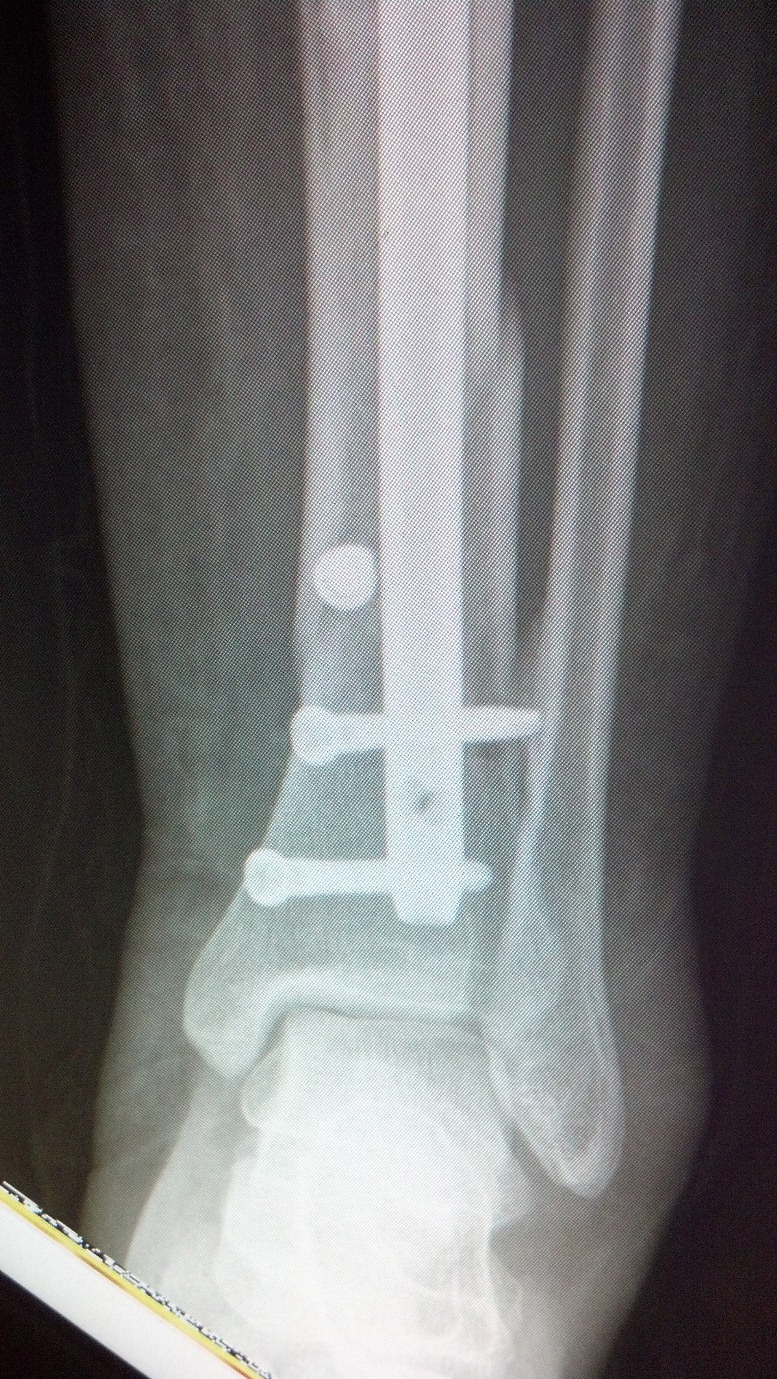
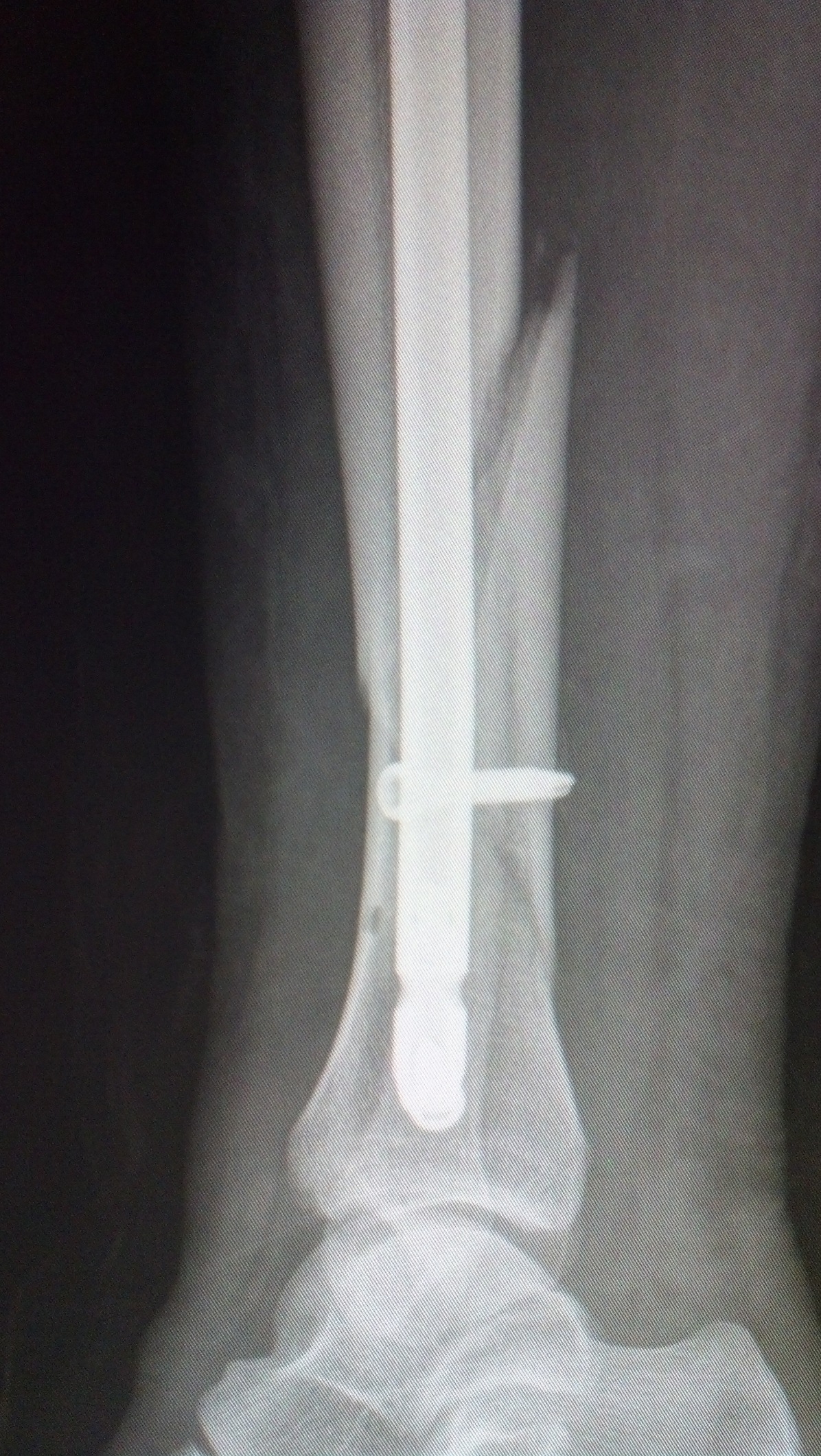


- need for 2 proximal and 2 distal interlocking screws;
- in the study by Isik, et al (2012), the authors performed IM nailing with 2 distal and proximal screws on 34 patients, with no
post op complications;
- references:
- Intramedullary Nailing and Angulation Prevention in Distal Metaphyseal Tibial Fractures
- Effect of distal interlocking screw number and position after intramedullary nailing of distal tibial fractures: a biomechanical study simulating immediate weight-bearing.
- transfibular blocking screw (as a temporary means of achieving reduction)
- instead of the classic blocking technique, a much easier technique involves percutaneous insertion of a 4.0 or 5.0 screw inserted
through the fibula;
- using percutaneous technique, insert a screw across the fibula until it engages the tibia.
- additional passage of the transfibular screw will begin to translate the distal tibial fracture site in medial direction;
- screw is advanced until it abuts the tibia, and then it is further advanced until the reduction is optimal;
- with soft bone, the screw may penetrate the cortex, but this is OK, because the screw will then continue to act as a blocking
screw against the nail;
- a second screw (inserted below the first screw) may also be required inorder to optimize the reduction;
- once the nail has been inserted and once interlocking screws are in place, the transfibular screws can be removed;


- ORIF of distal fibula:
- some authors recommend concomitant ORIF of the distal fibula (if frx is present), inorder to improve rotational stability;
- 85 % of patients with malalignment after nailing do not have fibula fixation;
- there is some evidence (Attal R, et al), that fibular fixation may lead to delayed union (8 fold higher risk of delayed bone healing);
-
- references:
- Effect of Fibular Plate Fixation on Rotational Stability of Simulated Distal Tibial Fractures Treated with Intramedullary Nailing.
- Does Fibular Plating Improve Alignment After Intramedullary Nailing of Distal Metaphyseal Tibia Fractures?
- The effect of concurrent fibular fracture on the fixation of distal tibia fractures: a laboratory comparison of intramedullary nails with locked plates.
- Fibular fixation as an adjuvant to tibial intramedullary nailing in the treatment of combined distal third tibia and fibula fractures: a biomechanical investigation.
- Distal leg fractures: How critical is the fibular fracture and its fixation?
- Distal quarter leg fractures fixation: The intramedullary nailing alone option
- Randomized, Prospective Comparison of Plate versus Intramedullary Nail Fixation for Distal Tibia Shaft Fractures
- A multicentre case series of tibia fractures treated with the Expert Tibia Nail (ETN)
- Distal tibial metaphyseal fractures: the role of fibular fixation
- [Intramedullary nailing of the distal tibia illustrated with the Expert(TM) tibia nail].
- Management of Concomitant Articular Fracture:
- see: restoration of articular anatomy in tibial plafond fractures;
- ref: Distal metaphyseal frx of the tibia with minimal involvement of the ankle. Classification and treatment by locked IM.
- Post Traumatic Claw Toes:
- Selective lengthening of the proximal flexor tendon in the management of acquired claw toes.
- Case example:
82 year old male, who is about 5 weeks into cast treatment of a tibia fracture. Because of pain, fracture malreduction, and inability
to maintain a cast, IM nailing is chosen. The fracture was scarred into the malreduced position which required aggressive use of
polar screws to get the nail into proper position;


- references:
- Modified tibial nails for treating distal tibia fractures
- Interlocking intramedullary nailing in distal tibial fractures.
- Dia-metaphyseal distal tibial fractures--treatment with a shortened intramedullary nail: a review of 15 cases.
- The unreamed tibial nail in the treatment of distal metaphyseal fractures.
- Intramedullary nailing of unstable diaphyseal fractures of the tibia with distal intraarticular involvement.
- Nonunions of the Distal Tibia Treated by Reamed Intramedullary Nailing.
- Intramedullary Nailing of Distal Metaphyseal Tibial Fractures.
- Treatment of Distal Tibia Fractures Without Articular Involvement: A Systematic Review of 1125 Fractures.
- Treatment of distal tibial metaphyseal fractures: Plating versus shortened intramedullary nailing.
- Radiographic and Clinical Comparisons of Distal Tibia Shaft Fractures (4 to 11 cm Proximal to the Plafond): Plating Versus Intramedullary Nailing.
- High association of posterior malleolus fractures with spiral distal tibial fractures
- Extra-articular distal tibia fractures: a mechanical evaluation of 4 different treatment methods.
- A prospective, randomised trial comparing closed intramedullary nailing with percutaneous plating in the treatment of distal metaphyseal fractures of the tibia.
- A randomised pilot trial of “locking plate” fixation versus intramedullary nailing for extra-articular fractures of the distal tibia
- Distal tibia fractures: management and complications of 101 cases
- [Evaluation of interlocking intramedullary nailing in distal tibial fractures and nonunions].
- [Intramedullary nailing of the distal tibia illustrated with the Expert(TM) tibia nail].
- Plate versus nail for distal tibial fractures: a systematic review and meta-analysis.