

- See:
- Reduction of Dorsal Angulation
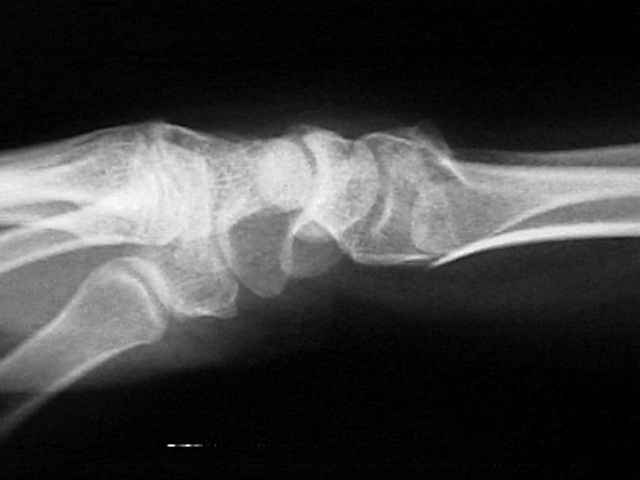
- Discussion:
- measured on lateral, from angle created between articular surface of distal radius & line perpendicular to long axis of radius;
- normal volar tilt measures between 0 to 22 degrees (mean 11 to 14.5 deg);
- rare individuals may even have a dorsal tilt (which for them is normal);
- dorsal tilt decreases moment arm of finger extensors, making wrist less efficienct;
- w/ dorsal tilt deformity, there will be significant transfer of load onto ulna;
- normally 82% of compressive load across the wrist is borne by radio-carpal joint, and 18% is borne thru the ulnocarpal joint;
- w/ a 45-deg dorsal angulation deformity, 65 % of axial load across carpus is directed onto ulna;
- remaining loads on radius will be concentrated on dorsal aspect of scaphoid fossa;
- Acceptable Reduction:
- most orthopaedist will generally not accept any angulation past neurtal;
- consider obtaining a lateral radiograph of the opposite wrist for comparison;
- note that some patients may be predisposed to ulnar mid carpal instability, and hence, even an "acceptable reduction" w/ 5 deg volar tilt may cause symptoms;
- note whether there is abnormal dorsal tilt of the lunate;
- as pointed out by Jupiter (1991), dorsal tilt greater than 20 deg will often become symptomatic w/ pain at radiocarpal articulation, as well as in limited grip strength, if angulation is not reduced;
- when radial shortening occurs w/ dorsal tilt, there may be dysfunction of the distal R-U joint, manifested by limited rotation of forearm & impingement of ulna on radius;
- Fractures of the distal end of the radius.
- Assoicatted Findings in Acute Injury:
- see unstable distal radial frx;
- in younger patients w/ distal radius frx, mid-carpal instability may be found in association w/ excessive dorsal tilt;
- look for dorsal tilt of the lunate (DISI deformity);
- comminution:
- dorsal surface is frequently comminuted;
- if comminution extends volar to midaxial plane of radius, then cast immobilization will frequently fail;
- expect increase in comminution w/ incr in amount of dorsiflexion;
- high-loading angles, (70-90 deg), have much more comminution than low loading angles of 20 to 40 deg;
- Effects of Chronic Dorsal Tilt:
- in chronic cases, a malunion w/ excessive dorsal tilt may lead to ulnar mid carpal instability;
- w/ healed fractures, symptotomatic dorsal angulation greater than 20 deg can be managed w/ a corrective opening wedge radial osteotomy
Midcarpal instability caused by malunited fractures of the distal radius.