

- Discussion:
- coronoid helps to resist varus stress and posterior elbow subluxation (radial head also resists posterior subluxation);
- pivotal role as an anterior buttress;
- at least 50% of the coronoid must be present for the ulno-humeral joint to have normal function (i.e., for joint to be stable);
- associated w/ elbow dislocation in upto 40%;
- references:
- The anteromedial facet of the coronoid process of the ulna
- classification and treatment:
- type I: frx of the tip of the coronoid process;
- very common with elbow dislocation w/ radial head fracture = (terrible triad)
- type II: frx or comminution constitutes about half of coronoid;
- treated w/ early motion if no instability is present;
- type III: frx or comminution constitues more than half of coronoid;
- almost always involves dislocation (see below);
- fractures near coronoid base are associated w/ increased instability due to loss of stabilizing function of coronoid itself
as well as loss of the insertion of anterior band of the MCL and anterior joint capsule;
- other patterns:
- large fractures of the coronoid process with anterior and posterior olecranon fracture-dislocations
- anteromedial facet fractures:
- with varus posteromedial rotational instability (and LCL tear)
- references:
- The anteromedial facet of the coronoid process of the ulna
- Fracture of the Anteromedial Facet of the Coronoid Process. Surgical Technique
- The effect of anteromedial facet fractures of the coronoid and lateral collateral ligament injury on elbow stability and kinematics.
- How should anteromedial coronoid facet fracture be managed? A surgical strategy based on O'Driscoll classification and ligament injury.
- Radiographs:
- coronoid fracture fragment may appear small and may be confused with a radial head fracture;
- opening angle:
- angle formed by lines drawn from the tip of the olecranon to coronoid and a line drawn down the axis of the ulna;
- ref: Coronoid fracture patterns.
- Dislocation + Coronoid Process Frx:
Classification;- frx is due to avulsion by brachialis when elbow is hyperextened;
- type I: avulsion of the tip of the coronoid process;
- type II: involving less than 50% of the process
- for above types closed reduction and early motion is recommended;
- fixation of frx fragments may not guarantee stability;
- consider external fixation distraction device;
- type III: frag involving > 50% of process
- almost always associatted w/ posterior dislocation;
- assoc w/ high redislocation rate & requires ORIF
- there will be assoc valgus instability since MCL inserts onto the fracture fragment;
- if frx pattern is not amenable to rigid fixation, is an indication for an external fixation distraction device;
- left untreated, the worst of all scenarios may develop: ie, an unstable eblow joint which is also stiff and painful;
- Closkey, et al: elbows of cadavera tested before and after fracture of the coronoid process to assess the stabilizing
contribution of coronoid;
- there was no significant difference, at any flexion position, in posterior axial displacement between the intact elbows
and the elbows in which 50 percent or less of the coronoid process was fractured (type I and type II) (p = 0.43);
- significant differences, across all flexion positions, in posterior axial displacement between the intact elbows
and elbows in which more than 50 percent of coronoid process was fractured (type III) (p = 0.006);
- in response to axial load, elbows with a fracture involving more than 50 percent of the coronoid process displace more
readily than elbows with a fracture involving 50 percent or less of the coronoid process, especially when the elbow
is flexed 60 degrees and beyond;
- reference: Coronoid fracture patterns.
- surgical approach:
- w/ associated radial head fracture: consider lateral approach to the coronoid fracture;
- w/ isolated coronal fracture: consider medial or anterior approach;
- anterior approach:
- medial approach:
- if the radial head was not excised, the coronoid is approached medially;
- ref: Medial Elbow Exposure for Coronoid Fractures: FCU-Split Versus Over-the-Top.
- fixation technque:
- ulnar nerve is transposed anteriorly;
- FCU heads are split and the anterior head is retracted anteriorly;
- cannulated screw fixation:
- ACL tibial guide is used to guide a K wire thru the posterior olecranon and up into the coronoid region;
- lasso technique:
- Huston suture passer is passed thru small drill holes thru the coronoid process and ulna which allow passage of
heavy non absorable suture for fixation;
- in the report by Garrigues, et al (2011), w/ terrible triad injuries, there was greater stability and fewer
complications w/ suture lasso technique vs screw fixation for coronoid fracture fixation;
- references:
- The Role of Coronoid Process in Elbow Stability. A Biomechanical Analysis of Axial Loading.
- Optimal screw orientation for fixation of coronoid fractures.
- Fixation of the Coronoid Process in Elbow Fracture-Dislocations
- Optimal screw orientation for fixation of coronoid fractures
- Use of Fine-threaded K-wires in the Treatment of Coronoid Fractures in Complex Elbow Instability
- Coronoid Fractures.
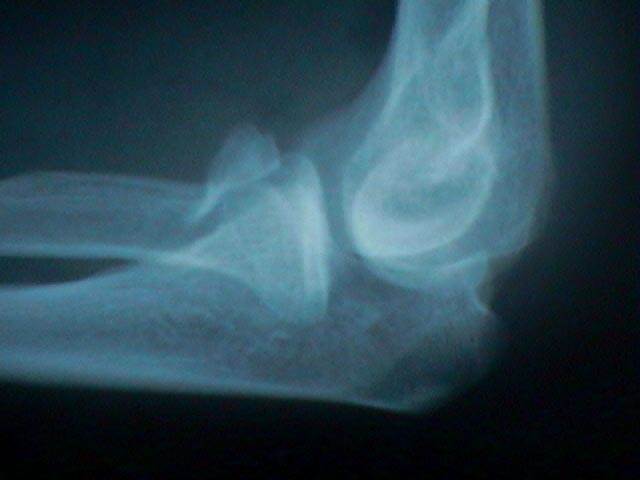
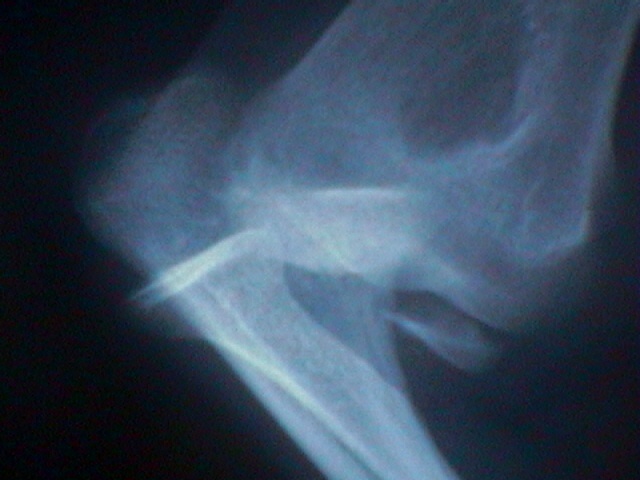
Reconstruction of the coronoid process with a radial head fragment.
Posterior Dislocation of the Elbow with Fractures of the Radial Head and Coronoid.
Medial oblique compression fracture of the coronoid process of the ulna.
Transverse Coronoid Fracture: When Does It Have to Be Fixed?
Terrible Triad Injuries of the Elbow: Does the Coronoid Always Need to Be Fixed?