

- See: Arthroscopic Acromioplasty
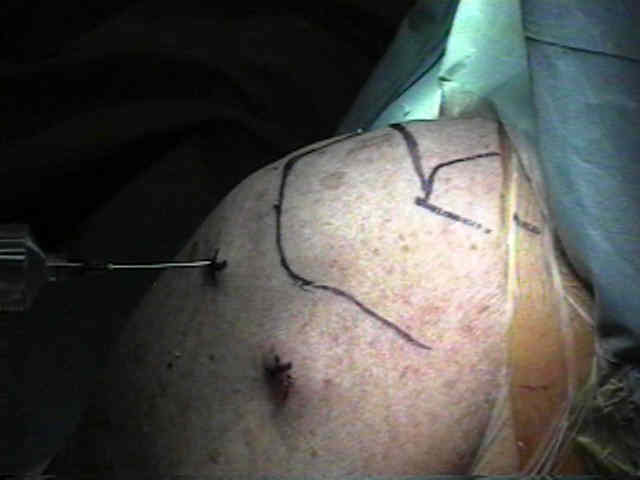
- Lateral portal:
- used for visualization of, or for insertion of instruments into, subacromial space, (usually for arthroscopic acromioplasty or for calcific tendinitis); calcific tendinitis);
- the key to lateral portal placement is that it must allow triangulation over the entire undersurface of the anterior acromion;
- if the portal is placed too posteriorly in a large muscular patient, it will be difficult for instruments to "turn the corner" inorder to reach the anterior acromion;
- place it laterally, in line with the mid-clavicle, and 2-3 cm lateral to its lateral edge; 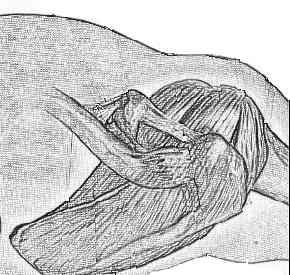
- alternatively insert it at a point that bisects the lateral acromion into anterior and posterior halves;
- when passing instruments thru the lateral portal into the subacromial space, it is often helpful to direct the instruments directly medial before triangulating toward the AC joint;
- it is also helpful to apply distraction to the arm, inorder to avoid rotator cuff injury;
- hazards:
- care should be taken, during placement of this portal, to avoid injury to axillary nerve, which enters deep surface of deltoid approx 5 cm lateral to the acromion;
- it must be noted that smaller branches of the axillary nerve may enter deltoid as close as one centimeter lateral to acromion


Arthroscopy of the shoulder: technique and normal anatomy.
