

- Discussion:
- adolescent bunion is present if IM angle > 10 deg & HV angle > 20 deg;
- moderate deformity: HV of 25 - 40 deg,
- severe deformity: HV of more than 40 deg;
- in children, the finding of short thumbs and juvenile bunions may suggest fibrodysplasia ossificans:
- Pathologic Findings:
- basis for juvenile hallux valgus is believed to be metatarsus primus varus;
- metatarsus primus varus & hallux valgus is most common combination of foot deformities encountered in adolescent;
- oblique 1st metatarsal - medial cuneiform articulation:
- another possible cause is increase lateral deviation of the distal articular surface of the MTP joint;
- obliquity of this joint may affect degree of metatarsus primus varus
- a flat joint will have minimal mobility where as a curved joint will have increased mobility;
- presence of long 1st metatarsal is also associated w/ juvenile bunion;
- approximately 50% of patients will have flexible flat feet, and many will have generalized ligamentous laxity;
- spasm/contracture of the abductor hallucis (which can occur in cerebral palsy);
- references:
- The pathophysiology of the juvenile bunion.
- Radiographs: 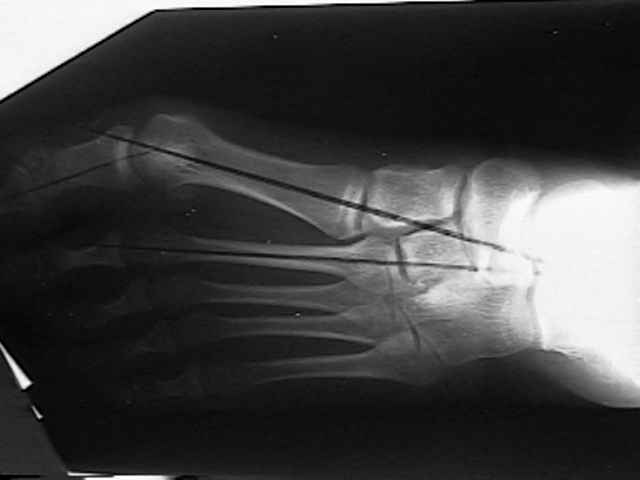
- Non Operative Treatment:
- shoe modification can be extremely beneficial;
- Operative Treatment:
- surgical indications: severe deformity which is accompanied by pain;
- any proposed operation should address the metatarsus primus varus deformity (if it is present);
- w/ excessive lateral deviation of the distal metatarsal articular surface, consider distal metatarsal osteotomy (such as a Chevron);
- hypermobile first ray:
- consider Lapidus procedure:
- shortening of the metatarsal will occur if a large biplanar wedge is resected from the joint;
- therefore, minimal cartilage resection is optimal technique;
- the incidence of pseudoarthrosis is approximately 15%;
- long first metatarsal:
- is associated w/ high rate of recurrence;
- avoid opening wedge osteotomy;
- Complications:
- bunion recurrence in > 60%;
- due to the high recurrance rate, most surgeons will attempt to delay surgery until after skeletal maturity
Preliminary Radiographic Outcomes of Surgical Correction in Juvenile Hallux Valgus: Single Proximal, Single Distal Versus Double Osteotomies
Roger A. Mann Award. Juvenile hallux valgus: etiology and treatment.
Bunion surgery in adolescents: results of surgical treatment.
Adolescent bunions treated by the modified lapidus procedure.
Bunions and Deformities of the Toes in Children and Adolescents.
Treatment of hallux valgus in adolescents by the chevron osteotomy.
Adolescent bunion treated with double osteotomy and longitudinal pin fixation of the first ray.
Early results of the modified Peterson bunion procedure for adolescent hallux valgus.