

(see also: acetabular component)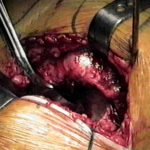
Discussion
- it is essential to have optimal acetabular exposure;
- once acetabular exposure is achieved, then note native acetabular anteversion;
Exposure
- for hips w/ severe osteoarthritis (or w/ heavily scarred hips) it may be necessary to fully release the quadratus femoris, and a portion of the gluteal sling;
- because the majority of the maximus inserts into the IT band, there is little consequence of releasing the gluteal sling;
- amount of gluteus tendon released is dependent upon how easy it is to retract proximal femur anteriorly;
protect the sciatic nerve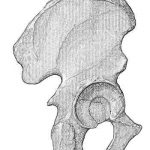
- note that hip flexion and knee extension will place the sciatic nerve under tension, and will risk a traction palsy with posterior retraction;
- hence keep the hip in only slight flexion, and make sure the knee is flexed 90 deg throughout;
Capsule
- see: anterior capsule:
- it is important to leave the superior half of the anterior capsule intact, inorder to avoid anterior instability;
- insert a bone hook around the greater trochanter and retract it anteriorly and laterally, which puts the anterior capsule on stretch;
- use heavy Mayo scissors to incise the inferior half of the capsule off of its attachment to the femur;
- alternatively, use large Kelly clamp to "puncture" and "spread" through the anterior capsule, right off of the anterior edge of the acetabulum;
- only incise enough capsule to allow sufficient anterior translation of the proximal femur so that the acetabulum is exposed;
Retractors
anterior retractor
- place acetabular retractor underneath the "elevated" anterior capsule (and underneath the psoas major tendon, and on top of the pelvic brim to pull stump of neck anteriorly;
- more proximal placement of the retractor may help avoid injury to the iliac artery (due to protection of the psoas muscle);
- care must be taken at this stage to avoid vascular injuries;
- references:
postero-inferior rectration
- a "sciatic nerve retractor" or a sharp Homan retractor is placed just inferior to the posterior 1/3 of the transverse acetabular ligament;
- hence the retractor comes to rest at the posterior ischial surface and superior to the obturator externus groove;
- in some cases, a second retractor needs to be placed directly inferior to the transverse acetabular ligament;
- retractors may be placed beneath the Charnley retractor and secured w/ a clamp, which then allows the assistant to handle anterior retractor;
- if retractor is placed too anteriorly, the retractor may injure the obturator artery;
- if retractor is placed to posteriorly, the retractor may injure the sciatic nerve;
superior rectraction
- glutei medius and minimus are distracted anteriorly;
- they may be restrained by inserting steinmann pin into ilium, 2 cm superior to superior margin of the acetabular labrum;
Labrum and Transverse Acetabular Ligament
- expose bony margins of the rim of acetabulum around it entire circumference to facilitate proper placement of acetabular reaming;
- anterior osteophytes are removed with a rongeur;
- superior osteophytes dont require removal because they rarely cause impingement & can augment acetabular coverage of cup;
- excise the acetabular labrum circumferentially;
- draw soft tissues into acetabulum and divide them immediately adjacent to acetabular rim (keep knife blade within acetabulum);
transverse acetabular ligament
- some surgeon will use the perpendicular from the ligament to help align optimal cup anteversion;
- often hypertrophied or calcified & requires at least partial removal (generally the inner half is release;
- branches of obturator artery may bleed in this area
- if transverse acetabular lig needs transection, then release it in posterior half, so to avoid bleeding from obturator artery;
- dividing the ligament will permit reaming to start inferiorly, which avoids the tendency of the reamer to migrate superiorly;
- references:
- The Transverse Acetabular Ligament: Optimizing Version
- The transverse acetabular ligament: an aid to orientation of the acetabular component during primary total hip replacement: a preliminary study of 1000 cases investigating postoperative stability.
- The role of the transverse acetabular ligament for acetabular component orientation in total hip replacement: an analysis of acetabular component position and range of movement using navigation software.
- Acetabular component positioning using the transverse acetabular ligament: can you find it and does it help?