

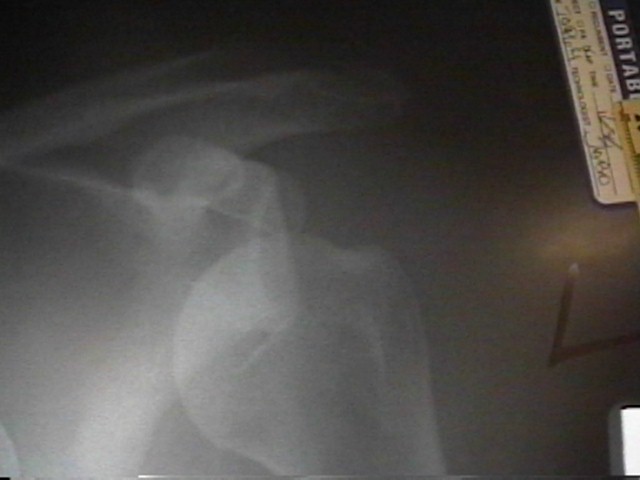
- Associated Injuries:
- Bankart lesion
- up to 90% of first time dislocators will have this lesion;
- fracture dislocation:
- fracture of humeral head, neck, or greater tuberosity;
- associated greater tuberosity frx may actually have less frequent recurrent instability than dislocations that occur w/o frx;
- compression or avulsion of anterior glenoid (see west point view);
- approximately 30% of first time dislocators will have anterior glenoid osteochondral lesion;
- Hill Sachs lesion:
- up to 2/3 of first time dislocators will show evidence of this lesion;
- SLAP lesions
- occur in 5-7% of first time dislocations;
- rotator cuff tear:
- occurs more often in older patients;
- references:
Treatment of primary anterior shoulder dislocation in patients older than 40 years of age. Conservative versus operative.
Anterior dislocation of the shoulder in the older patient.
Anterior dislocation of the shoulder and rotator cuff rupture.
Concurrent rupture of the rotator cuff and anterior dislocation of the shoulder in the older patient.
- neurologic injuries:
- references:
- Nerve lesions associated with shoulder dislocation; an electrodiagnostic study of 11 cases.
- Brachial plexus lesions associated with dislocated shoulders.
- Recovery of brachial plexus injury after shoulder dislocation.
The terrible triad: anterior dislocation of the shoulder associated with rupture of the rotator cuff and injury to the brachial plexus.