

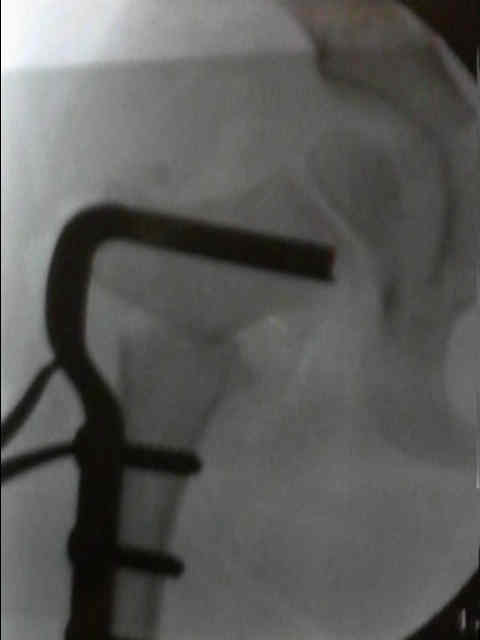
- Discussion:
- performed to correct either anteversion / valgus deformity of femoral neck in patients w/ dysplasia that reduces w/ abduction and medial rotation;
- if hip is not reducible, then open reduction is performed prior to osteotomy;
- the procedure is most useful when the acetabular dyspasia is not severe, however, significant correction of acetabular dysplasia is expected in children less than 4-5 years of age;
- it appears that benefits of femoral osteotomy decr after 4-8 yrs of age;
- its beneficial effects on the acetabular index occur in children less than age 4 years;
- in chidren older than 4 years of age, consider concomitant pelvic osteotomy in order to correct a high acetabular index;
- w/ large osteophyte on the medial aspect of the femoral head:
- use radiographs w/ leg in adduction to determine whether a valgus osteotomy of the proximal femur will position more normal cartilage adjacent to acetabulum;
- osteotomy should leave neck shaft angle less than 100 to 115 deg;
- the main effect that VDRO (varus derotational osteotomy) should have on the acetabular index should be seen w/ in the first 1 1/2 years following the procedure;
- Pre-Requities for Osteotomy:
- hip should be reducible on radiographs when placed in abduction, internal rotation, and in flexion;
- a deficient lateral acetabulum along w/ a deficient lateral acetabular labrum (as judged by arthrogram), may indicate the need for concomitant pelvic osteotomy;
- Complications:
- in adolescents, more than 15 deg of correction will cause leg length discrepancy
Varus derotation osteotomy in the treatment of persistent dysplasia in congenital dislocation of the hip.
Derotation osteotomy in the management of congenital dislocation of the hip.