

- See:
- Herniated Disc in the Child:
- Intervertebral Discs:
- Anatomy:
- disc herniation may vary in severity from disc protrussion to disc extrusion, to finally disc sequestration;
- disc containment:
- w/ a contained disc herniation, the disc material herniated through the inner annulus but not the outer annulus;
- the material is therefore contained, but still can distort the path of the nerve;
- w/ a non contained herniation, the disc material penetrates both the inner and out layers of the annulus;
- the material may reside beneath the posterior longitudinal ligament or may penetrate through it, or can be sequestered as a free fragment;
- posterolateral disc herniation:
- protrusion is usually posterolateral into vertebral canal, where it may compress the roots of a spinal nerve;
- w/ posterolateral herniation, disc will not affect nerve corresponding in number to that intervertebral discs (that nerve emerges above disc);
- note that each nerve emerges thru upper part of foramen and lies against body of vertebra above;
- protruded disc usually compresses next lower nerve as that nerve crosses level of disc in its path to its foramen;
- hence, protrusion of fifth lumbar disc usually affects S1 instead of L5;
- in this case, an L4-L5 disc herniation will protrude on the L5 nerve root;
- central (posterior) herniation:
- in the lower lumbar segments, central herniation may result in S1 radiculopathy
- less frequently, a protruded disc above second lumbar vertebra may compress spinal cord itself or or may result in cauda equina syndrome;
- far lateral disc herniation:
- may compress the nerve root above the level of the herniation (hence a L4-L5 far lateral herniation may result in a L4 radiculopathy);
- occurs in 6-10% of all lumbar disc herniations;
- L4 nerve root is most often involved;
- patient typically have intense radicular pain (sciatic 25% and femoral 75% of the time);
- when pain is femoral, sleep in the prone position is especially painful;
- localized steroid injection:
- in the study by Weiner and Fraser (JBJS 1997), sustained relief of symptoms occured in 27 out of 30 patients;
- surgical approach may consist of a muscle splitting intertransverse approach, which gives exposure of to spinal nerve and dorsal root ganglion;
- references:
- Foraminal and extraforaminal lumbar disk herniations.
- Far lateral lumbar disc herniation. The key to the intertransverse approach.
- The paraspinal sacrospinatus splitting approach to the lumbar spine.
- Foraminal injection for lateral lumbar disc herniation.
- Disc Pressure / Failure:
- intradiscal pressure is higher when sitting than when standing;
- sitting-leaning forward > sitting > standing > lying on side > supine;
- rotation combined w/ flexion are the worst positions for disc injury;
- it is elevated by bending forward, bending to side, lifting, coughing, sneezing, and straining;
- flexion, extension, and lateral bending all produce small displacements of the nucleus;
- asymmetric & cyclic loading combined w/ lateral bend, compression, and flexion are risk factors for disk herniation;
- Clinical Presentation and Diff Dx:
- discogenic pain:
- w/ radiculopathy, there should be a predominance of leg pain over back pain;
- Exam: (neurological exam and exam of the lumbar spine)
- straight leg raise: used to diagnose L5 and S1 radiculopathy;
- femoral stretch test: used to diagnose L4 radiculopathy;
- this test is performed by raising the leg while the patient is prone;
- wt relief flexion test:
- MRI of Disc Herniation:
- Natural History:
- prognosis of disc herniation is generally good regardless of treatment;
- patients operated on for proven disc herniations improved more rapidly than patients treated non operatively;
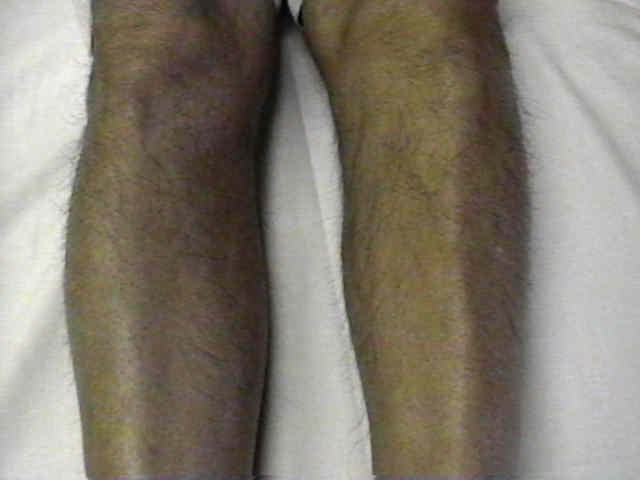
- within 4-5 years both operative and non operative treatment groups will generally have comprable
neurologic recovery;
- hence long term results are similar w/ or w/o surgery;
- of all patients who sustain acute sciatica, less than 25% will require surgery;
- despite the generally good prognosis, some patients will not recover such as this patient who had chronic
anterior compartment atrophy and a mild foot drop (he was never treated operatively);
- Invasive Managment:
- epidural steroid injection:
- best effects are found in patients whose leg pain (or radicular symptoms) are worse than back pain;
- at least one epidural injection should probably be tried in most patients with a disc herniation since it is often the inflammation
generated from the disc which causes symptoms rather than direct mechanical compression from disc material;
- selective nerve root injection:
- contrast radiculogram is made to ensure that the correct nerve root was being injected;
- patient was placed prone on a fluoro table;
- C arm is adjusted to allow visualization of the target area in posteroanterior, oblique, and lateral positions;
- entry site should allow visualization of the lateral edge of the pars interarticularis, transverse process, and articular facets on the side to be
injected was selected within a few centimeters lateral to the spine;
- disc space at that level is typically profiled;
- use 22-gauge spinal needle with a short bevel and consider bending the tip for easier entry;
- injection is delivered into the anterosuperior portion of the selected lumbar foramen;
- contrast solution is injected under fluoroscopic control inorder to verify proper needle placement and to verify absence of intravascular injection;
- inject one cc of 0.25 % bupivacaine along with one cc of betamethasone (six milligrams per cc);
- references:
- The use of epidural steroids in the treatment of lumbar radicular pain. A prospective, randomized, double-blind study.
- The Effect of Nerve-Root Injections on the Need for Operative Treatment of Lumbar Radicular Pain. A Prospective, Randomized, Controlled, Double-Blind Study
- percutaneous discectomy
- diskectomy
- post operative management:
- Complications:
- Post Operative Diskitis:
Lumbar disc excision in children and adolescents.
The form and structure of the extruded disc.
Biochemical changes associated with the symptomatic human intervertebral disk.
Lumbar disc herniation: Controlled prospective study with 10 years of observation.
Histological changes in aging lumbar intervertebral discs. Their role in protrusions and prolapses.
Histological development of intervertebral disc herniation.
Lower-extremity sensibility testing in patients with herniated lumbar intervertebral discs.
Surgery for lumbar disc herniation: What are the choices? Murrey DB, Hanley EN. J Musculoskel Med. Jan. 1999:39.