

- See:
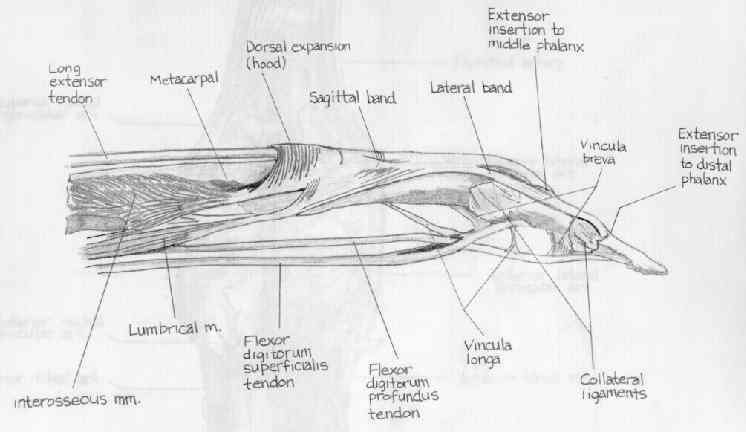
- Phalangeal Injuries
- Rheumatoid Boutonniere
- Thumb Boutonniere Injuries
- Discussion:
- an aquired lesion of the extensor mechanism, in which the PIP joint develops a flexion deformity and the the DIP joint develops an extension deformity;
- w/ time, these deformities become fixed, as the surrounding ligaments and volar plate become contracted;
- pathology and mechanism of injury:
- differential diagnosis:
- collateral ligament injury (w/ acute injuries)
- volar PIP dislocation
- pseudo-boutonniere:
- flexion contracture of PIP joint w/o hyperextension of DIP joint;
- may result from forced hyperextension of flexed PIP joint (such as rope being jerked from hand) resulting in injury and scarring of PIP volar plate and ligaments;
- may result from chronic extensor tendon subluxation over the MP joints;
- Clinical Presentation and Exam
- Radiographs:
- look for dorsal chip frx from base of middle phalanx which represents an avulsion of bone by the central slip of extensor tendon;
- Non Operative Treatment and Splinting
- Surgical Indications:
- failure of non operative treatment;
- at least 3 months of splinting should be tried prior to surgery;
- full passive ROM of the PIP and DIP joint needs to be established, prior to surgical correction;
- boutonniere injury with avulsion fracture w/ free frag overlying PIP
- long standing Boutonniere injury in a young person;
- volar PIP dislocation central slip should be repaired;
- boutonniere w/ Fracture:
- a large displaced avulsion fracture requires open reduction and internal fixation;
- as a part of fracture fixation, it is also important to repair triangluar ligament inorder to correct volar subluxation of lateral bands;
- excessive reefing of these bands will limit subsequent flexion of joint;
- open boutonniere injury: (laceration)
- central slip is repaired w/ non absorbable suture along w/ splitting of PIP for 4-6 weeks (DIP is left free);
- Soft Tissue Reconstructive Procedures
- Chronic Boutonniere (more than 2 months after injury);
Chronic boutonniere deformity--an anatomic reconstruction.
The management of chronic posttraumatic boutonniere deformity.
Surgical repair of the boutonniere deformity of the fingers.
Correction of the severe nonrheumatoid chronic boutonniere deformity with a modified Matev procedure.
Biomechanical evaluation of chronic boutonniere reconstructions.
Tendon reconstruction for postburn boutonniere deformity.
The Problem of Boutonniere Deformity.
The Proximal Interphalangeal Joint. Anatomy and Causes of Stiffness in the Fingers.