

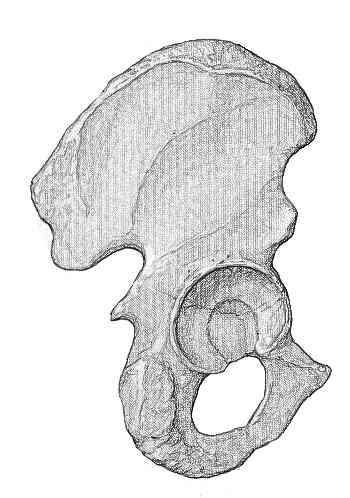
- See: Total Hip Replacement Menu:
- acetabular component revision:
- operative considerations for hip dyplasia
- protrusio
- reaming technique:
- component insertion:
- component position:
- screw placement:
- bone grafting for acetabular defects:
- acetabular component revision:
- Discussion:
- design of acetabular components: (see surface coating)
- acetabular component loosening:
- osteolysis
- normal bone ingrowth:
- generally for bone ingrowth to occur, component must lie within 40-50 micrometers of the acetabulum, and have enough mechanical stability (less than 40 to
50 micrometers) inorder for host bone ingrowht to occur;
- Bloebaum RD, et al (1997), bone ingrowth into component averages only 12%, even though 84% of cup surface was in contact w/ periprosthetic bone;
- bone ingrowth was found to be uniform in all zones, most likely due to the uniform distribution of stresses from the metal backing;
- references:
- Postmortem analysis of consecutively retrieved asymmetric porous-coated tibial components.
- Histological and radiographic assessment of well functioning porous-coated acetabular components. A human postmortem retrieval study.
- Incomplete seating of press-fit porous-coated acetabular components: the fate of zone 2 lucencies.
- acetabular offset and latealized acetabular liner:
- this may induce additional torque and shear at the metal osseous surface leading to loosening;
- references:
- Offset acetabular components introduce torsion on the implant and may increase the risk of fixation failure.
- Histological and radiographic assessment of well functioning porous-coated acetabular components. A human postmortem retrieval study.
- Acetabular Revision With a 7-mm Lateral Offset Component Inserted Without Cement in Patients Who Have Acetabular Deficiency.
- Midterm Radiographic Comparison of Cementless Acetabular Shells Containing Lateralized and Nonlateralized Liners.
- types of press fit surfaces:
- acetabular liner / femoral head size: (vs metal on metal)
- as pointed out by Jasty M, et al (1997), the thickness of the polyethylene component is especially important in metal backed press fit components;
- w/ smaller acetabular components consider using a 26 mm rather than a 28 mm head in order to better prevent osteolysis;
- as noted by Cobb, et al (1997), there was no indication of early loosening of elevated rim liners at 5 years as compared to neutral liners;
- optimally orthopaedists should be able to choose specific liners based on long term data of liner survival;
- Hylamer liner from DePuy is associated w/ early signs of wear and osteolytic changes.
- references:
- Wear of polyethylene acetabular components in total hip arthroplasty. An analysis of one hundred and twenty-eight components retrieved at autopsy or revision operations.
- Effect of femoral head size on wear of the polyethylene acetabular component.
- Size of the femoral head and acetabular revision in total hip-replacement arthroplasty.
- Effect of the elevated-rim acetabular liner on loosening after total hip arthroplasty.
- Elevated-rim acetabular components. Effect on range of motion and stability in total hip arthroplasty.
- Complications of total hip arthroplasty associated with the use of an acetabular component with a Hylamer liner.
- Impingement and loosening of the long posterior wall acetabular component.
- Effect of femoral head size and abductors on dislocation after revision THA.
- Range of motion and stability in total hip arthroplasty with 28-, 32-, 38-, and 44-mm femoral head sizes
- outcomes:
- as noted by Bohm and Bosche (1998), the 11 year survivorship of press fit Harris Galante components was 97.7%;
- there was only one case of osteolysis in this study;
- mean postoperative inclination was 42 deg;
- holes in the acetabular component did not correlate with pelvic osteolysis;
- references:
- Survival analysis of the Harris-Galante I acetabular cup.
- Acetabular augmentation in primary and revision total hip arthroplasty with cementless prostheses.
- Comparison of porous-threaded and smooth-threaded acetabular components of identical design. Two- to four-year results.
- Comparison of in vivo cementless acetabular fixation.
- A preliminary report of the use of a cementless acetabular component with a cemented femoral component.
- Metal-backed acetabular cups in total hip arthroplasty.
- Further follow-up on socket fixation using a metal-backed acetabular component for total hip replacement. A minimum ten-year follow-up study.
- Range of motion caused by design of the total hip prosthesis.
- Hip Replacement with a Threaded Acetabular Cup. A Follow-up Study.
- Total hip replacement with insertion of an acetabular component without cement and a femoral component with cement. Four to seven-year results.
- Early failure of acetabular components inserted without cement after previous pelvic irradiation.
- Cementless press-fit cup. Principles, experimental data, and three-year follow-up study.
- Development and first experience with an uncemented press-fit cup.
- Postmortem Analysis of Bone Ingrowth into Porous Coated Acetabular Components.
- Histological and radiographic assessment of well functioning porous-coated acetabular components. A human postmortem retrieval study.
- Fixation of acetabular cups without cement in total hip arthroplasty. A comparison of three different implant surfaces at a minimum duration of follow-up of five years.
- Fixation of the acetabular component: the case for cementless bone ingrowth modular sockets.
- Radiographic Evaluation:
- preop acetabular x-ray evaluation:
- protrusio:
- reference:
- Radiographic measurements in protrusio acetabuli.
- bone grafting for acetabular defects:
- references:
- The acetabular teardrop and its relevance to acetabular migration.
- Bone grafting in total hip replacement for acetabular protrusion.
- postop radiographic evaluation:
- acetabular component loosening:
- component position;
- polyethylene wear:
- osteolysis:
- references:
- Severe Osteolysis of the Pelvis in Association with Acetabular Replacement without Cement.
- The relationship between design, position, and articular wear of acetabular components inserted without cement and development of pelvic osteolysis.
- Are cementless acetabular components the cause of excess wear and osteolysis in total hip arthroplasty?
- Complications:
- acetabular fracture:
- acetabuli should not be underreamed by more than 1 mm, especially in osteoporotic bone;
- underreaming of the acetabulum by two milimeters may result in frx in 20-25% of cases;
- when intra-operative fracture is recognized intra-operatively, then augment the component with as many acetabular screws as possible;
- acetabular component loosening:
- dislocation
- screw insertion injuries;
- osteolysis
- protrusio:
- references:
- Periprosthetic fractures of the acetabulum during and following total hip arthroplasty.
- Fracture of the acetabulum during insertion of an oversized hemispherical component.
- The elevated-rim acetabular liner in total hip arthroplasty: relationship to postoperative dislocation.
Secondary total hip replacement after fractures of the femoral neck.
Current status of acetabular fixation in primary total hip arthroplasty.