

- Surgical Indications:
- MCP contracture greater than 30 deg;
- PIP joint: any significant contracture (more than 20);
- precautions:
- take care to note any sluggish filling of the digital vessels (Allen's test);
- women may have higher incidence of postoperative stiffness & RSD;
- because women have flare reaction if they undergo a carpal tunnel release when the palmar fascia is exised, it may be prudent to stage these procedures;
- patients should clearly understand that results of surgery are variable and recurrence is not uncommon;
- MP joints can more predictably be corrected than PIP joints;
- consider use of a digit wigit to gain PIP extension prior to formal subtotal fasciectomy;
- Choice of Incisions:
- Surgical Options:
- total palmar fasciectomy:
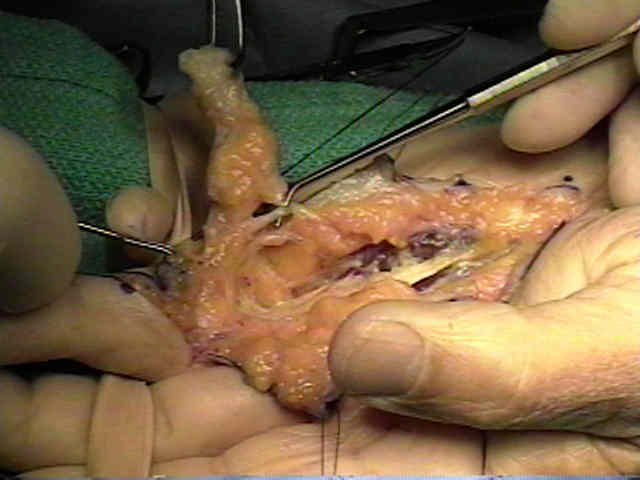
- mentioned to be condemned because of the frequent profound postoperative morbidity;
- subtotal palmar fascietomy (preferred technique)
- local fasciectomy:
- for debilitaed patients, MPJ contracture, & will improve the PIP joint;
- excise a short segment of disease tissue;
- limited subQ palmar fasciotomy is a temporizing partial solution that is applicable to patients who are unsuitable for anesthesia;
- recurrence may occur in up to 66% of patients;
- open palm technique from McCash (1964)
- The open palm technique in Dupuytren's contracture
- dermofasciectomy
- (Hueston) may be required for recurrent cases;
- involves excision of overlying skin as well as fascia;
- attempt to save skin over the flexor tendons;
- requires FTSG for coverage;
- reference:
- Dermofascietomy for Dupuytren's disease.
- full thickness skin grafting:
- indicated for patients w/ risk factors for recurrence (such as, previous surgerical release, bilateral or ectopic disease, ect);
- also indicated for patients w/ dippled contracted skin, which may be excised (rather than incised in the usual manner);
- requires that tourniquet be deflated and hemostasis be achieved;
- consider temporary application of thrombin to defect during graft harvest;
- pt must understand that hand must be kept elevated post op;
- sutures and dressings are removed at 3 weeks weeks;
- ref: Does a 'firebreak' full-thickness skin graft prevent recurrence after surgery for Dupuytren's contracture?: a prospective, randomised trial.
- fasciotomy
- original surgery preanesthesia and preantibiotics,;
- simple subQ fasciotomy should never be attempted in digits, where the neurovascular elements may be easily injured;
- subcutaneous fasciotomy is no longer needed;
- refs:
- Treatment of Dupuytren's contracture. Long-term results after fasciotomy and fascial excision.
- The long term results of closed palmar fasciotomy in the management of Dupuytren's contracture.
- Dupuytren's contracture - the role of fasciotomy.
- misc:
- note that it is easier to prevent digital spasm than to manage it;
- consider irrigating vessels prophylactically during the case w/ lidocain or papaverine;
- Post Op:
- carefully fashioned bulky hand dressing is manditory;
- the bulky hand dressing needs to have enough gauze placed in the palm so that the AP diameter exceeds the width of the metacarpals;
- this allows for more efficient compression against the wound;
- pain in the post operative period must alert the surgeon of a possible post operative hematoma;
- some advocate several days of immobilization of hand w/ slight wrist extension along w/ MP flexion and slight PIP flexion before early mobilization is started;
- MP and PIP extension may place extensive tension on the wound, which can lead to necrosis;
- it is essential to avoid postoperative stiffness;
- after several days, consider initiation of active ROM and/or extension splinting at night;
- Complications:
- recurrent hematoma
- skin loss
- infection (treated with early debridment) - use of K wires is thought to promote infection;
- joint stiffness
- RSD:
- look for swelling, pain, stiffness, and discoloration;
- causes:
- neuroma formation
- digital nerve scarring at the incision site;
- excessive wound tension;
- secondary carpal tunnel syndrome (from edema)
- secondary trigger finger;
- recurrent disease:
- risk factors:
- Northern European ancestory;
- ectopic disease and/or bilateral disease;
- multiple digit involvement
Surgical alternatives in Dupuytren's contracture.