

- Technique:
- position: supine;
- ulnar fractures: arm pronated across the chest;
- radial fractures: arm abducted and in neutral rotation;
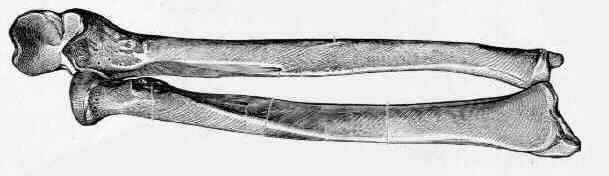
- fractures of both bones of forearm are carried out through separate incisions, w/ 2-2.75 inch skin brige left between two;
- Approach to the Ulna:
- parallel and slightly volar to the subcutaneous crest of the ulna;
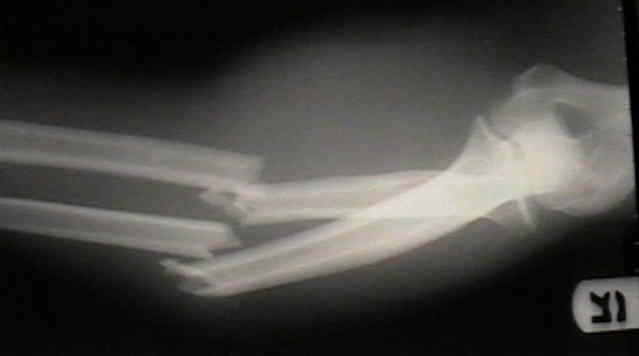
- w/ Henry approach, make the incision more dorsally and with the Thompson approach make the incision more volarly (to maximize the skin bridge);
- note that volarly placed incisions, may cause incisional discomfort when the patient rests the forearm on a table (not the case w/ more dorsal incisions);
- Approach to the Radial Shaft:
- Anterior Approach: (Henry);
- anterior approach is required if compartment syndrome is present;
- some surgeons prefer this approach for proximal 1/3 and distal 1/3 radial frx;
- proximally, the PIN is protected by the supinator, which facilitates future plate removal;
- although this defies placing plate on the tension side (dorsal radius), soft tissue coverage on volar side is better & bone contour is flat, making it easier to apply plate;
- if the anterior approach to the radius is utilized, then the ulnar incision should be made more dorsally;
- Dorsal Approach (Thompson):
- some prefer dorsal approach for fractures of the middle third;
- main disadvantage is potential injury to PIN;
- also danger to nerve if plate is removed through dorsal approach, since scarring makes visualization of nerve is difficult, esp in proximal 1/3;
- note: if the dorsal approach to the radius is utilized, then the ulnar incision should be placed more volarly inorder to maximize the skin bridge
Comparison of Dorsal and Volar Approaches to the Proximal Radius