

- See:
- Sliding Screw Insertion Technique
- Sliding Screw Fixation in Subtroch Frx
- Discussion:
- treatment of unstable intertrochanteric frxs w/ sliding screw device w/o obtaining necessary bony stability, risks hardware failure;
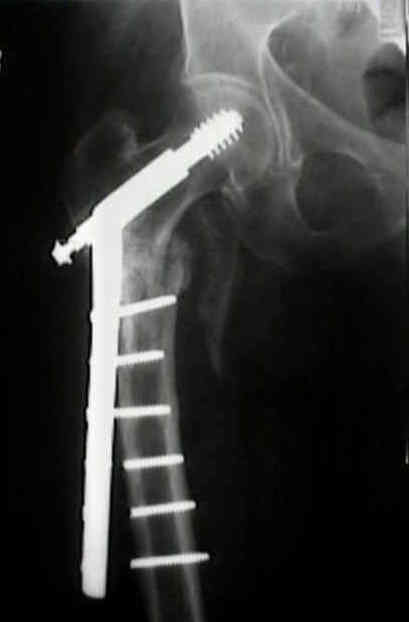
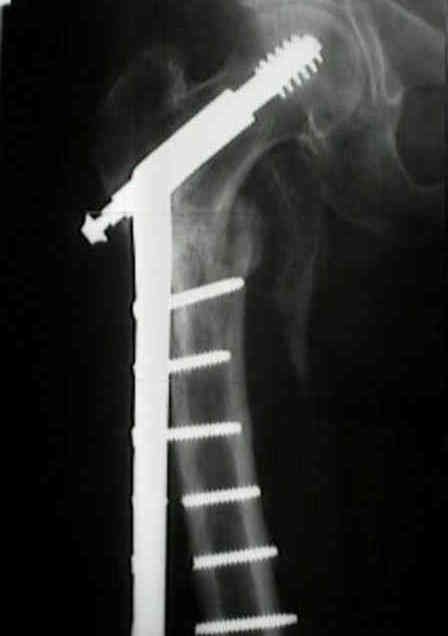
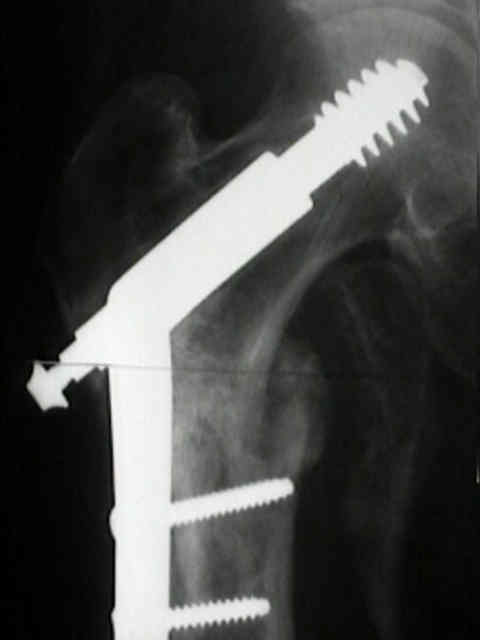
- if device impinges, it will act as a fixed angle nail plate and will result in either cutting out or penetration of the head as the unstable frx settles into a position of bone stability;
- because sliding hip screw allows controlled collapse at frx site, unstable frxs which are anatomically reduced can be expected to impact spontaneously to stable & often medially displaced position;
- as slinding device shortens w/ settling of unstable frx, the lever arm acting on the nail on the nail plate junction shortens w/ settling of the unstable frx, thereby reducing force on the implant;
- unstable frx treated w/ sliding device may undergo shortening and medial displacement, but frx tend to go onto union;


- the following example is self explanatory as to why sliding screws should be used w/ caution in treating subtrochanteric fractures;
- trochanteric stabilization plate:
- the trochanteric stabilization plate is designed to fit onto a DHS (dynamic hip screw) and has an superior extension of the plate which provides lateral support for the trochanter prevents excessive
medial displacement of the shaft fragment;
- in the study by Madsen et al. 1998, there was 6%;
- Dynamic hip screw with trochanteric stabilizing plate in the treatment of unstable proximal femoral fractures: a comparative study with the Gamma nail and compression hip screw.
Integrity of the Lateral Femoral Wall in Intertrochanteric Hip Fractures: an Important Predictor of a Reoperation.