

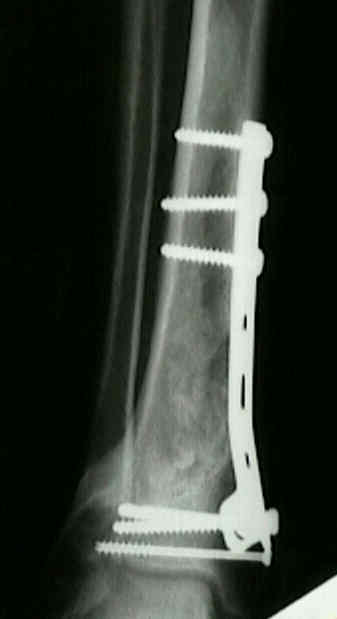
- Discussion:
- see plating of tibia fractures and synthese products
- six cortices should be held proximal to most proximal fracture line, and lag screws should be used when frx lines cross;
- when using medial plate, additional anteroposterior lag screw fixation may be needed to secure posterior lip frx;
- anterior lateral aspect of distal tibia needs special attention;
- this area is often comminutd &, when not secured, may allow valgus tilt of articular surface to occur;
- cautions:
- Definitive plates overlapping provisional external fixator pin sites: is the infection risk increased?
- surgical approach
- lateral approach:
- Lateral approach for fixation of the fractures of the distal tibia. Outcome of 20 patients. Technical note.
- Anterolateral distal tibia locking plate osteosynthesis and their ability to capture OTAC3 pilon fragments
- posterior approach:
- Staged Posterior Tibial Plating for Treatment of Orthopaedic Trauma Association 43C2 and 43C3 Tibial Pilon Fractures.
- fracture blisters
- References:
- Early limited internal fixation of diaphyseal extensions in select pilon fractures: upgrading AO/OTA type C fractures to AO/OTA type B.
- A prospective study evaluating incision placement and wound healing for tibial plafond fractures.
- Trans-syndesmotic fibular plating for fractures of the distal tibia and fibula with medial soft tissue injury: report of 6 cases and description of surgical technique.
- Type C tibial pilon fractures. short- and long-term outcome following operative intervention
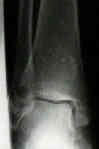
- butress plate: (historical information)
- butress plate may prevent collapse but risks skin slough;
- to ensure anatomical reduction of provisionally fixed tibia, butress plate may be applied either anterior or medially, depending
upon the area of comminution;
- medial buttress plate may be either of T plate or clover leaf;
- T plate or clover leaf plate may be used as a medial butress to prevent possible varus deformity when fracture pattern is more
in saggital plane, allowing the medial to lateral screws to be lagged across the fracture;
- T plate: often the best choice;
- clover leaf:
- is weak & should only be used where comminution is so great that multiple screw holes are required for fixation;
- if comminution is anterior, spoon plate will give better fixation;
- clover leaf plate adapts nicely to medial malleolus, is thinner than 4.5 DCP, & uses smaller 3.5 mm cortical & 4.0 mm
cancellous screws;
- if needed the, the posterior leaf may be cut off for better fit on the medial tibial surface;
- if frx pattern is more in coronal plane, spoon plate is best;
- this plate will fit on anterior crest of the tibia;
- contouring is necessary w/ all of these plates to avoid displacement of anatomic reduction with screw placement;
- cancellous bone grafts to repair defects;
- distal tibial spiral frx w/ intra-articular extensions are best neutralized w/ narrow 4.5 DC plate & lag screws;
- in some cases, small fragment one third tubular plates or small radius T plates are appropriate if there is a concern about
wound closure;
- if small plates are used to hold the articular reduction, then it is important that an external fixator span the ankle joint in
order to hold the fracture out to length and to prevent collapse