

- See: DDH - Main Discussion
- Discussion: 
- 95-98% of DDH cases are possibly reversible;
- 2% of DDH cases may have teratologic dislocation which is generally not reversible;
- less than 2% of infants will have a positive Barlow's test (dislocatable hip);
- 60% will normalize w/ no treatment after 1 month;
- 88% will normalize w/ no treatment after 2 months;
- this comes to about 1-2 patients per 1000 which have a true DDH which will go on to produce the pathological changes of DDH;
* Early Diagnosis and Treatment of Congenital Dislocation of the Hip.
- when radiographic findings are added to clinical findings the number of
good results (w/ no treatment) diminish significantly;
- 22% will normalize w/ no treatment;
- 39% will retain some dysplastic features;
- 13% will be subluxed;
- 26% will remain dislocated;
* Congenital dysplasia of the hip in the Navajo infant.
- concave acetabulum cannot develop without concentric force exerted by the reduced femoral head;
- w/ time, there is progression of pathologic features which include development of intra-articular impediments to reduction develop and muscule groups about
the hip become shortened and contracted;
- an untreated hip dislocation becomes more difficult to reduce causing Ortolani's test to becomes negative;
- normal acetabular development ceases and the potential for the acetabulum to resume normal growth onced reduced is diminished;
- this decrease in remodeling potential can occur after age one year;
- CE angle has limited predictive value for DJD, when patients w/ subluxation are excluded from consideration (subluxation is most important risk factor);
- Natural History in Adults:
- development of false acetabulum


- 76% will have poor result w/ well developed false acetabulum;
- 48% will have poor result w/ moderately developed or absent acetabulum;
- if femoral head does not articulate w/ the acetabulum, degenerative changes will not occur and range of motion will generally be maintained;
- unilateral dislocation:
- flexion-adduction deformity of the affected hip;
- gait disturbance which is quite noticable;
- leg length inequality;
- valgus deformity of the knee which can lead to DJD of lateral compartment;
- scoliosis;
- contra-lateral "normal" hip is often found to have acetabular dysplasia;
- it may not be appropriate to apply standard hip functional studies (such as Harris Hip Score) to DDH patients w/ complete dislocation;
- these studies are geared to the problems of elderly patients rather than the functional considerations of younger patients;
- 48% will have poor result w/ moderately developed or absent acetabulum;
- if femoral head does not articulate w/ the acetabulum, degenerative changes will not occur and range of motion will generally be maintained;
- even if degenerative changes do not develop, patients will often fatigue when they attempt to walk distances more than several hundred meters;
- bilateral dislocation:
- when both hips are dislocated, perineal space is widened, & greater trochanters are more prominent than normal;
- buttocks are broad & flat, & lumbar spine is hyper-lorddotic;
- child with bilateral hip dislocation has a waddling gait;
- back pain may develop due to hyperlordosis;
- objective functional studies are lacking, but it is generally felt that complete bilateral dislocation causes relatively mild functional limitations as compared to the complications associated w/ forced reduction (AVN and DJD);
- subluxation:
- by definition implies not only subluxation but also acetabular dyplasia;
- Shenton's line is broken;
- clear progression of DJD based on age of patient and degree of subluxation;
- prognosis is worse in females;
- early radiographic changes include sclerosis along the wt bearing portion of the acetabulum;
- early clinical findings include groin pain;
- females begin to complain of pain in mid 30s (depending on CE angle);
- degenerative changes usually develop around age 45 yrs;
- often DJD will not appear until 5 yrs or more after onset of symptoms;
- once degenerative changes begin, they can progress quickly;
- males begin to complain of pain in mid 40s-50s;
- radiographic changes may not develop until age 70 yrs;
- acetabular dysplasia:
- by definition subluxation is not present;
- Shenton's line is intact;
- has a better prognosis than subluxation and progression to DJD is less predictable than w/ subluxation;
- can be an incidential radiographic finding;
- prognosis is worse in females;
- often DJD will not appear for 10 yrs or more after onset of symptoms;
- in the report by Mladenov K, et al (2002), the authors that the management
of Management of clinically stable hips with an increased age-related acetabular index (AI) remains controversial;
- 4 patterns of evolution were observed:
- type 1 (25 hips) had rapid progression to normal range in the first 2 years;
- type 2 (19 hips) had slow improvement, with AI values reaching the normal range between 4 and 11 years;
- type 3 (20 hips) had improved hip morphology with persistence of minor deviations from the normal values;
- type 4 (4 hips) showed no improvement.
- reference:
- Natural history of hips with borderline acetabular index and acetabular dysplasia in infants.
- Acetabular Dyplasia in the Adult.
- Case Example: of untreated DDH:
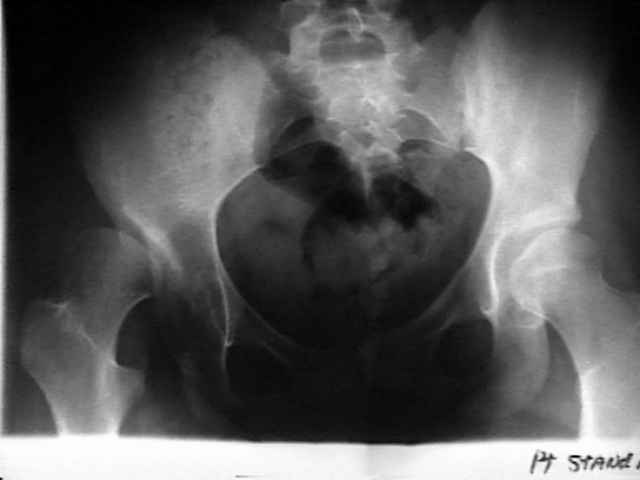

- 14 yr old female w/ untreated DDH who presented w/ progressive hip pain;
(patient's mother declined formal orthopaedic treatment, despite the advice of 3 different orthopaedists)
Congenital dysplasia of the hip in the Navajo infant.
Untreated congenital hip dysplasia in the Navajo.
Congenital Hip Dislocation. Long Range Problems, Residual Signs, and Symptoms After Successful Treatment.
The Natural History of Congenital Dislocation of the Hip: a Critical Review.
Early Diagnosis and Treatment of Congenital Dislocation of the Hip.
Natural history of congenital hip dislocation (CDH) and hip dysplasia.