

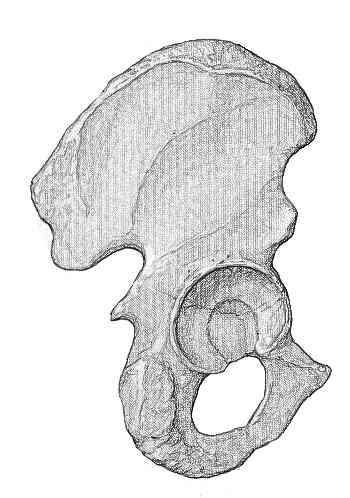
- Discussion:
- classified pelvic ring injuries simply according to site of injury;
- anterior disruption can occur thru either pubic symphysis or pubic rami;
- injury may be through the ilium, the SI joint, or the sacrum;
- it can involve frx-dislocation of SI joint, which commonly involves frx thru most posterior
portion of iliac wing that crosses joint;
- frx line leaves a portion of ilium in its nl position, articulating w/ upper portion of the SI joint;
- more anterior portion of the ilium dislocates from lower SI joint;
- acetabular fracture is another possible site of pelvic ring disruption;
- classification: includes ten fracture types subdivided by 5 simple frx and 5 combined frx patterns;
- 5 simple frx types: account for about 20% of acetabular frx;
- posterior wall;
- posterior wall frxs always involve posterior articular surfaces, often accompanied by a portion of retroacetabular
surface and sometimes the entire surface;
- ilioischial line remains intact;
- posterior column;
- bony strut running from PSIS to inferior pubic ramus, & includes posterior wall;
- involves not only the posterior articular surfaces, but also the ilioischial line;
- anterior wall
- anterior column;
- bony strut running from ASIS to superior pubic ramus, & includes Anterior wall;
- iliopectineal line is involved;
- transverse frx;
- involve both anterior & posterior acetabulum: dividing the innominate bone into superior segment containing
acetabular roof & intact ilium, & inferior segment consisting of single ischiopubic fragment;
- 5 combined frx types:
- discussion:
- account for about 80% of acetabular frx;
- are composed of two or more of the elementary fracture patterns;
- many assoc frx types, esp two-column frx, require more extensive exposures than are achieved by either
ilioinguinal or posterolateral approach alone;
- frx types:
- posterior wall & post column frx
- posterior wall and transverse frx
- t-shaped fracture
- common associated frx type (about 35% of acetabular frx);
- combines a transverse component & vertical component that separates the lower ischiopubic segment into the
anterior and posterior columns.
- anterior and posterior hemitransverse frx,
- anterior column or anterior wall predominating in displacement;
- low and usually minimally displaced posterior hemitransverse component is present;
- both column frx
- all segments of the articular surface are detached from the ilium;
- Radiographs: classfication is based on 3 x-ray views;
- AP view;
- Obturator view;
- Iliac view
- Quadrilateral Plante Fractures:
- The “safe zone” for infrapectineal plate-screw fixation of quadrilateral plate fractures: An anatomical study and retrospective clinical evaluation
A Sobering Message to Acetabular Fracture Surgeons: Commentary on an article by Diederik O. Verbeek, MD, et al.: "Predictors for Long-Term Hip Survivorship Following Acetabular Fracture Surgery. Importance of Gap Compared with Step Displacement".
Predictors for Long-Term Hip Survivorship Following Acetabular Fracture Surgery: Importance of Gap Compared with Step Displacement.