

- Discussion:
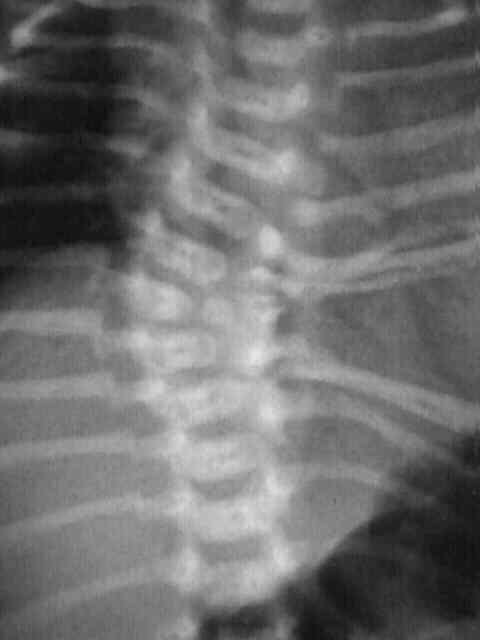
- open disk usually has an active growth plate;
- double hemivertebrae:
- those that are ipsilateral and adjacent to one another are more likely toproduce a progressive scoliosis and require
arthrodesis;
- two or more hemivertebrae on the same side are likely to result in scoliosis that progresses as the child grows.
- when 2 hemivertebrae exist on opposite sides, scoliosis may be slight.
- fully segmented hemivertebrae:
- will progress more than semisegmented hemivertebrae;;
- semisegmented hemivertebrae:
- these will progress more than nonsegmented hemivertebrae;
- nonsegmented hemivertebrae: (block hemivertebrae)
- these should not progress;
- Hemi-epiphysiodesis:
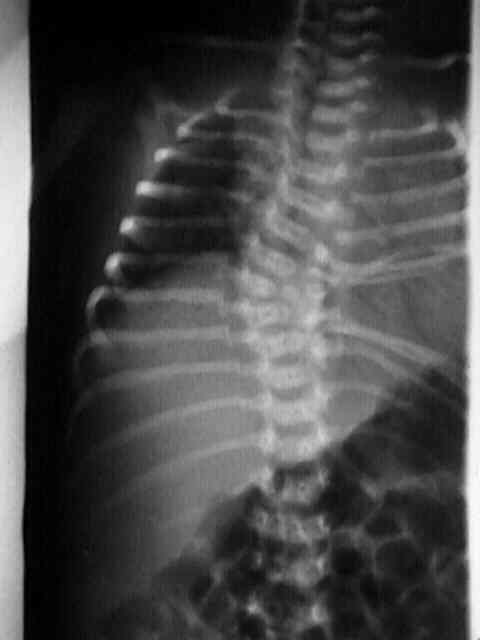
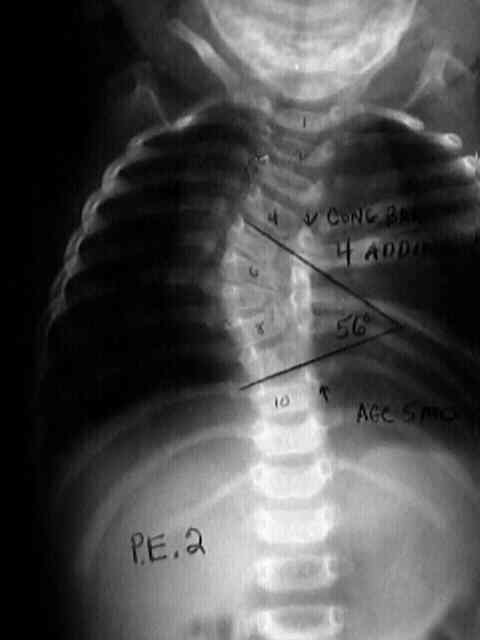
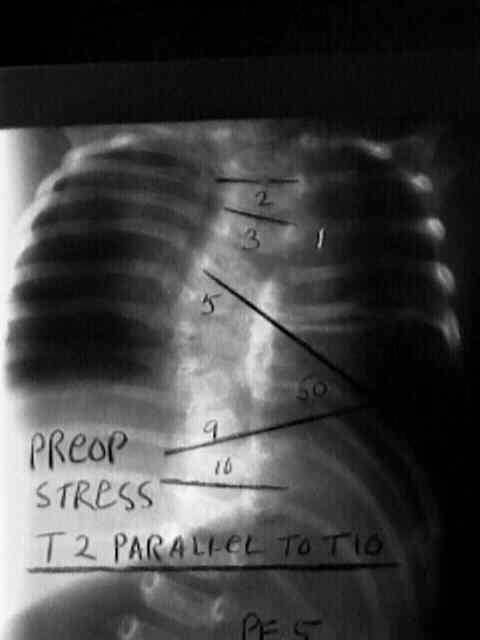
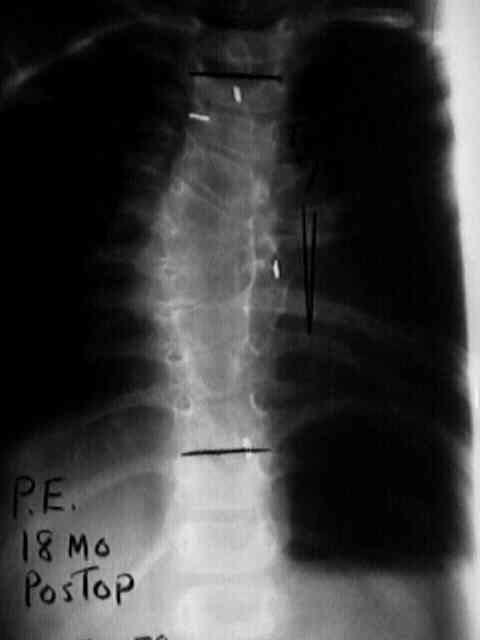
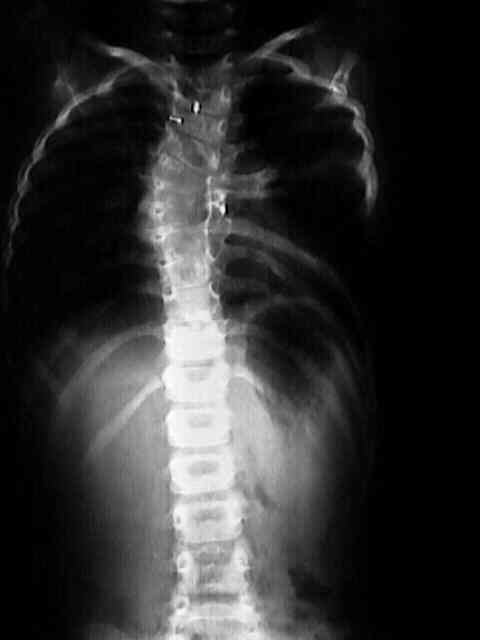
- Hemivertebral Excision:
- can be performed over wide age range (infant to adolescent), and is indicated w/ curve progression and/or progression of pain;
- requires preop MRI to rule out dyraphic deformities as well as renal w/u;
- may include anterior and posterior hemiepiphyseodesis with or w/o fusion of of the convex portion of the curve;
- anterior & posterior lumbar (L-1 to L-4) hemivertebral excision is considered if sig cosmetic deformity or decompensation of trunk is
present;
- hemivertebral excision is procedure of choice for L-4 L-5 deformity (involving lumbrosacral junction) w/ severe decompensation and
tilting of the spine;
- can also be performed in mid thoracic spine, however, the complication rate is higher;
- this procedure may be associated w/ significant blood loss as well as neurologic injury (22%);
- in the report by Deviren V, et al (2001), the authors evaluated ten consecutive patients who underwent excision of thoracic or
thoracolumbar hemivertebrae for either angular deformity in the coronal plane, or both coronal and sagittal deformity;
- vertebral excision was carried out anteriorly alone in two patients;
- 7 patients had undergone previous posterior spinal fusion;
- mean age at surgery was 13.4 years (6 to 19) and follow-up was 78.5 months (20 to 180);
- mean preoperative coronal curve was 78.2° (30 to 115) and was corrected to 33.9°(7 to 58) postoperatively, a mean correction
of 59%;
- preoperative coronal decompensation of 35 mm was improved to 11 mm postoperatively;
- 7 patients had significant coronal decompensation preoperatively, which was corrected to a physiological range postoperatively;
- there were no major complications and no neurological damage.
- ref: Excision of hemivertebrae in the management of congenital scoliosis involving the thoracic and thoracolumbar spine.
- in the report by Klemme WR, et al, the authors report the results of a consecutive series of 6 very young children who underwent
single-anesthetic sequential anterior and posterior hemivertebral excision;
- the children, all less than 34 months old (mean age 19 months), presented with high magnitude or progressive congenital scoliosis
related to an unbalanced hemivertebra;
- curve correction required hemivertebral excision, which was accomplished during a single operative event using sequential anterior
and posterior procedures.
- intraoperative curve correction was maintained with plaster immobilization for 3 months;
- mean postoperative curve correction (67%; range 52%-84%) compared favorably with the average correction at final follow-up
(70%; range 50%-85%);
- radiographs revealed a consistently solid arthrodesis with no evidence of curve progression.
- there were no neurologic or other significant complications;
- ref: Hemivertebral Excision for Congenital Scoliosis in Very Young Children
Excision of Hemivertebrae and Wedge Resection in the Treatment of Congenital Scoliosis.
Lumbosacral hemivertebrae: A review of 24 patients with excision in eight.
One-stage anterior and posterior hemivertebral resection and arthrodesis for congenital scoliosis.
Hemivertebra as a cause of scoliosis: A study of 104 patients.
Convex growth arrest for progressive congenital scoliosis due to hemivertebrae.
Results of lumbar hemivertebral excision for congenital scoliosis.